
Jose Luis Hernandez started working in 1999, just barely a teenager, due to his family’s financial situation. He never set foot in a high school. But in 2019, he found himself in a classroom working on getting a contractor’s license after having just started his own septic business.
To get there, he had faced a number of challenges over the years, but always found a way through. The difficulties toughened him up and gave him confidence. He always wanted a better future for himself and eventually saw an opportunity that led to starting a business.
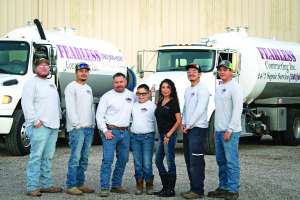
His company is Fearless Contracting in Tucson, Arizona, which he runs along with his wife Claudia Baker who handles bookwork, finances and reporting. They operate out of a commercial yard, although Baker works at home. About half their work is septic pumping and half is installations. They also do septic inspections for real estate transactions.

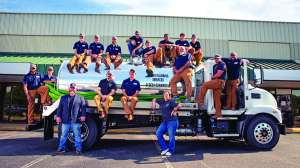
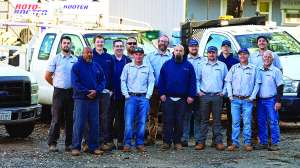
The company has four employees. Ruben Mendoza is the foreman on the installation side and works with laborer/apprentice Juan Suarez. Omar Villegas and Alex Suarez handle pumping work. The Hernandez’s 11-year-old son Jonathan, also occasionally rides along and gets in on the action. They work within a 50-mile-radius for residential customers but will go 100 miles for commercial accounts.
PATH TO SELF-EMPLOYMENT
Hernandez’s first job was working as a dishwasher at a restaurant, but by the time he was 15, he had a job in construction. That worked out well for him — until the 2008 recession hit seven years later when he was 22 and engaged to be married. “I got laid off,” he says. “There was no work so I was obligated to change careers. I did door-to-door sales for security systems and took odd jobs just to put food on the table.”
He picked up a commercial driver’s license during this time but no one would hire him because of his age and lack of experience. So he worked for free just to get some experience and credentials. “I knew someone who was an owner/operator,” he says. “I volunteered for him for six months driving an 18-wheeler.”
That sacrifice led to local truck-driving opportunities and he soon got a job as a vacuum truck driver and heavy equipment operator with a heavy civil contractor specializing in large-scale infrastructure projects.
It was there that he saw an opportunity that would lead to his next career move — self-employment. When the company worked on sewer lines, they would hire a pumping contractor to do sewer bypass work, but waiting for them often delayed projects.
“That’s how I got the idea of buying a septic truck and doing that,” Hernandez says. “I spoke with my boss, Jason de Carlo, and he said he would give me work. And with his support and blessing, I quit my job.”

Hernandez bought a vacuum truck from a private party — a 2004 Mack built out by Pik Rite with a 4,700-gallon steel tank and Jurop LC420 pump. And then he went to work for a local septic company to educate himself on the industry. He did that for six months then in 2019 struck out on his own.
EARLY DAYS
Hernandez knew from the beginning he wanted to be a full-service septic company. That’s how he ended up in school to study for his contractor’s license enabling him to offer installation services. “It was a game changer,” he says. “Installation work is way more profitable, less overhead, margins are better.” He also got an inspector’s license from the National Association of Wastewater Technicians.
Hernandez worked hard to get the word out. “I would post on Facebook every day,” he says. “We made signs. I would go door-to-door to offer my services. I would go to community gatherings and festivals and introduce myself. I couldn’t have done it without Claudia’s support and hard work and her knowledge in real estate. She was a Realtor and helped get a lot of the inspection business.”
In less than a year, Hernandez was able to buy a vacuum truck to replace the Mack, which was too big for the work they were doing and not really working out. And by the next year, 2021, he hired his first employee.
PUMPING SIDE
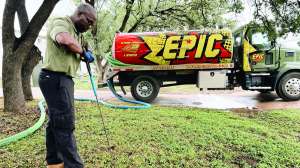
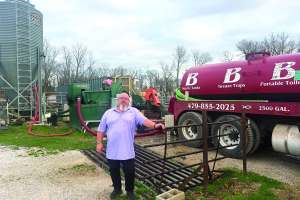
For their pumping work, the company has three vacuum trucks, all built by Stephenson Specialty Trucks — a 2012 Kenworth with a 3,600-gallon steel tank, a hydraulic hoist assembly and a Jurop LC420 pump; a 2010 Freightliner with a 3,600-gallon steel tank and Jurop blower; and a 2025 Mack with a 2,500-gallon steel tank and Battioni blower (Chandler VAC). Two of the trucks have 3,500 psi toolbox jetters with Honda gas engines.
Equipment includes RIDGID locators and several sewer cameras bought off Amazon. Many customers don’t have risers so tanks are sometimes hard to find. Occasionally the company runs into situations where a customer has never had their tank pumped.

“We recently pumped a tank that was 30 years old and never serviced,” Hernandez says. “It was backing up. It was a little challenging to find it. We had a snake and put in a camera. It was 90% solids and had no water. We’re grateful for our equipment. The blower pumps do a great job.”
Hernandez does not put his customers on traditional maintenance contracts. “It’s more of a verbal contract,” he says. “I don’t want our customers to feel obligated. We want them to be happy with us. It just gives a different vibe.”
Commercial work includes taking care of pumping for about 20 schools and doing sewer line bypass work for several contractors.
They have a couple options for disposal. One is a county treatment plant, the other a private facility.
INSTALLATIONS
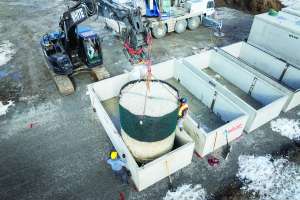
Equipment on the installation side includes four excavators — a 2020 John Deere 50G, a John Deere 17G used to uncover tank lids, a John Deere 30P used for gravel and tight areas, and a 2026 Caterpillar 305 used for excavating.
Other equipment includes a 2014 Bobcat S70 skid-steer and two 2014 Ram 1-ton service trucks. In 2026 they will be adding a 2014 Ford F-450 to the service fleet.
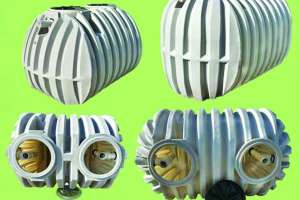
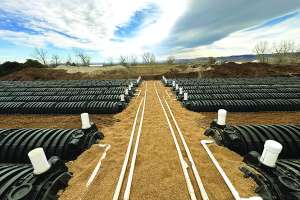
Hernandez says the soils in their area are good and they generally use traditional gravel-bed systems, perforated pipe and Infiltrator chambers. But occasionally they use advanced treatment units, such as systems from Norweco or MicroFAST (BioMicrobics), depending on requirements from the engineer. “It’s generally in the mountains where it doesn’t perk,” he says.
Hernandez works closely with the soil engineer or designer on a project. “I will do a percolation test with them and they’ll design it for me. Then I send it to the county for revision. Once they approve it, I get started.” He says they sometimes work on two or three installations at a time, or even four if they’re working in a subdivision, depending on how soon the contractors want to get started.

A GOOD TEAM
Finding employees is not easy, Hernandez says. Some people call or he’ll put an ad online. “But out of three hires, one will stay,” he says. “I had to fire the last kid — just attitude.”
Hernandez says his current team is the best he’s had. “They’re all great employees. They’ve been with me for a while. None of this would be possible without them. They make it happen and help us get to the next level.”
When Hernandez isn’t managing overall operations, he’s running around helping whoever needs it. And when they have more installs than his team can keep up with, he grabs a machine and one of the guys on the pumping side and does it himself.
“Every day is different,” he says. “Some days are easy, some are challenging. I’m shorthanded right now so if somebody calls in sick I’m hurting. I do have a friend with a pump truck, that if I need him he’ll help out.”
Having had some difficult bosses in the past, Hernandez says he is inspired to be a different kind of boss. “I treat them well, pay them right and appreciate their work. We thank our employees. We have dinners and barbecues and a Christmas party. They’re like family, all of them.” He says he’s too small to be able to offer health insurance right now, but he provides bonuses, two-week vacations and paid holidays.
Every morning the team gets together to go over the day’s plan. They talk for a bit, warm up the trucks and equipment, go over the tasks for the day, talk about safety and answer questions.

All the guys can operate equipment, even the pump truck drivers. “I train them,” Hernandez says. “Ruben, who’s now our foreman, didn’t even know how to drive a truck and now he’s doing all my installations, pulling a big trailer, reading plans.”
Working with sewage isn’t for everyone, Hernandez says. “It takes grit, courage and a willingness to do the tough jobs others won’t do.”
REWARDING CAREER
Hernandez says plans for 2026 include hiring at least one more person and maybe adding another vacuum truck. They are also looking into software that would help them with scheduling. Claudia currently does the routing and scheduling using Google Calendar.
Hernandez says while running a business hasn’t been easy, it has been very rewarding. “We have been fortunate to grow every year and along the way have gained many customers we now consider friends,” he says. He and his former boss still have a great working relationship.
His advice? — Work hard and do quality work. “Nothing is given to you. Nobody owes you anything. There are millions of dollars out there, you just have to go get it.”
The name “Fearless” represents Hernandez’s operating philosophy. “We didn’t have any knowledge about starting a business,” he says. “But we chose to be fearless, and we trusted in God when we decided to leave a stable job and step into the unknown. Being self-employed has been a blessing.”
Continue reading for free