
Canadian Sanitation is located in Midland, Ontario, Canada, on the shores of Georgian Bay in an area known as the Thirty Thousand Islands. As a full-service company offering septic design, installation, maintenance and pumping, serving island clients often requires transporting pump trucks, excavators and materials by barge.
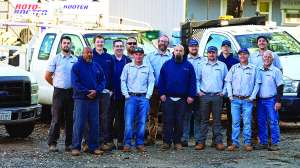
The company is co-owned by Brock Peel and Brad Corey, who primarily handles the service end of the business. Canadian Sanitation works with barge companies in the area to arrange transportation, sizing the barges according to contract requirements.
“Using barges for transport is time-consuming, but it’s the only way to reach these clients,” says Corey.
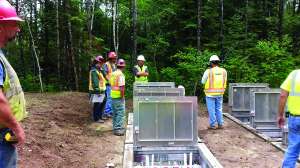
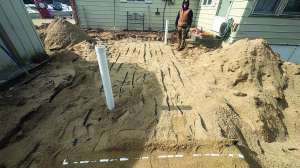
Recently Corey installed a new filter bed for an island client, a lengthy process in which multiple loads of material are transported across the bay.
“On this barge, they can fit two truckloads of material at a time,” he says. “This job requires 15 truckloads of filter bed material. The trip is an hour to the destination, an hour to unload and an hour to get back. That’s a limit of two trips a day.”
On each trip, the barge drops an off ramp onto the beach and Corey augments the ramp with sand to create a suitable access. The trucks then drive to the island cottage, drop off the loads and return to the barge.
Project management is everything.
“Barges show up about every three hours,” Corey says. “If you drop a load onto the barge at 7:30 in the morning, the dump truck could be back by 8:30 or 9 with another load, but you don’t want the dump truck sitting at the landing waiting for the barge to arrive at around 11. It’s a big logistics challenge.”
Corey never rides the barge, instead taking a 17-foot bowrider to the project site, arriving in a few minutes.
“That gives me time to set the tank, get the hookups done, the pipes cut and put in a lot of labor while I wait for the barge to arrive,” he says.
Canadian Sanitation often works with a construction company that owns a barge. “He’ll be building a new home on the islands and gets us to quote septic system installation. We coordinate our schedules to get the job done quickly.”
Corey estimates that working on the islands typically adds 30% to the cost of installations and pumping in terms of time, plus the cost of barge transportation. “But people are accustomed to paying a premium to live on the islands. They say the lifestyle is worth it.”
Read more about Canadian Sanitation in a profile story in the April issue of Onsite Installer.
Continue reading for free