The Wisconsin plumbing code SPS383.54(3)(b) requires that “the servicing frequency of an anaerobic treatment tank for a POWTS shall occur at least when the combined sludge and scum volume equals one-third of the tank volume.”
Several years ago, a burgeoning cottage industry of "maintainers" sprang up, explaining to those receiving their three-year county reminders for pumping that less-expensive measuring of your solids might be the best course of action — why pump if you are at less than one-third solids?
Online (where anything goes) I see people saying, “I haven’t pumped my system in 20 years, and it’s just fine.” I want to say to them, “Define ‘just fine,’ please. Have you looked in your tank you haven’t pumped for 20 years? Do you even know where the tank is?”
The importance of pumping at three-year cycles
Decades ago, I was told the tank sizing we use in Wisconsin is based on a three-year maintenance cycle.
Septic tanks work on retention time, which is proportional to the volume in the tank. The more volume you have the more retention time. As solids build up in the tank the volume and retention time both reduce. The more retention time, the slower the water moves through the tank, allowing more solids to settle out of the wastewater. When more solids build up in your tank, the volume decreases; as volume decreases, retention time decreases. This means as solids fill the tank, the water takes more waterborne solids with it — which are then clogging up the distribution cell (seepage bed) portion of the system and causing eventual failure. Every time the tank is pumped it removes the solids that will eventually cause the system to fail. I always tell my customers to think of it as an oil change: removing the bad stuff so the engine doesn’t blow. By pumping you also increase the volume in the tank, allowing for better settling of the solids in the tank.
Research at Penn State has shown that an onsite system actually benefits from the time after pumping that it is not receiving any effluent. In a 2023 article, Professor Albert Jarrett even recommends pumping prior to a vacation so the system gets extra days without receiving effluent.1 Jarrett’s article says that “homeowners should get in the habit of having the septic tank pumped.” Jarrett goes on to say that if homeowners are “able and willing to have your septic tank pumped on a routine basis (such as every two or three years), it may be possible to further enhance the effectiveness of your entire on-lot wastewater disposal system.”
If I can get by with just measuring, then why not?
So let’s say I just measure a tank this year and determine it’s 20% solids. The code says I don’t have to pump unless it reaches one-third solids, so today — at year three in the cycle — I don’t pump.
If I have 20% solids, the tank volume is reduced; I don’t have to pump, but my retention time has been reduced. Right now more solids are getting out of the tank, which will eventually cause system failure.
But there’s more: When the homeowner elects not to pump at year three, who is measuring solids at year four? Year five? What is the solids percentage during those years? The county will not be requiring another inspection until year six. Because I was less than one-third solids at year three and didn’t pump, now it will be six years without pumping before I am required to have anybody look at my system again. This is what I call dropping the ball. If the intent is to check (and not pump) at year three, years four, five and six are really going to be a problem, and I’m seeing that come to fruition…
Year six is upon us
In the past two months, I know of four homeowners who called for service on their systems: one for a home sale evaluation and one because their filter alarm activated, two others for routine maintenance. In all cases solids were well over 30%; two had solids to the access cover. It's uncertain how these system were functioning. One of the customers was a single-person household. In all cases, the homeowners were given the option not to pump three years ago, due to tanks with less than one-third solids. So now these systems are at six years and in extremely bad shape. The home sale evaluation did not pass, although not solely due to this issue. One of the houses was a very large home that had 12 people living in it, and were told they could skip pumping! Now we were back at year six and the tank was in horrible condition, with incredibly thick solids in both the lower (sludge) layer and the upper (scum) layer.
Not pumping at year three skips another important service that pumping provides
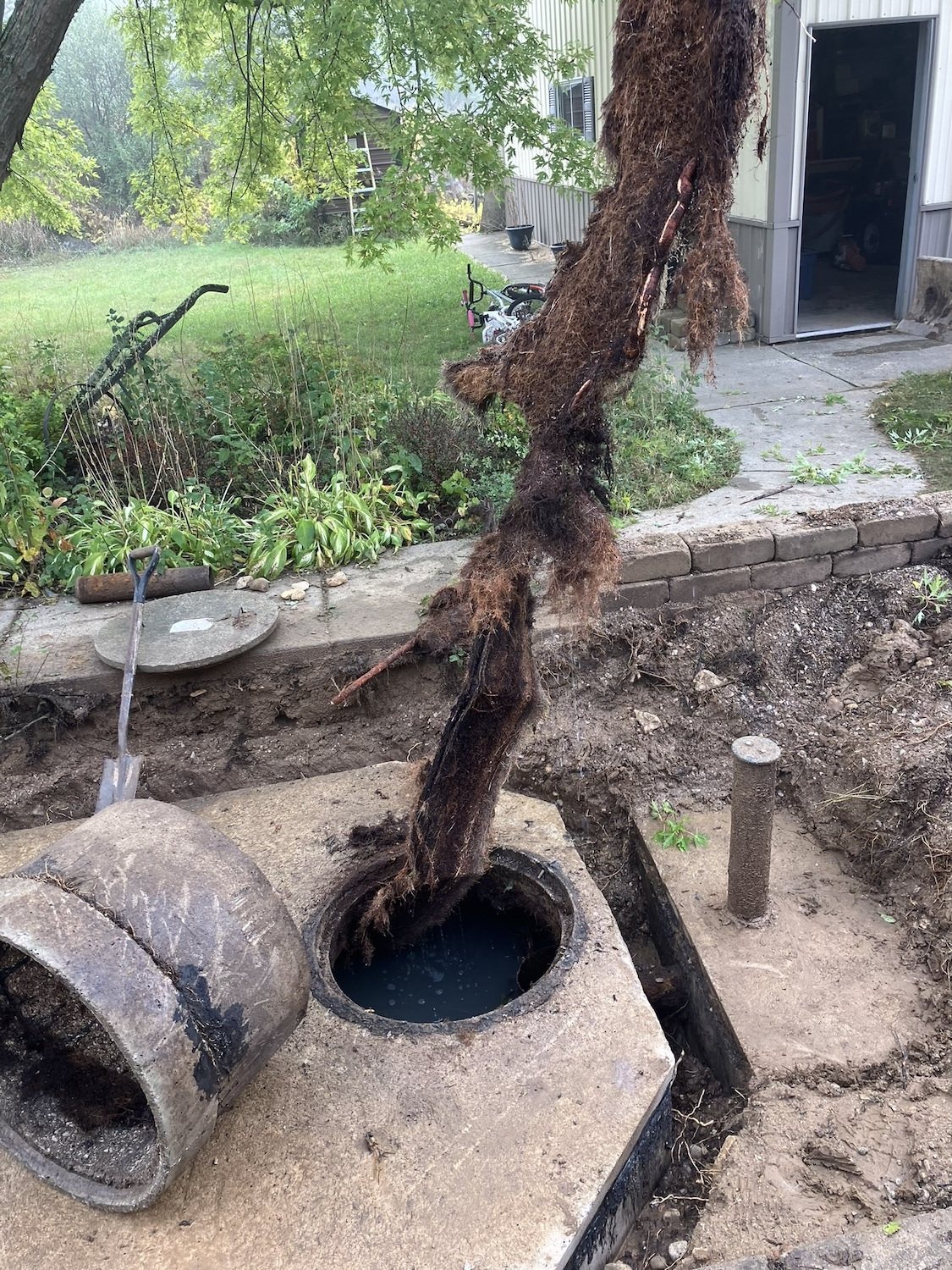
When the tank is not pumped at year three, there is no visual evaluation of the condition of the tank. I mentioned earlier that the home sale evaluation did not pass. Hidden beneath the incredible amount of solids in the tanks was a 4-inch diameter root. If found three years ago, maybe it would not have been such a major issue, but at year six it certainly was. Just measuring solids does not allow the person any of the visual evaluation of the condition of the tank that pumping the tank allows.
I’ve been in the onsite business now for 36 years. I know firsthand how vitally important pumping septic tanks is to the longevity of any system. Solids leave the tank in one of two ways: through the outlet pipe on its way to clog the soil pores, or pumped into a truck.
When someone has a system backup, with sewage in the basement or coming out of the access cover in their yard or both, who do they call? The “measuring guy”? No, the "maintainer" isn’t the person getting the calls that my company gets every day with people having severe issues with their systems. Suffice to say a person whose only tool is a solids measuring device wouldn’t be able to help a person in failure mode. Maybe if those people would get all the emergency calls they might learn a little more about what they are recommending.
Systems should be pumped at three years, plain and simple — the way it always was until someone found a loophole and decided to exploit it. This shouldn’t even be an argument. Pumping (for those who know systems) at three years is common sense. If the system is not going to be pumped, but solids merely measured, then the system should require inspection and measurement each of the following years until it is pumped. Measuring at three years and just leaving the system unattended for another three years is not the intent of the three-year cycle, and certainly not good for the systems. This is another reason it’s important as onsite professionals to get involved with state associations, in order to stay informed about proposed regulations that impact our industry.
1 Jarrett, Albert, Ph.D. “Septic Tank Pumping” article from Penn State Extension July 21, 2023
About the author
Todd Stair is vice president of Herr Construction, Inc., with 34 years’ experience designing, installing, repairing, replacing and evaluating septic and mound systems in southeast Wisconsin. He is the author of The Book on Septics and Mounds and a former president of the Wisconsin Onsite Water Recycling Association.
Continue reading for free