
Problem
As growth continued throughout St. Tammany Parish in Louisiana, the need for additional wastewater treatment capacity became increasingly urgent. Existing aboveground steel treatment systems at the Goodbee site were aging and struggling to keep pace with rising demand while long-term plans for a future 5 mgd regional treatment facility were still years away. Parish leaders needed an interim solution that could provide immediate capacity, support continued development and serve as a stepping stone toward larger regional infrastructure goals.
The project site itself presented a series of complex challenges. The available footprint was extremely limited, positioned between existing treatment infrastructure and surrounded by environmentally sensitive and residential areas. Nearby neighbors raised concerns about operational noise, particularly from blower equipment, making sound mitigation a critical design consideration from the beginning. In addition to the spatial limitations, the rural location created transportation and constructability challenges. Oversized treatment structures would need to navigate narrow roads and sharp turns before being set into deep excavations with significant crane reach requirements.
At the same time, the project required treatment tanks substantially larger than standard precast wastewater structures. The engineering team had to develop a system capable of balancing structural integrity, watertight performance, constructability, transportation limitations and long-term scalability. All while meeting regulatory approval requirements for a nontraditional large-scale precast approach.
Solution
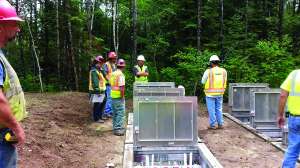
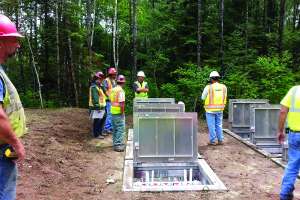
To address these challenges, the project team developed a custom large-capacity precast concrete wastewater treatment system specifically engineered for the site constraints and future expansion goals. The final design utilized four-piece precast treatment tanks measuring approximately 26 feet by 12 feet with heavily reinforced 10-inch walls. Each tank section was carefully engineered to optimize strength while remaining transportable and liftable within the limitations of the site and available crane capacity.
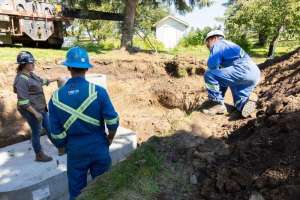
Constructability played a major role throughout the design process. Every detail, from wall thickness and reinforcement layout to crane positioning and hauling routes, was evaluated through the lens of installation feasibility. Detailed lift planning was required to safely place tank sections weighing nearly 60,000 pounds into excavations exceeding 90 feet in crane reach.
To achieve long-term watertight performance, the tanks incorporated precision-engineered tongue-and-groove joints combined with elastomeric sealant systems designed to accommodate movement while maintaining a leak-resistant connection. High-strength 6,000 psi concrete with crystalline waterproofing admixtures was used to improve durability and reduce permeability in the aggressive wastewater environment.
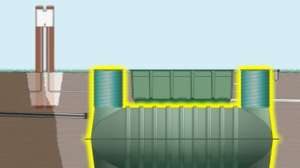
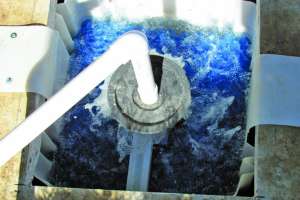
The process layout was also engineered to maximize treatment performance within the limited footprint. The compact configuration integrated equalization, aeration, anoxic zones, clarification, disinfection and effluent pumping into a tightly coordinated system. To address community concerns, blower equipment was enclosed within a dedicated sound attenuation building designed to significantly reduce operational noise near neighboring properties.
The project ultimately became a highly collaborative effort between engineers, permitting officials, contractors, production teams and field crews. Continuous coordination allowed the team to adapt designs, overcome logistical obstacles and refine the system throughout construction and installation.
Result
The completed Goodbee Regional Wastewater Treatment Plant successfully delivered a scalable wastewater treatment solution capable of supporting both immediate demands and future regional growth. Despite the site’s severe footprint constraints and complex installation requirements, the project team successfully installed the oversized precast structures while maintaining strict quality and performance standards.
The system achieved watertight performance during initial testing and provided a significant operational improvement over the existing aging treatment facilities. The compact precast configuration minimized site disruption while allowing treatment capacity to be added efficiently in a challenging environment. Noise mitigation measures also helped reduce community impact and improve compatibility with surrounding properties.
Beyond the immediate project goals, the Goodbee facility demonstrated the broader potential of large-scale precast wastewater infrastructure for regional treatment applications. The project showed how collaborative engineering, constructability-focused design and innovative precast solutions can provide durable, expandable and efficient wastewater treatment systems capable of meeting growing infrastructure demands.