A contractor was subdividing agricultural land in Joplin, Mo., but soil limited onsite system options to drip distribution. Three-bedroom homes required 1,800 feet of drip tubing, which meant the drainfield would occupy about one-quarter of the one-acre lots. Missouri’s sanitary code specifies reserving equal space for a replacement drainfield.
The Jasper County Health Department was working with Theo Terry, manager of technology for Ring Industrial Group in Oakland, Tenn. The company had developed a new MD5 pressure distribution geosynthetic aggregate drainage bundle and was looking for a test site. The worst of the subdivision lots was chosen for the MD5 drainfield with experimental zones. Ring Industrial retained the rights to monitor the system through the University of Missouri.
The recirculating system was installed in September 2007, and monitoring was scheduled to begin the following spring.
Soil conditions
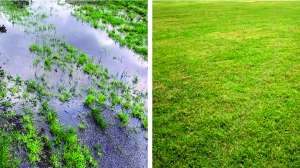
The site has 8 inches of topsoil, then a 4-foot-deep dense clay layer. The design hydraulic loading rate was 0.1 gal./sq. ft. per day.
System components
Terry designed the system to handle 360 gpd. Its major components are:
• 1,000-gallon, single-compartment concrete septic tank with two risers. All tanks made by Henson Septic Tanks & Supplies, Neosho, Mo.
• EF-6 Combo effluent filter from Tuf-Tite, Lake Zurich, Ill.
• 1,000-gallon single-compartment pump tank with STEP system from Quanics, Crestwood, Ky.
• 6606-RCW hydrostatic valve from K-Rain, Riviera Beach, Fla.
• 1,800 feet of MD5 geosynthetic aggregate drainage bundles in six zones of four laterals from Ring Industrial Group.
• Installer Friendly Series timer control panel from SJE Rhombus, Detroit Lakes, Minn.
System operation
Wastewater gravity flows through a 4-inch PVC pipe to the septic tank, through the effluent filter, and into the pump tank. The STEP package inside contains a 44-inch filtered pump vault, 1/2-hp high-head turbine pump, risers and lids, and time-dose control panel. The pump runs for 2 1/2 minutes every four hours, sending 32 gpm into a zone determined by the hydrostatic valve. Each zone has four 75-foot-long bundles installed in two 24-inch-wide trenches.
The dosing sequence is in numerical order, but the zones are staggered — 1-4, 2-5, 3-6 — to spread the effluent out as much as possible in the dense clay. “At design load, it takes at least 16 hours before Zone 4 is dosed,” says Terry. “At actual flow, it may take 20 or more hours before Zone 4 is dosed.”
The MD5 drainfield can be considered a hybrid between drip dispersal and a low-pressure pipe (LPP) system. The long, narrow bundles, developed specifically to work in shallow soils, increase the infiltrative surface area, while pressurization maintains a constant, equal distribution.
Zones 1, 4, 2, and 5 continually flush into the sewer line through individual 3/4-inch PVC pipes. The bottom zones, 3 and 6, have experimental passive aerators. Effluent from those zones returns through separate lines to a sampling area inside the second riser on the septic tank.
“We could have sized the drainfield much smaller, but because it is an experimental application, we retained the original specified 1,800 feet,” says Terry. The drainfield’s footprint is 75 by 46 feet.
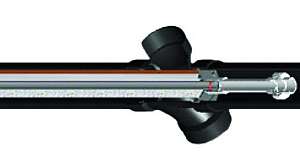
The 4-inch bundles have 3/4-inch tubing with 5/32-inch orifices every 40 inches. Expanded polystyrene aggregate encased in netting surrounds the tubing, providing storage capacity. The product is made in 150-foot-long continuous coils that installers can cut to length. Internal couplers splice the sections together.
Installation
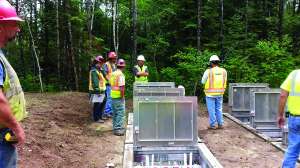
Vaughn Terry and Adam and Kyle Carden of A-Quality Excavating in Joplin. Mo., installed the system. During excavation for the tanks, the dense clay came out in large chunks.
Excavating for the trenches went more smoothly because the drainfield bundles were installed 8 inches deep in the topsoil. “We used a 2-foot bucket on a trackhoe so the operator could work without compromising the site,” says Terry. “Not having to dig in that clay made life a lot easier.”
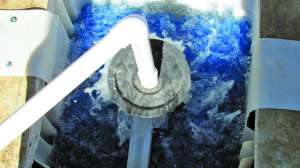
They installed a venturi at the head of Zones 3 and 6 to test the effect of aerating effluent in the trenches. The pressure in the lines operates the venturi. “Because of the clay, we hope that adding a little oxygen will jumpstart the biological activity in the trenches,” says Theo Terry. “We’re sampling the return lines to determine what percentage of dissolved oxygen is in the effluent. If it proves beneficial, the venturi will become an MD5 option.”
Vaughn Terry installed a curtain drain of 6-inch EZflow bundles to deflect subsurface water from the drainfield. He also tied all the downspouts from the house into the drain.
Maintenance
Because the system is experimental, monitoring will continue as long as necessary. Randall Miles, Ph.D., associate soil science professor at the University of Missouri, and his students are conducting the study. “One objective of our con-tinuous recirculating design is to reduce the need to manually flush the laterals,” says Terry.
Continue reading for free