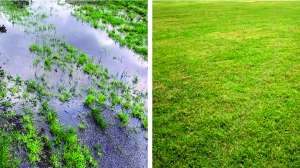
Seasonal high water tables are among the toughest challenges onsite installers face. The challenge is to ensure ade-quate separation between the bottom of the infiltrative surface for septic tank effluent and the saturated soil.
Separation is necessary to provide for unsaturated flow from the trench and to enable oxygen exchange, which results in effective treatment of the effluent. Our preferred solution is to install an at-grade or mound treatment system to avoid the water problems. However, we are always asked about using artificial drainage as a way to solve the problem, and in some instances this can be a preferred solution.
Misconceptions
There is a common misperception that if we install drain tile around a system, as in agricultural drainage, we will lower the water table to the depth of the tile across the entire area. What actually happens is that the water is drawn down to the tile, but there is mounding in the area between the tile lines. The drawdown is actually similar to a cone of depression caused by a pumping well. This makes it very difficult to predict the appropriate depth of the drain tile to provide for separation.
Under certain conditions, agricultural drain tile can help intercept and drain off excess water from the site. However, the purpose of agricultural drain tile is not to lower the water table in the field but to drain away excess water so that the crops can survive. This is much different from an overall lowering of the water table.
Typical designs for agricultural tile systems will allow saturated soil conditions to come up to the level of the redoximorphic (soil mottles) features, but for a much shorter duration than if the tile were not in place. Research has shown that the water table returns to this level during the course of a wet season, but will not stay there as long.
In an onsite system, the drainage situation is not acceptable if the water table is within three feet of the bottom of the system. This is because a lack of oxygen in saturated soil reduces treatment efficiency and promotes formation of a thicker and more resistive biomat. These systems are expected to work 365 days a year at high treatment efficiencies. That means some changes in drain tile installation are necessary.
Zone of influence
When drain tile is used to lower a water table, a drawdown curve or zone of influence is apparent. The steepness of this curve is determined by the soil texture and permeability. In sandy soils, the curve is flatter and the area affected by the tile is much greater. In heavier-textured clay loam soils,the slope is steeper and the area affected is far smaller.
The way to increase a zone of impact is to place the tile lines deeper and closer together. This can be very costly, and it presents installation problems of being able to fit the system to the site. There is also the issue of establishing an outlet. Care needs to be taken not to divert large amounts of water onto the neighboring property.
The most effective places to use drain tile are in areas of seasonal high water tables where the land is sloping. Here, you can install interceptor or curtain drains upslope to catch the water and direct it away from the system. You should locate interceptor drains with at least 10 feet of undisturbed soil between the sidewall of the soil treatment unit and the drain tile.
A variety of materials have been used to construct such drains. These include concrete or clay tiles. Now, plastic drainage tubing is the norm. The usual size is four inches, but that depends on the flow. Wrap the tile in a geotextile fabric and install it so as to maintain the 3-foot separation between the system and the groundwater. This depth varies according to the site conditions.
The trench to place the drain tile should be at least six inches wider than the outside diameter of the tile. Place an envelope of pea gravel or inspected and approved clean gravel around the tile. Use the same material, or clean sand, to backfill the trench to within one to two feet of the top.
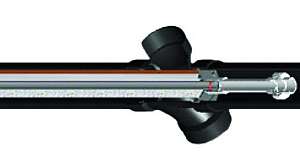
The grade on the pipe should be no flatter than 1 1/4 inches per 100 feet and the inside pipe diameter no smaller than four inches. You can connect the curtain drain to an existing tile drain when depth and grade permit and when approved by the local unit of government. Use a factory-manufactured tee or Y to make the connection.
Surface drainage
When the drain must outlet to the surface, use a corrugated metal pipe at least 12 feet long and a solid animal guard or outlet gate. Locate the outlet where water can flow away from it as fast as it is discharged. There should be at least six inches of clearance between the bottom of the outlet pipe and the surface of the ground or the water beneath it. Use only one outlet for the curtain drain. The water must exit onto the owner’s property or into a drainage easement.
Locate the curtain drain on the treatment system plans and submit it with the as-builts to the permitting authority. Include the elevations of the curtain drain with respect to the drainfield, initial and proposed topography, trench widths, spaces, details of the tubing, and placement and depth of drain material and cover.
Remember, approach the use of drain tile cautiously, and use it only in areas where it will achieve the desired result. Our bias is to stay away from it if at all possible.
Continue reading for free