A school in rural Alabama needed a new onsite system, and the project proved to be a bigger challenge than expected for the team at Gulley Construction of Stevenson, Alabama. “Anything that could go wrong with this system went wrong,” says Chris Gulley, the company president.
Gulley’s work was the endpoint of years of complaints from neighbors about septage escaping from the school’s former onsite system. Neighbor Mitchel Stubblefield told WHNT-TV News of Huntsville, Alabama, that septage had been leaking onto his property for years. His land abutted the old dispersal field. After a grandchild reached the septage, Stubblefield said his son-in-law complained to the Alabama Onsite Wastewater Board, which sent a letter to the school district ordering it to fix the problem.
That’s about where Gulley came into the project.
THE SYSTEM
To build the new system, Gulley’s crew tied into an existing lift station system set up around the school. Wastewater comes out of the lift station in a 3-inch force main and travels about a half-mile to the treatment and dispersal area.
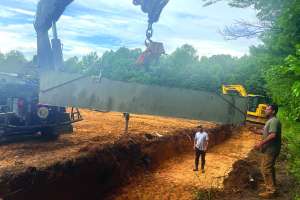
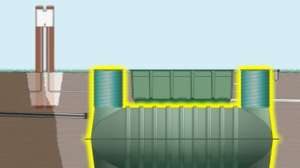
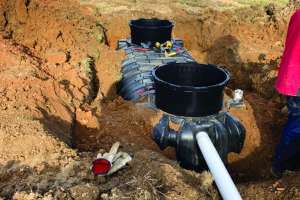
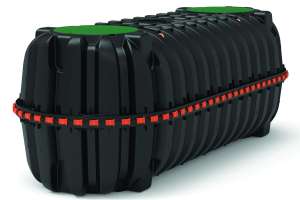
First is a 3,000-gallon trash tank. Next is a 3,000-gallon equalization tank, and wastewater flows by gravity into a 3,000-gallon tank holding a Delta ECOPOD (Infiltrator Water Technologies). Tanks were spaced about 5 feet apart. Wastewater flows next into a 1,500-gallon pump tank with two Champion pumps that came from Delta with the ECOPOD package.
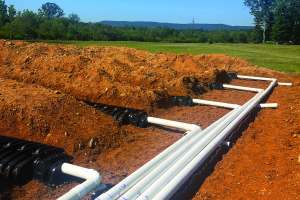
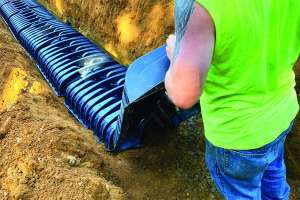
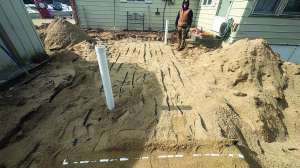
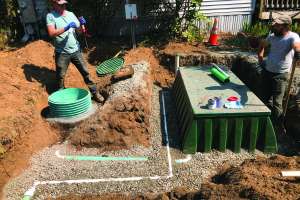
A 2-inch pipe conveys water to an Orenco Hydrosplitter with 11 discharge points for 1-inch pipe. About 900 feet of pipe in total takes water to 11 120-foot-long rows of Infiltrator chambers set 10 feet apart. Each row of chambers has its own charging line. Adapters convert the 1-inch pipe to 4-inch just before pipe enters the chambers.
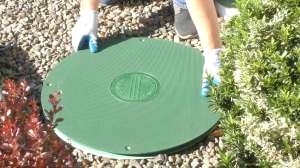
All tanks were concrete and came from Mitchell Concrete Specialities in Alabaster, Alabama. All tanks also have Infiltrator EZset risers and lids. The Hydrosplitter was housed in a 24-inch TUF-TITE riser with a heavy-duty flat lid.
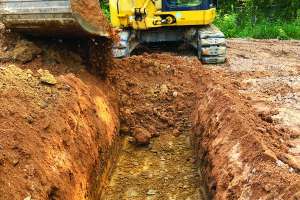
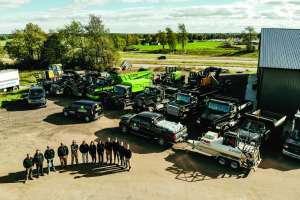
To do the work, the Gulley team used a John Deere 700J bulldozer, a Komatsu PC88 excavator, a John Deere 333G skid-steer and a Komatsu D39 bulldozer.
PIPES BUT NO WASTEWATER
The project moved slowly because there was a period of evaluating the existing system, Gulley says. The old system used chambers, and it had been worked on several times through the years, he says. When he excavated the old system, Gulley found the laterals were full of sludge. “The reason the system had failed is because the original system did not have any tankage, did not have any storage for the solids,” he says. All the laterals filled up with sludge.
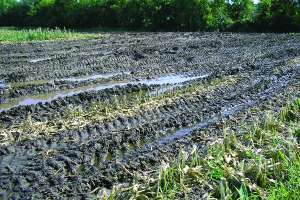
Then COVID came along and delayed material delivery. “We probably had this thing under contract for almost a year before we were able to get out there and do the work because, first, it didn’t perk.” School was in session, and so much wastewater was flowing to the drainfield that it wasn’t clear how good the soil was, he said. “Another thing is, we had to build a road to get the material in there because the existing road was not suitable for heavy construction traffic.”
Then one of the tanks showed up out of design spec and required modifications both to the tank and the process of setting it in the ground. Part of that work involved core-drilling a new outlet.
“I ordered a brand-new $3,000 Milwaukee core drill to do the outlet,” Gulley says. He has smaller core drills, he says, but nothing that could put the required 5-inch hole through thick concrete. Because of rocky soil, the tanks are set shallow, he says, so to use the core drill his team excavated a pit outside the tank to accommodate the drill.
“So when we put the system in, and we were waiting on Delta to come and do the startup with us, we never got any sewage,” Gulley says. School began, and still there was no wastewater. “So we thought we had a rupture in the force main, but we couldn’t find any sewage on top of the ground.” He and his team dug down through the road they’d built to check the force main, and there was nothing wrong. They traced back along the force main, and still they couldn’t find any evidence of a fault in the pipe.
Next, Gulley says, he went to the school grounds. He found wastewater in the tall grass around the lift station. “There’s just sewage ankle-deep all around this, so that tells me all this school year the sewage has just been running out on the ground there,” he says.
About 5 feet below grade, two 2-inch discharge pipes had broken where they combined into a 3-inch force main, he said. “So we had to come back and do a lift station repair: dig that up and repair the pipes coming out of the lift station.”
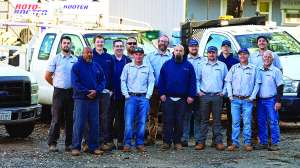
Despite all the challenges, Gulley says, he couldn’t have asked for a better group of people to work with than the people at the school district. They were patient about having work done, he says, and they didn’t hesitate to order necessary repairs as the job progressed.