In northwestern Wisconsin, the Eau Claire Humane Association needed to expand. It was outgrowing its current animal shelter building, which in 2022 took in 1,514 animals.
The job for Stolt Excavating & Trucking, based in Bloomer, Wisconsin, was to put in a new mound system to handle the larger building, and then tie it to the old building, which was being served by a failing system. Joe Rubenzer, owner of Stolt, says he found the failing system during his preparation for designing the new system.
ROCK MOUND
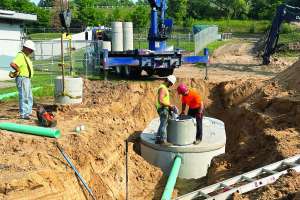
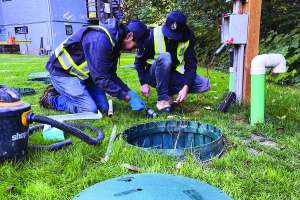
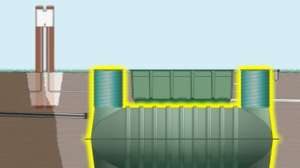
Wastewater leaves the new building in a 6-inch diameter pipe and flows about 70 feet to a 2,500-gallon single-chamber tank that settles solids and collects trash. Inside is a Polylok PL525 filter with an SJE Rhombus vertical read switch to sense plugging.
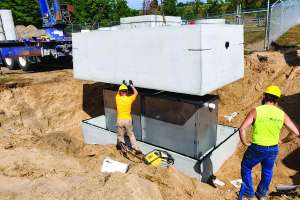
A few feet of 6-inch pipe takes wastewater to a 4,200-gallon equalization tank. Also in this tank is a duplex pump system with Goulds PE31M pumps, an SJE Rhombus IFN panel and an SJE Rhombus C-Level sensor in place of floats. Rubenzer says he added a couple of mechanical floats to provide redundancy for alarms and to turn pumps off.
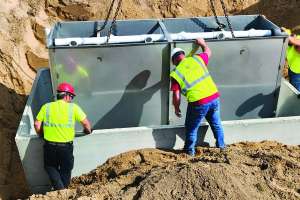
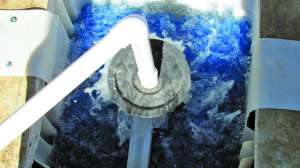
Pumps are time-dosed to push water through 2-inch PVC pipe to a 6,010-gallon tank holding a Delta ECOPOD E600D and duplex blowers. Next, water flows to a 3,000-gallon dosing tank with Goulds WE1518H pumps and an SJE Rhombus commercial series panel. Each pump is also equipped with a Sim/Tech STF100A2 force main filter.
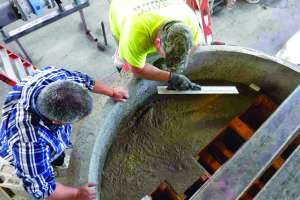
All tanks are concrete and came from Wieser Concrete of Maiden Rock, Wisconsin.
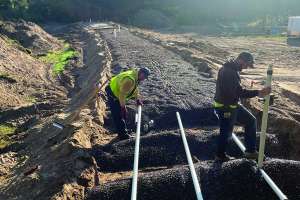
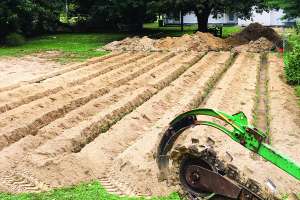
About 150 feet of 2-inch force main takes effluent from the dosing tank to a rock and pipe mound for dispersal. The mound is 10 feet wide by 250 feet long and contains about 750 linear feet of pipe in three runs. Runs are split into two cells fed from the center.
The mound was built with 22 inches of C33 sand. A 6-inch layer of 3/4-inch washed rock was laid on top of the sand, and pipes were laid on top of the rock layer. Rock was added to fill space to the top of the pipes, and the mound was covered with soil.
Given the number of gravel pits in his area, it made economic sense to use rock as the growth medium in the mound, Rubenzer says. Go an hour north, however, and the cost of trucking rock makes engineered media the more economical option, he adds.
Each pump in the dosing tank feeds one cell. Rubenzer said he thought about using a flow-splitter valve, but that would have required him to change pumps to add more head. Splitting the flow with the pumps was simpler, he says.
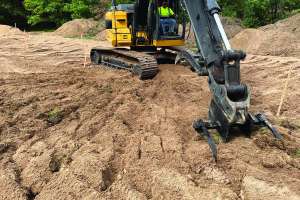
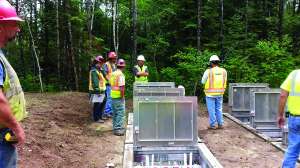
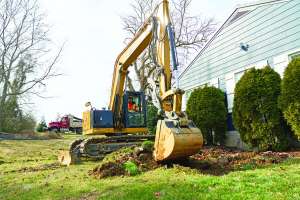
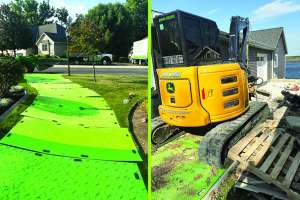
To do the job, the Stolt team used a John Deere 130 excavator, a Bobcat 595 skid-steer, a Bobcat 770 skid-steer and a John Deere 35C ZTS mini-excavator.
Rubenzer was joined on the job site by Forest Clements and Mark Yohnk.
EXPERIENCE COUNTS
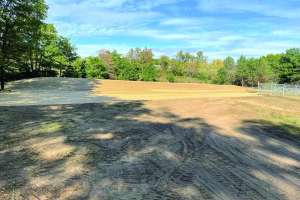
The new mound was located on the north end of the shelter property in about the same place as the previous mound.
As he was doing planning work, Rubenzer says, he discovered the previous soil borings were not correct. “Based on our borings we were required to put in 22 inches of C33 sand instead of the 6 inches used originally.”
That was when he found the existing mound, installed in 2017, was already failing. “It had water ponding and everything else. We’re talking only six years old.
“Based on our water meter readings, it was sized pretty close to what the shelter was using, but they never accounted for high-strength waste,” he adds.
A few years ago, Rubenzer installed a replacement onsite system for the Chippewa County Humane Association about 20 miles north of Eau Claire. That experience came in handy for this job. The original bid request asked for only a holding tank for animal waste and a system for the other wastewater, he says. Rubenzer says he called Market & Johnson, the general contractor, and asked whether they had considered combining animal wastewater with the rest of the wastewater.
As soon as he received the subcontract for the onsite system, Rubenzer says, he scheduled a meeting with the humane association staff. “Knowing it’s a commercial system, we wanted to talk to them about the future, what chemicals they’re using to clean, explain that we need to do the water meter readings, and explain that their system might be larger,” he says.
At the Chippewa County shelter, he had installed water meters to measure actual flows. On days when the shelter was open, flows were 754 to 1,015 gpd. But on days when the shelter was closed flows reached 1,208 to 1,432 gpd because staff were cleaning. There were also multiple daily loads of laundry to wash animal beds, he says. All of it was enough to overwhelm the original 450 gpd system.
The new Eau Claire association building was planned to be about double the size of the old building, Rubenzer said. To make his flow projections more accurate, he calculated them using the square footage of the building as a basis, and then again using the number of kennels as another basis. He compared all his results with what he had learned in the Chippewa County job, and they were similar, he says.
When he finished the calculations, the new system needed to be significantly larger than his original projection, 4,300 gpd instead of 2,800 gpd. Cost increased by more than 50%.
Flow metering took an extra month because the shelter staff had to make time for recording numbers, he says. “They’re supposed to be daily for a minimum of 30 days, but they weren’t being done daily.” That in turn delayed the ECOPOD order because he didn’t know what size would be required.
Once the first and second tanks were in the ground, wastewater from the old building was routed into them, and they became holding tanks that needed pumping. That remained the case for about three weeks because power had not been run to the new system, Rubenzer says.
One addition by Market & Johnson was a manhole outside the new building. The wastewater pipe to the new system runs through it, and if municipal sewer ever becomes available on the property, the onsite system can be disconnected and flows can be directed to a municipal plant. Although the property is now served by municipal waterlines, municipal sewer is unlikely, Rubenzer says. It would require boring under the four lanes of Interstate 94, which is on the north side of the humane association land, and adding a lift station, he says.