



Name and title or job description: David Austin
Business name and location: Frederica, Delaware, consultant to Septic Masters, Wyoming, Delaware
Age: 69
Services we offer: Septic Masters does septic installs, repairs and pumping. I consult with them on site evaluation, soil work, inspections and design, and do some sales.
Years in the industry: After two years of civil engineering school, in 1978 I started a business building log homes, then went to Alaska and did surveying, then came back to Delaware to build log homes again and work as a building inspector. Around 1982 I started doing some backhoe work and put in a few septic systems. Eventually focused more on septic installations. I’ve put in about 2,300 new tanks, designed close to 1,000 systems and inspected 1,000 systems. In 2020 I sold my business to Septic Masters and agreed to help them for a few months — but I’m still working with them.
In Snapshot, we talk to a member of a state, provincial or national trade association in the decentralized wastewater industry. This time we visit a member of the Delaware On-Site Wastewater Recycling Association.
Association involvement: I’ve been a member of the Delaware On-Site Wastewater Recycling Association since it started in 1996. I was president for a couple years, and over 20 years I’ve represented installers, designers and Class H-licensed inspectors.
Benefits of belonging to the association: There’s the camaraderie, sharing your knowledge, helping others with suggestions. It gives you a chance to speak your piece in the industry and see what’s going on in Delaware. It’s also a way to have a voice with the state, which is more effective when it’s a few hundred people than if it was just you. We present classes on whatever people need to learn. We’re also trying to educate Realtors and homeowners, a lot of whom moved here from cities and have no idea what a septic system is. The board includes seats for all areas of the industry — pumpers, installers, inspectors, Realtors, designers, engineers, manufacturers, the Delaware Department of Natural Resources (DNREC) — so we can all work together and learn all sides of the story.
Biggest issue facing your association right now: We have a couple hundred members but we’re lucky to have 25 at a meeting, which we have every three months. It’s hard to find people to get involved. Everybody has good ideas, but nobody wants to pursue them. It takes time and effort to be involved in something. When we started we would have 75 or 100 people at every meeting. Then people started butting heads and regulations were constantly changing.
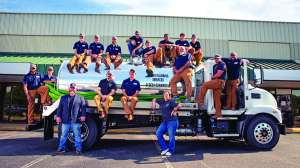
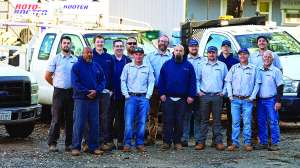
Our crew includes: The team at Septic Masters includes owner Paul Beachy, foreman James Ray, his helper Patrick Beachy, pumper Jesse Hudgins, and secretary Kim Rogers.
Typical day on the job: I go to my office/shop behind my house, return calls, answer emails. Then I schedule what I want to do for the week — designs, inspections, obtain information. I also have a 55-acre gravel pit so I might load sand and gravel for a while. And if I don’t have anything to do I go ride one of my Harleys.
The job I’ll never forget: It was 98 degrees. Black flies were eating us alive. I forgot my water jug. It was a tight site, there were overhead wires everywhere. A neighbor, who just paid $5,000 to rent a house, complained about the noise. Other neighbors wouldn’t let me park anywhere, so I parked in the middle of the road. They called the police, who came and said it was fine, which ticked off the neighbors. It was so hot the tires on the dump truck and the tank truck went right through the blacktop down to the sand. We spent six hours with a Cat 315 excavator trying to dig a hole for a 1,500-gallon tank. It was nothing but sand and kept caving in. We hit water and had to pump that. We had to pull the truck out with a chain. My worker was so upset he quit. I finally got the tank in the ground. Then a neighbor said there was a well under the storage shed that feeds her house and it was only 30 feet to the tank. She called DNREC. I called the engineer who said it was my responsibility. Turns out the lady chose not to connect to central water when service was installed in the neighborhood. So the owner of the well shut it down and DNREC and the engineer accepted that. It was a day from hell.
Most challenging site I’ve worked on: It was tough to design systems for halfway houses for disabled people. There might be five or six people living in the house with two full-time nurses and a cook and people coming and going during the day. It’s hard because, to figure out the water usage. You’ve got to know exactly how many full-time people, how many part-time people, how many stay overnight, how many come in just during the day, how long showers last when users are in wheelchairs. You have to communicate and have a detailed contract so everybody knows exactly what’s going on. It’s not just a simple four-bedroom house.
The craziest question or comment from a customer: If you tell a customer there are six things wrong with their system, they’ll say, “You’ve got to be kidding. We never had a problem.” They had a problem, they just didn’t know about it. Or people say, “Nobody told me I had to pump the tank.” My answer is, “When you bought your car nobody told you you had to change your oil. You’ve got to learn this stuff.” But I think people are getting smarter about it now.
If I could change one industry regulation, it would be: I’d like to see a requirement for a water meter in every house. When we do inspections, if there was a meter, we could roughly determine how many gallons a day they use, and it would help us solve problems. People say, “Oh, we don’t use much water,” but we can show them proof of what they actually use.
My small business advice: Make sure you do the job right every time, no matter what. And don’t grow too fast. Learn the job and make smart decisions. People want to buy a bunch of equipment and jump into the business and all of a sudden we get a tight spot in the economy and they go out of business because they get into debt. When you’re ready to buy something, step back and think about it for a couple days or a week. Do you really need it or do you just want it.
If I wasn’t working in the wastewater industry, I would: Be riding one of my Harleys or four-wheelers. In the winter I’d be on my snowmobile heading up to my cabin in the mountains.
Crystal ball time – This is my outlook for the wastewater industry: This industry is constantly changing, like all other businesses. It depends on the economy, the weather, people buying and selling houses. Everything’s changing in this world and we’re just going along for the ride. Don’t forget to smell the roses along the way.
Continue reading for free