Servicing the rotating biological contactor in a 115-lot seasonal recreational vehicle park was inconvenient, as technicians had to cut a hole in the roof of the building to lift the axle and access the components.
Although the RBC still produced quality effluent, repairs happened more frequently and sourcing replacement parts was more difficult. Taking preemptive action, park officials in Mission, British Columbia, hired Arden Consulting Engineers in Abbotsford to design an upgrade. Canadian Septic in Langley won the bid. The resort and RV park was finally set for a system facelift.
“This was the first project we’ve done that exceeded the residential design flow limit of 6,000 gallons per day, but it didn’t look that challenging on paper,” says James Stiksma, owner of Canadian Septic. “After park maintenance razed the contactor enclosure, we were to slide in the two concrete treatment tanks, then install the proprietary aerobic treatment modules from Canwest Tanks and Ecological Systems. What could go wrong?”
Work began in early January 2024 and lasted until mid-February. Despite rain, mud, snow, subzero temperatures and surprises, the project ended successfully.
System components
Arden designed the system to handle 6,160 gpd. Major components are:
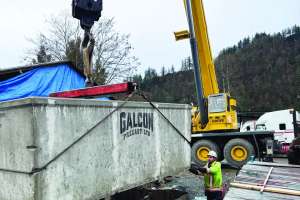
- 6,125-gallon single-compartment concrete equalization tank with duplex 4/10 hp pumps (Liberty Pumps) and risers (Polylok). Tanks from Galcon Precast, Duncan, British Columbia.
- 6,125-gallon single-compartment concrete septic tank with PL-525 effluent filter and risers (Polylok)
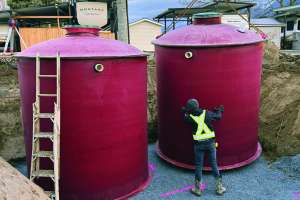
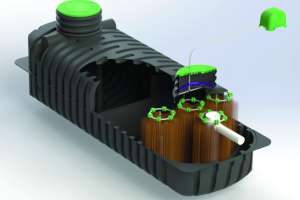
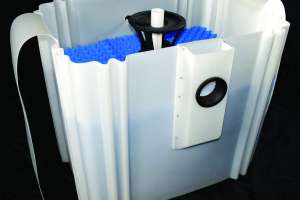
- Three 1,500 gpd aerobic treatment units (Canwest Tanks & Ecological Systems) with P-122 effluent filter and heavy-duty lids (Polylok)
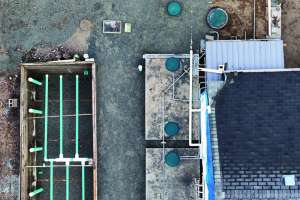
- Existing 30-by-10-foot-wide sand filter
- Existing 3.50-foot-diameter concrete pump vault
- Envir-O ET400 1/2 hp blower with alarm (Blue Diamond)
- Three Envir-O ET300A diaphragm blowers with alarm (Blue Diamond)
- Two EZ IN-SITE control panels and C-level transducers (SJE Rhombus)
System operation
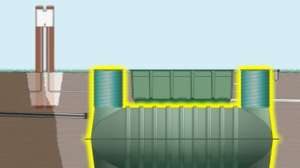
Wastewater pumped from the lift station flows 97 feet through a 4-inch force main to the equalization tank with preaeration. Alternating pumps send time-dosed effluent from the equalization tank to the septic tank, then it gravity flows to the distribution box and treatment modules. They discharge water to a 6-inch SDR 35 pipe running 30 feet to the intermittent sand filter with six 4-inch distribution laterals.
A 6-inch perforated pipe at the bottom of the filter bed connects to an 8-inch underdrain discharging to the pump vault. The alternating pumps cycle 24 times per day, sending 187 gallons per dose through a flowmeter and out to three drainfields. Control panels are in a mechanical shed.
Preparation
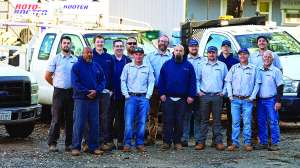
Arriving on site, Stiksma, Arien Brouwer and Tom Daniels discovered that pulling out the metal contactor tank was impossible without damaging the garage, because a wall was attached to a length of angle iron welded to the top of the tank.
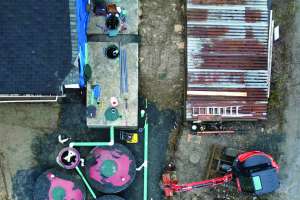
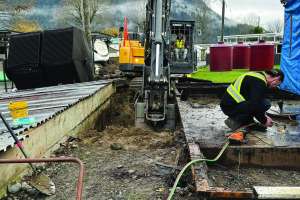
“My alternate plan was to slide the concrete tanks into the metal tank,” says Stiksma, who hired Heidelberg Contracting for bulk excavation work. Using a Volvo ECR235EL crawler excavator, operator Malcolm Jansen extracted the rotating disc and exposed the tank walls. He switched to Stiksma’s Kubota KX057-5 crawler excavator to dig out the narrow space between the tank and the sand filter’s concrete box.
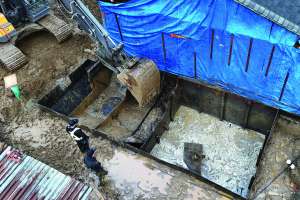
Stiksma hired RAW Welding and Fabrication to cut the tank to 2 feet below finished grade. “The rain had the potential to cause the silty sand to cave in, so I also viewed the tank as a trench box,” he says.
RAW Welding technician Don McElwee tried to cut holes in the compartment lids, but the accumulated detritus and puddles on the surface quickly burned out the plasma tips. The crew switched to a gas axe, but progress against the hardened steel was slow.
Multiple surprises
Meanwhile, Jansen used the Volvo excavator to uncover the rear of the tank and discovered the corners tapered in. Excavating further, he unearthed a riser, then the top of a concrete tank. “Nobody knew it was there, or the second tank half buried under a massive tree stump adjacent to a utility pole,” says Stiksma.
Then Jansen uncovered a third tank. He pulled out the first one to make room for the fiberglass modules, but left the other two so as not to jeopardize the pole’s stability.
At the same time, Brouwer and Daniels discovered a false floor in the disc compartment. Working with McElwee, they removed the floor and the four bulkheads supporting it. Park operators hired Ace Tank Services to vacuum the 1,800 gallons of sludge in the disc compartment and the 2,000 gallons of water that rushed into the clarifier compartment when a pipe was disconnected.
After cutting out the bulkhead between the two compartments and sawing off the last 3 feet of the tank, the crew bedded the bottom with 6 inches of gravel. Then they backfilled the excavation with 3/4-inch minus, a mixture of sand and crushed gravel.
Tank days
An outside carrier delivered the concrete tank halves, but the approach to the park and the narrow entry gate left little space for the B-Train trailer. “The delivery was so uncertain that I hired a local crane truck to shuttle in the halves if necessary,” says Stiksma. “However, two spotters walked the driver through the gate and he cleared it.”
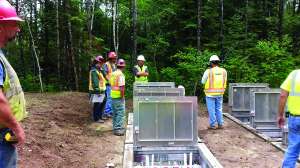
Setting the bottom halves was another squeaker, as the hoist crane’s spreader bar interfered with the garage. The next day, Brouwer and Daniels spent six hours installing the stainless steel hardware that suspended the preaeration system 1 inch off the bottom of the equalization tank. Once the top halves of the tanks were set, Allied Water Services filled them.
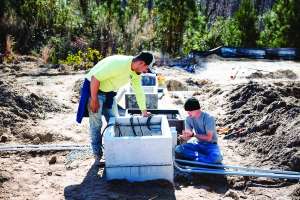
It took another day to set the fiberglass modules behind the septic tank, then Brouwer and Daniels pumped the stored water into the ATUs before the concrete truck arrived to pour deadmen around them. After the mix dried, they backfilled to just below the piping with 3/4-inch minus.
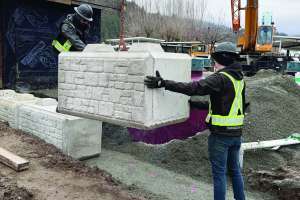
With the distribution box connected, Stiksma suggested to the client that they build a retaining wall around the ATUs to help insulate them against the subzero air pouring into the valley. The client also permitted Stiksma to upgrade the pump vault and flowmeter box.
End in sight
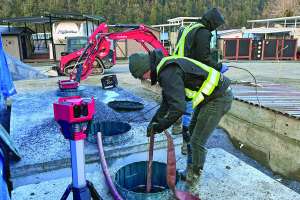
While waiting for the lock blocks to arrive, Daniels gutted the messy pump vault. “If the power wasn’t off, what was down there could electrocute you,” says Stiksma. “Tom mounted dual Liberty FL60 effluent pumps and a C-level transducer, all within reach from the surface.”
Then the crew swapped out the 6-foot-by-2-foot-by-4-foot-deep flowmeter box for a utility box and buried some piping for a professional appearance. They also prepared the base for the retaining wall. Building the two-course wall and backfilling took a day.
Because the concrete tanks were elevated 3.5 inches above grade to avoid the floodplain, Brouwer and Daniels anchored the air lines and electrical conduits on top of them. “It’s difficult to make an install look clean when it has exposed piping, but they nailed it,” says Stiksma.
The blowers required a negative slope to ensure condensate in the air lines drained toward the tanks. “We didn’t have it until the park operators moved the 8-foot-square mechanical shed they built to a different location.”
Brouwer and Daniels installed clean-outs on the sand filter drainlines and replaced the original media. They were not responsible for the drainfields.