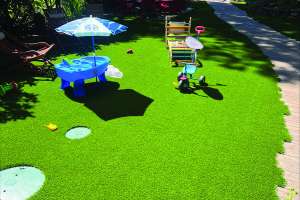
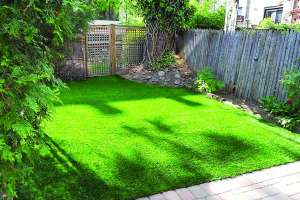
Artificial or synthetic turf is not new, but it has increased in usage recently in residential applications, particularly in areas with limited water resources.
There are a few reasons for this. The benefits of artificial turf include:
- Reduced water usage — Artificial turf requires little to no watering outside of the occasional rinsing to get rid of dirt and debris. Turf also reduces excessive water waste from timed sprinkler systems that run whether they need to or not.
- No pesticides or herbicides — These products may also be harmful if they leech into local water sources, an important consideration for those in drought-ridden areas.
- Reduced yard waste — Yard trimmings that do not get composted often end up in a landfill.
- No pollution from land mowing equipment — According to the EPA, lawnmowers and other lawn maintenance equipment like hedge trimmers and edgers are a major source of air pollutant emissions across the country.
- More free time — If you do not have to mow you can use this time in other ways.
- Recycled material — Most turf products are made with recycled materials and can be recycled when they are replaced (every 10-20 years).
But, can they be used over septic system components? Particularly with newer systems, many components that are installed must be accessible to the surface for maintenance.
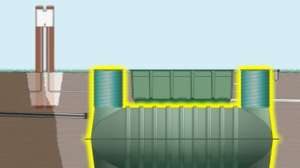
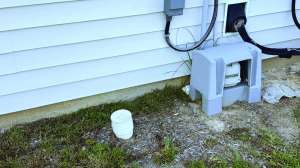
- Building sewer clean-out — Often outside the home, there is a clean-out to access the building sewer in case it ever needs to be serviced.
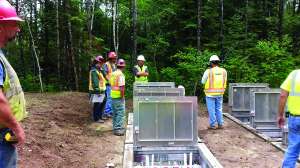
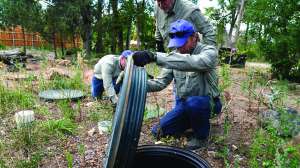
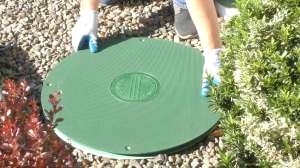
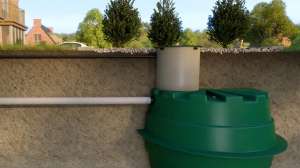
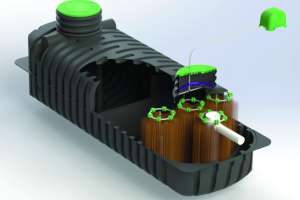
- Septic tank manhole(s) or inspection ports — These are used for cleaning out the septic tank or to see if service is needed.
- Inspection ports in the soil treatment area — These are used to locate components (such as distribution boxes) and measure the amount of ponding.
- Soil treatment area clean-out — A soil treatment area clean-out in low pressure pipe systems allows for checking the head and cleaning of lines.
Over tanks
Installing turf over the septic tanks is not advisable, but could be done as the turf can be pulled up for maintenance and then reinstalled. Another option would be to cut around risers, clean-outs and ports to allow access. Artificial turf will not provide the same insulating properties as natural vegetation so freezing may be more likely. There are sites however that due to a lack of soil cover, property owners may have trouble getting vegetation to grow over the top septic tanks. Installing a small piece of artificial turf may be a solution in these situations though other creative landscaping options exist as well.
If turf was installed over piping to the septic tank and other components, property owners must understand that the turf should be removed by the property owner or someone who installs artificial turf prior to service work being performed. There are specific installation requirements to assure the turf stays in place that must be followed. Most artificial turf is not designed to be driven on my heavy equipment such as the pump trucks needed to service the septic tank, which can make accessing components challenging.
Over treatment areas
Artificial turf should not be installed over the soil treatment area due to the many problems it could cause. Good vegetative cover — usually grasses, wildflowers or groundcovers — should be planted over the soil treatment area and mowed or maintained as needed. With turf grass, mowing is necessary to encourage growth without using fertilizer and to prevent woody vegetation from growing in the area. The vegetative cover helps the system remove nutrients such as nitrogen and phosphorus by using them for plant growth and, in cold climates, it will help to insulate the system.
If the correct vegetation is planted, watering is only necessary to get plants established. If the septic system is installed so the roots of the vegetation can access the water and nutrients the plants will transpire the water. The roots of plants also contribute to soil structure. With good soil structure, the soil pores open, providing air and oxygen needed for wastewater treatment and water movement.
The soil treatment area utilizes natural aerobic microorganisms to treat the wastewater. Soil microorganisms need the same basic conditions as humans do to live and grow: a place to live, food to eat, water, oxygen to breathe, suitable temperatures and time to grow.
These microorganisms thrive in natural healthy soil. Suitable soil is an effective treatment medium for wastewater treatment because it contains a complex biological community. One tablespoon of soil can contain over one million microscopic organisms including bacteria, protozoa, fungi, molds and other creatures. The bacteria and other microorganisms in the soil treat the wastewater and purify it before it reaches groundwater.
A typical residential septic system will treat several hundred gallons of wastewater every single day. Artificial turf will cause more rain and stormwater to enter the system. The turf is typically installed flat so that means all the rain that falls on the turf must infiltrate. The recommendation with septic system components is that they be crowned to shed surface drainage away from septic system components. Artificial turf drains at a rate of up to 1,200 inches per hour compared to grass-covered soil which is less than 1 inch per hour.
The typical installation techniques for artificial turf require the compaction of the natural soil. There are many ways to install artificial turf, but the process starts with removing the existing vegetation to a depth of 2-4 inches. This has the risk of damaging shallow components and compacting the underlying soil. The next step is commonly the application of a geotextile for stabilization and a physical weed barrier which could impact the oxygen transfer to the system.
Often this is followed by installation of base materials (such as Class 2 road base) which are compacted to provide a stable flat base for the turf. This compaction activity can also compact the underlying natural soil and damage shallow components. Artificial turf is designed to drain rainwater, so by design the pore space should remain open to allow water movement. In heavy rain events, the drainage material may store rainfall until it can infiltrate into the underlying soil. How often this occurs will depend on the amount of rainfall, natural soil permeability, water table, and topography. This is problematic as this rainwater reaches the natural soil, which may have been negatively impacted by installation, and then the rainwater must flow through the same soil the septic system uses for treatment and water movement.
Concern exists about toxic chemicals in artificial turf, which are known carcinogens including benzene, arsenic, cadmium, chromium and other toxins which are respiratory irritants. Another concern with turf is that it can get extremely hot. Artificial turf can reach temperatures up to 150 degrees Fahrenheit.
Artificial turf and septic systems are not a good combination. If a property owner is interested, they should understand all the risks and confirm if this is allowed in local regulations, which may prohibit it. Many regulations require a close-growing, vigorous vegetative be established over the soil treatment and dispersal system and other vegetatively disturbed areas.