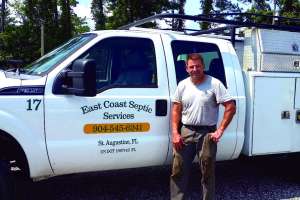

Name and title: Curtis Robinson, owner
Business name and location: East Coast Septic Services, LLC, St. Augustine, Florida
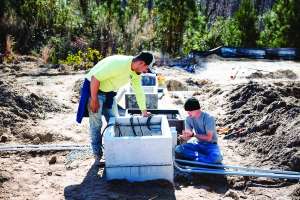
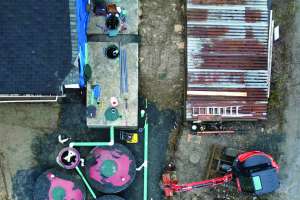
Services we offer: On the septic side, we do septic pumping, service calls, repairs and new installations. I’m also an underground utility contractor so we do sewer connections and sewer main extensions, and install lift stations.
Age: 56
Years in the industry: 40 years. I worked with my dad when I was a kid. He did septic repairs as part of his business. That was in Massachusetts. They changed some of the code in the mid-1990s and I started specializing in the septic business. My dad and I were in business together up until the mid-2000s and then he retired and I relocated to Florida and started this business in 2009.
Association involvement: I’ve been a member of the Florida Onsite Wastewater Association for about five years, although sometimes it was a little spotty. And I’ve been on the board of directors for two years.
Benefits of belonging to the association: They provide our continuing education. They’re a big help with some of the challenges we face. Right now we’re going through a conversion where our regulatory agency is changing from the Florida Department of Health to the Florida Department of Environmental Protection. So, the association is helping us navigate that change — and all the challenges we face.
Biggest issue facing your association right now: There’s a big push to change from conventional septic systems to advanced treatment units. There’s a nitrogen problem in the waterways and the government places the burden on us, saying it’s caused by septic systems. But they leave agriculture out of it with their fertilizers. I tend to think it’s more them than us. Another issue is septage disposal. A lot of us have to go quite a distance to empty our trucks. Here in St. John’s County there is no local municipal facility that will take it. So I have to go approximately 30 miles each way. A couple contractors in town have their own facilities but it’s solely for their own use.
Our crew includes: Right now it’s just me. That’s another challenge — finding qualified employees. I have a couple people I can call on in a pinch. And for a lot of my permitting I use a private soil evaluator who will do the permitting portion of the job for me.
Typical day on the job: I do paperwork from about 7 to 8 a.m. Then I’m on site. I try to wrap up my day by 4:30 although sometimes there’s paperwork at the end of the day. The work is a mix between septic and sewer work. It comes in waves. Most of my septic work is installations. I’m more set up for that and, honestly, it generates more revenue for me.
The job I’ll never forget: I went to look at a job where the customer had a failing septic system. He couldn’t understand why it failed because he had installed it himself with his son. He said they used “best practices.” I could tell right off the bat it was undersized and in the water table. There was no talking to him about it, so I walked away from that one. You have to pick and choose sometimes.
My favorite piece of equipment: My Caterpillar 304 mini-excavator is super versatile. It’s small enough to get into the tight yards we work in here in Florida, but big enough to install tanks and do all the excavating I need it to do.
Most challenging site I’ve worked on: We had a job at a single-family residence that was built on filled marshland. They had a failing septic system and there was no way to legally permit a new system for the property. We ended up installing a 10,000-gallon tight tank (basically a holding tank). The excavation was incredibly hard because we had no room on site to store materials so everything had to be trucked off. We had a tidal water table issue so we had to keep the hole pumped down and had to bring in a large crane to set the tank. We had to use all our knowledge to get that tank installed. It took a couple weeks.
Oops, this didn’t work out as planned: I had a pumping job at an assisted living facility that had a couple tanks that needed to be pumped out on a regular basis. The tanks were downhill from where I could park the pump truck. When I opened one of the tanks up, it was solid wipes. I spent a few hours attempting to tackle the job but it was impossible to pump.
The craziest question or comment from a customer: “Why do I have to have a big mound in my yard?” A lot of customer education is required in this job.
If I could change one industry regulation, it would be: I’d like to see stronger enforcement on unlicensed work. A lot of people are installing systems without a license. It’s legally required but there’s not a lot of enforcement.
Best piece of small business advice I’ve heard or came up with: Avoid debt when you can. Don’t get over-extended with brand-new trucks and equipment. Always pay for your materials when you pick them up. Pay bills on time.
If I wasn’t working in the wastewater industry, I would: I’d like to be working in motorsports — NASCAR. That would have been a fun career. I have an open-wheel modified race car and race it at the New Smyrna Speedway.
Crystal ball time – This is my outlook for the wastewater industry: I think the industry is going in the right direction with the ATUs. And despite the challenges finding help, I recently read an article that more of the Gen Z people are leaning back toward getting involved in the trades. They find it a little more attractive than racking up a lot of college debt. So, I think in the next 10 or 15 years, we’re probably going to see a shift with more people getting involved in the industry.
Continue reading for free