Zach Woody invested 10 years working with developers and homebuilders in the Raleigh, North Carolina, area before branching off into septic services. As the owner of Full Circle Environmental in Clayton, he’s aiming to bring a full life cycle approach to local clients, from design, maintenance, repair and pumping to turnkey installations of onsite wastewater systems. For many homeowners and developers, the company is now considered the contractor of last resort to install septic systems in challenging locations.
Woody, now 37, saw opportunities in the market resulting from the large number of new homes being built in the area, and the lagging ability of public sewer system development to keep up with the building boom.
“So many people are moving here to raise families and if it means installing a septic system to buy a more affordable home, they understand that and are willing to work it into their budget,” he says.
He founded Full Circle Environmental in 2017 with the purchase of a septic pumping truck — a used 2012 Kenworth with a 2,000-gallon steel tank and Jurop pump — to test the market.
“I did some research and networked with other industry professionals in the area, so I could figure out the right setup for the pump and the tank until I was confident,” he recalls. “It was a learning curve, not just to understand the industry, but also to understand best practices and to develop practical skills like time management and being organized. Then I got my feet wet pumping septic tanks part time after hours and on weekends.”
Committing to it
As additional opportunities presented themselves, Woody began to train and hire friends to take on the work. However, seeing the growing demand for septic system installation in the local market convinced Woody to turn the part-time trial into a full-time pursuit in 2019.
“There was a big demand for septic systems from the builders, but it was tough to keep up with the volume of work,” he says. “I quickly realized that mass installation of septic systems was not in our wheelhouse.”
Woody says that the sheer number of homeowners willing to spend the extra money to install a compliant septic system to build their house where they want to live convinced him to pursue a more specialized clientele.
“We started focusing on niche projects and working with homeowners and engineers on modifications, additions and repairs, so they could comply with local regulations,” he says. “I find that type of problem-solving project extremely interesting. By avoiding the volume installation model of slamming stuff into the ground as quickly as possible, I could take the time to really focus on the job and not worry so much about a particularly tough project interfering with overhead.”
Credentials and systems
North Carolina offers four levels of certification to installers, beginning with conventional gravity septic systems and concluding with complex, advanced wastewater treatment systems. The third and fourth levels require successful completion of a certification exam by the North Carolina Onsite Wastewater Contractor Inspector Certification Board. An additional NCOWCIB certification is required to inspect existing onsite wastewater systems for real estate transactions. Woody has achieved Level 4. His wife Anna, who helps support the business behind the scenes, holds the inspection certification.
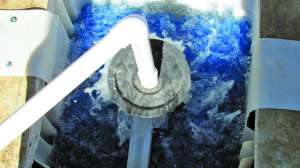
North Carolina features a range of soil types from sand to clay, even across Full Circle Environmental’s service area, which can determine the type of septic systems that can be installed. The company installs surface and subsurface drip systems, with direct discharge of pretreated septage into water bodies. Irrigation spray systems, where wastewater is sprayed on vegetated areas that consume its nutrients, are also classified by the state as direct discharge systems.
Repairs of failing systems, particularly in the Raleigh and Durham areas, can often lead to full replacement.
“If conventional systems were permitted years back, but have now failed, they need to meet new code compliance for setbacks and design standards,” Woody says. “So a conventional system may suddenly need to be replaced with an alternative system.”
The septic systems of older homes located in downtown Durham have required considerable ingenuity to remain compliant following system failure.
“Where it’s not feasible to tap into the sewer lines, the state of North Carolina evaluates the property and presents the homeowner with a plan to remain compliant,” Woody says. “Often the solution is to hire an engineer to design a direct discharge system, which involves pretreating the wastewater to a high standard and then discharging that purified effluent into a ditch, creek or other body of water.”
What they offer
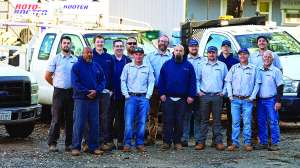
Full Circle Environmental hired its first full-time employee in 2019 and today employs seven workers, including Woody. With a tight labor market and heavy competition for skilled workers, he has a simple formula for attracting employees: Pay well and present an attractive employment offer.
The company started out serving the counties surrounding the city of Raleigh. In early 2023, Full Circle Environmental expanded its service map to the counties along the southeast coast. With the company headquarters located in Clayton, Woody leverages partnerships in the coastal area around Wilmington to store and stage equipment as well as reduce the length of trips required to serve area clients.
Current service offerings include septic tank installation, maintenance, repairs and inspections, in addition to utility services, tapping into sewer and waterlines and installing grinder pumps as necessary on behalf of developers or local utilities. The company has also recently returned to pumping services, including sludge and biosolids handling, following a departure from that market in 2021.
“Early on, septic pumping was taking up a lot of bandwidth that we wanted to devote to building the installation side,” Woody says. “Now that we have additional resources to tackle that growing need, it makes sense to get back into pumping.”
Equipment matters
Woody recently purchased a 2014 Peterbilt outfitted with a 3,500-gallon aluminum tank and a pump from National Vacuum Equipment to start out.
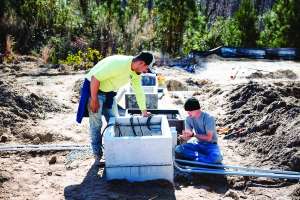
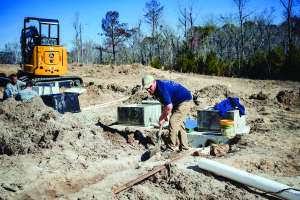
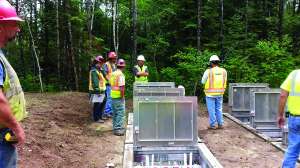
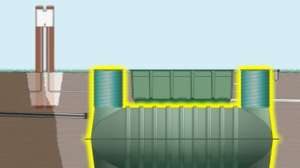
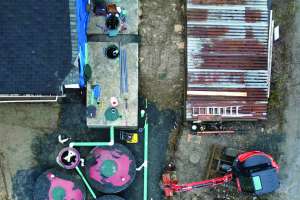
The company installs concrete tanks in most instances, and poly tanks where the project site is too constricted for boom trucks. They tend to use concrete tanks from local suppliers Shoaf Precast, High Point Precast Products and Sunland Septic Tanks. Treatment components and resources are primarily supplied by Orenco through local distributor AQWA located in Wilson, North Carolina. American Manufacturing Company supplies drip dispersal materials. The company also installs T&J Panel block systems that can be installed on sites with limited space. Pipes and drainfield material are supplied by Drillers Service.
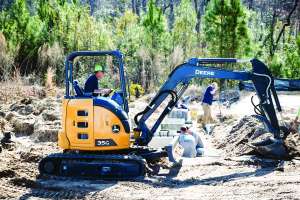
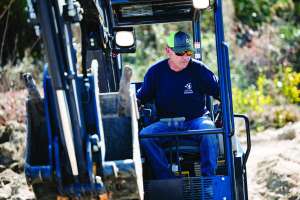
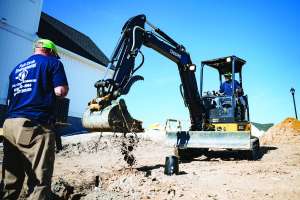
The company’s construction fleet includes a John Deere 60G compact mini-excavator, a Bobcat E50 compact mini-excavator, a Bobcat T590 compact track loader and a Caterpillar 320.
Most of the tools used by Full Circle Environmental are manufactured by DeWALT.
Woody says he’s benefited from networking with other local companies to discuss challenges and solve problems. He frequently confers with other industry professionals and partnering companies such as Inman Septic out of Hampstead, North Carolina.
“Understanding the industry has humbled me because there’s so much to learn,” he says. “But I’m not shy about reaching out to other industry professionals, suppliers and business owners to learn more.”
Woody’s plans for the business focus on continued growth and the adoption of new technologies to meet the standard of increasingly intricate regulations. He’s recently made plans to expand the company’s headquarters to a larger office with space for equipment storage and stocking of inventory.
“I didn’t inherit this business,” he says. “I built out the footprint on my own and that can be challenging, not only from a work perspective, but also in managing your cash flow and working with limited resources. Now that we are established, we have a lot more options available to us.”