
The primary function of secondary pretreatment is to remove oxygen demand by providing naturally occurring organisms with sufficient oxygen to process organic matter, ammonia nitrogen and other compounds present in wastewater prior to entering the soil treatment area.
Permit stipulations may allow aerobically treated effluents to be dispersed or discharged into receiving environments that are considered “high risk.” The risk as used here is based upon the sensitivity of the receiving environment and how much additional treatment can be expected in that environment. A property may have the option to use subsurface soil dispersal, but the soil may be shallow with limited treatment capability. By applying aerobically treated effluent, the soil can more readily finish the treatment cycle and safely disperse the water back into the hydrologic cycle. Likewise, if the effluent is discharged to surface waters, the lower oxygen demand will reduce environmental degradation as previously described.
Doing the heavy lifting
Aerobic (oxygen-loving) bacteria are the workhorses of wastewater treatment. As part of their metabolism, they use oxygen to oxidize many organic compounds to carbon dioxide and water. The organic compounds serve as food to the bacteria, and the bacterial population will grow to match the food source.
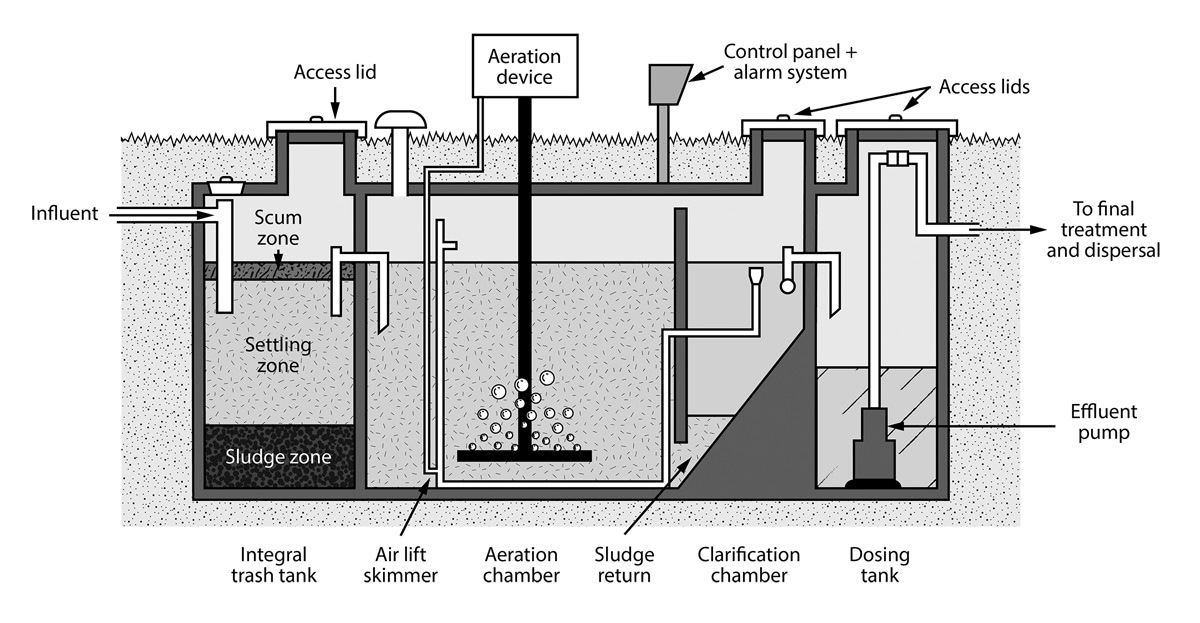
An aerobic treatment unit provides the dissolved oxygen needed to support the necessary population of active aerobic bacteria in a saturated environment. A few ATUs are preceded by a separate septic tank, but most systems designed for individual home use have an integrated tank to separate out trash and paper products in place of a septic tank and allow settling of the solids. This pretreatment device provides rapid decomposition of organic matter, a reduction of pathogens due to the hostile environment, and transformation of nitrogen-containing compounds to nitrate.
Air supply
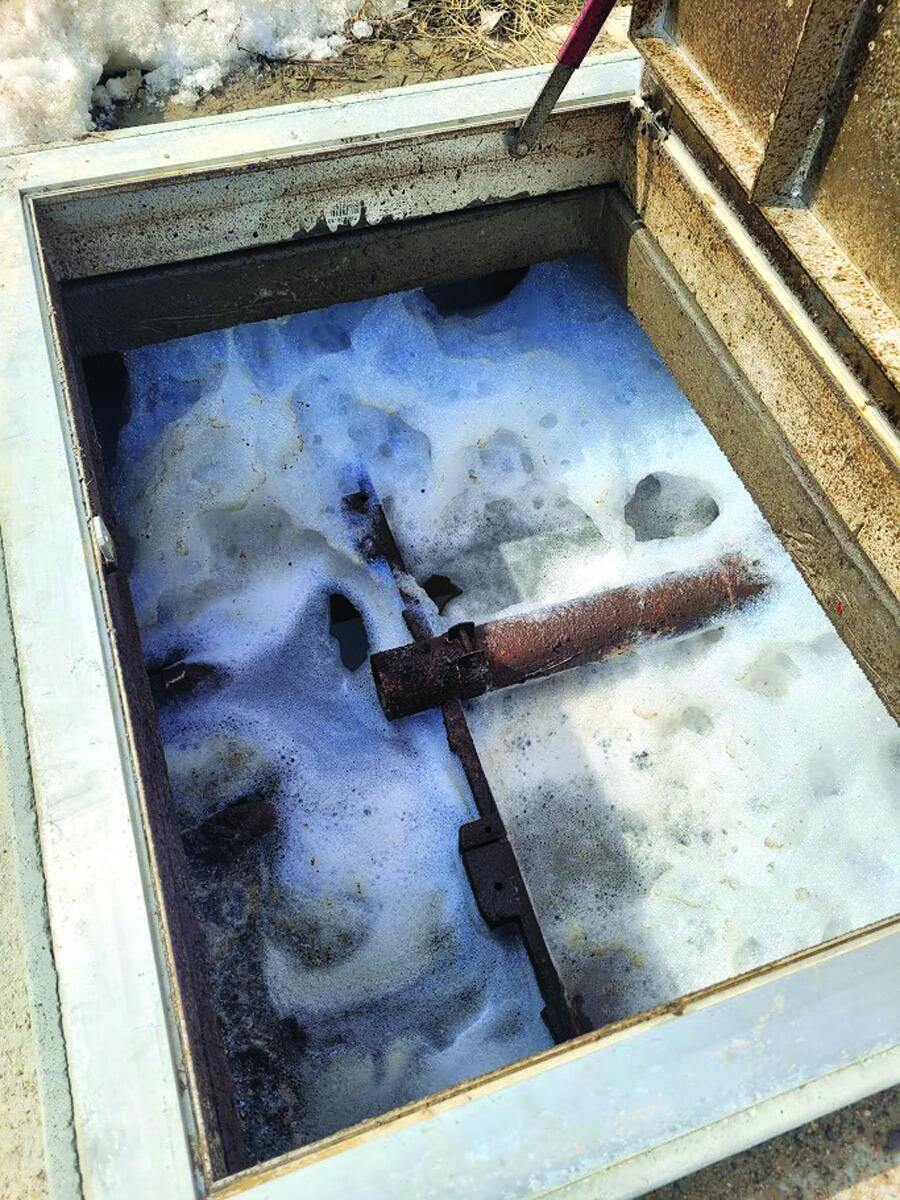
All ATUs have a device that delivers air into the sewage being treated. Oxygen (contained within the air) will dissolve into the water and create aerobic conditions. Depending on the manufacturer, the aeration system may be a blower, a compressor or an aspirating propellor.
The aeration process also serves to mix the contents of the ATU tank, ensuring good contact with the organic compounds and the bacteria. This process is called suspended growth, because the dense population of aerobic bacteria is suspended in the effluent by the mixing action of the aeration system. The other common type of ATU is suspended growth with a submerged fixed growth media which encourages microorganisms to grow on a fixed surface to which wastewater is applied. The effluent from an ATU can be discharged to a soil treatment area or, after disinfection, to the surface or a surface water in some jurisdictions.
Building the environment
A typical ATU includes an aeration basin filled with effluent into which air is injected. Air injection mixes the contents of the tank and causes oxygen to become dissolved in the effluent. The mixing action brings the suspended microorganisms or media into contact with the organic matter (food) and dissolved oxygen (fuel). Because there is plenty of food and dissolved oxygen, microorganisms thrive and become concentrated within the basin either in groupings of microorganisms (floc) or on the media. The microbes oxidize the organic matter into carbon dioxide, new microbes and insoluble matter (residuals).
The mixing of effluent, organic matter and air in the same basin is known as the activated sludge process, and the concentrated mass of microorganisms is called biomass. Most ATUs operate in the extended aeration mode by keeping the wastewater in the basin for a long time while providing plenty of air but a limited amount of organic matter to the organisms. If sufficient dissolved oxygen is supplied and minimal food is available, the microbes will readily consume organic carbon — including each other. The advantages of extended aeration include excellent organic carbon removal and nitrification. The primary disadvantage is the higher electrical consumption needed for aeration.
Standard layouts
There are many brands and configurations of ATUs with the most common discussed below.
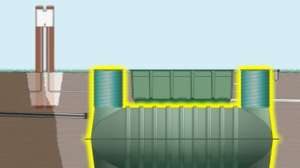
- Complete-Mix Suspended Growth - Typically, a complete-mix suspended growth aerobic treatment system is composed of a main treatment basin (aeration chamber) where bacteria, organic matter and effluent are mixed by the turbulence created by air injection. A second chamber (clarifier) provides quiescent conditions to allow biomass to settle. The two chambers may be separate tanks as shown in the figure or they may be combined in one tank. See the figure below for a generic representation.
- Sequencing Batch Reactors - A sequencing batch reactor provides treatment using one chamber. As the name suggests, processes occur in a particular order to provide aeration and biomass separation. These include filling the chamber, aerating the effluent, allowing the biomass to settle, pulling out the clarified effluent (decanting) and then removing a portion of the biomass. This is a batch operation, which means storage must be provided for effluent that arrives while sequential operations are in progress. The SBR process provides some flow equalization.
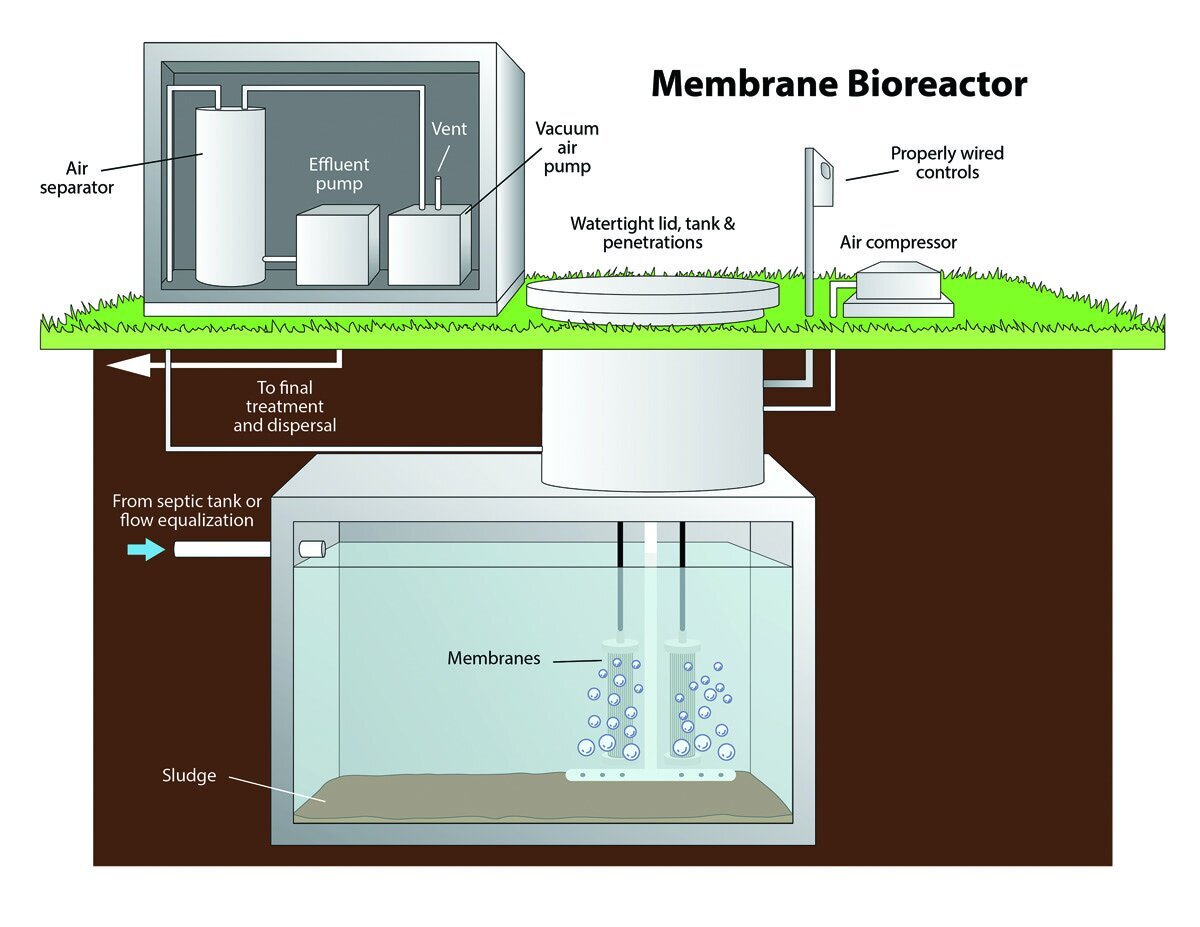
- Membrane Bioreactors - Membrane Bioreactors include activated sludge components but use membrane filtration units to separate biomass from effluent. Unlike the suspended growth configurations previously mentioned, MBRs do not depend on gravity (settling) to separate the biomass and effluent. With membrane filtration, time and space required for biomass separation is significantly reduced. MBR systems can thus treat a greater volume of water and occupy less space than conventional suspended growth systems. However, the increased treatment capacity is accompanied by increased electrical cost because greater aeration capacity and pressurization is needed to operate a MBR at its full potential.
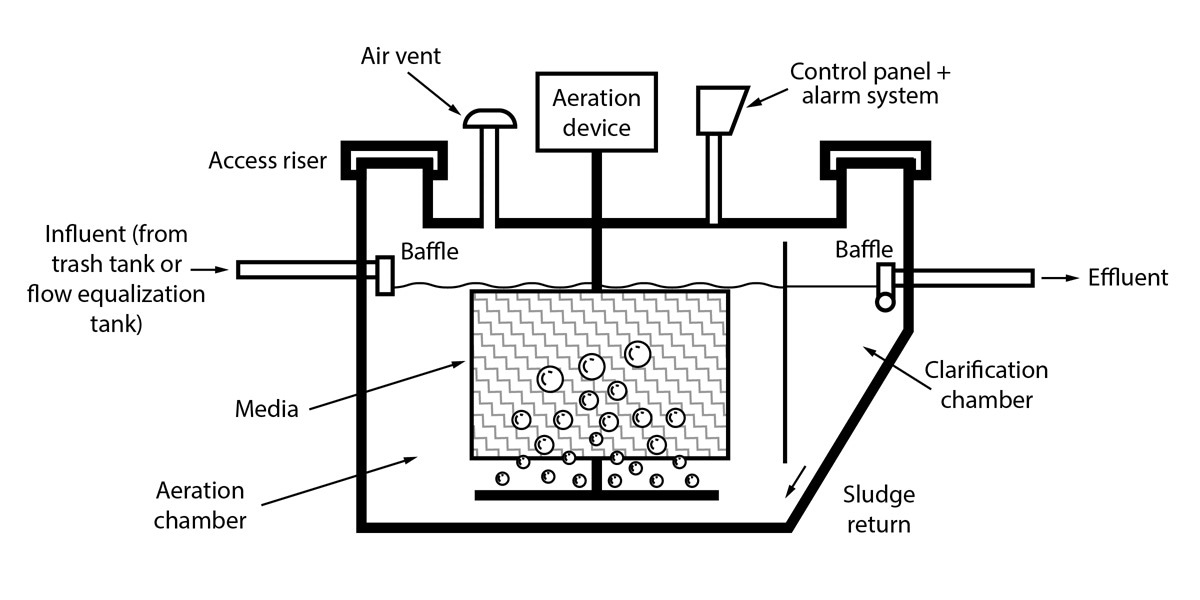
- Fixed Film and Integrated Fixed-Film/Activated Sludge - The aeration chamber contains media which serves as a location for a biofilm to develop. The media is typically fixed in one location and is commonly plastic or other synthetic solid material. The media that will support attached growth of biomass on its surface and within its porous structure. Wastewater comes into contact with the film containing the active fixed biomass by pumping the water past the media or mixing within the tank. This biofilm will digest the waste and slough off when it becomes thick and will need to be periodically removed. When fixed-film and suspended growth configurations are combined in the same aeration chamber, the configuration is referred to as an integrated fixed-film/activated sludge system. In these systems, excessive growth falls off or “sloughs” and settles on the bottom of the chamber. These solids will accumulate and must be removed as part of periodic maintenance procedures.
In all cases after aeration/mixing, the effluent then moves into a quiescent zone/clarifier where the bacteria will settle to the bottom. The clarified effluent then proceeds to the next phase of treatment or dispersal. As biomass accumulates, it is periodically removed (either automatically or manually). The removed biomass becomes a residual that can be taken to be land applied or subjected to further treatment.
Continue reading for free