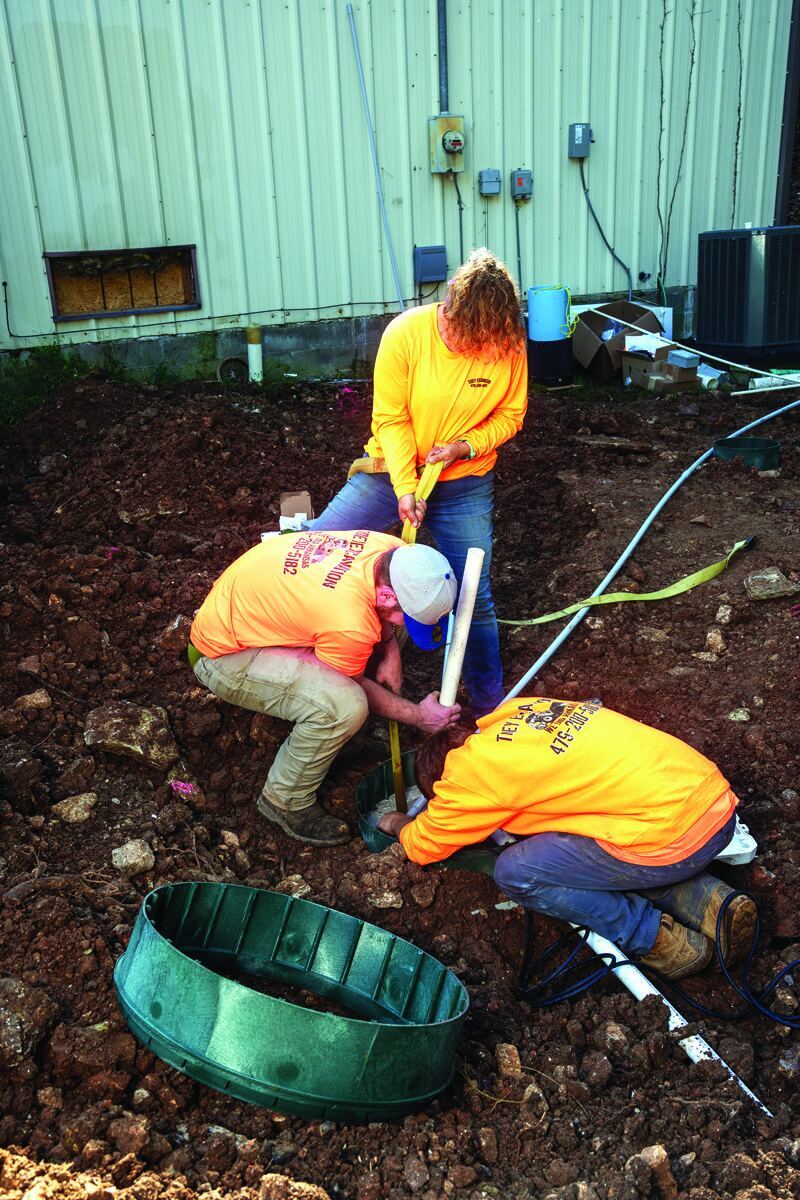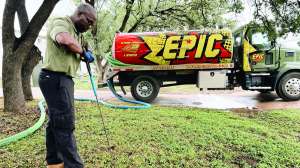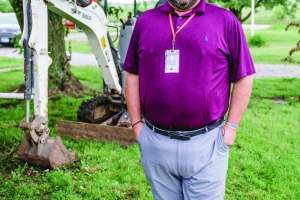
There’s not much this crew can’t do when it comes to dirt work. Leading the charge on the septic installation side of the business for Tidey is (from left) Angie Bingham, Cyndel Bingham, Traven Bingham and Logan Frasier. (Photos by Denny Medley)


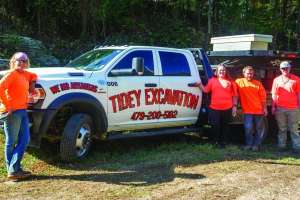
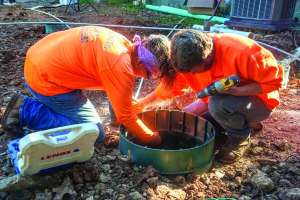
There’s not much this crew can’t do when it comes to dirt work. Leading the charge on the septic installation side of the business for Tidey is (from left) Angie Bingham, Cyndel Bingham, Traven Bingham and Logan Frasier. (Photos by Denny Medley)
Jack Tidey is not afraid to do things others won’t, or don’t want, to do, whether it’s working on steep hillsides using a dozer as an anchor assist, or seeing potential in a woman applying for their lead installer position who had no installation experience.
Jack served four years in the U.S. Air Force after high school, then used the education he received to work for a startup company that made frequency filters for cellphone towers. The startup didn’t make it, but he soon met Mark Patterson, a builder in the area, and went to work for him, becoming his “jack of all trades” over four years.
Patterson became a mentor to him, and Jack enjoyed working with him, but after a few years he was inspired to start his own business. Patterson encouraged him to get into septic work and gave him his blessing.
Today Jack’s company, Tidey Excavation in Avoca, Arkansas, operates two divisions — excavation work and septic services. He and his wife Lisa operate the business out of their home situated on eight acres. They have a staff of seven. Their service territory covers the northwest corner of the state in about a 60-mile radius.
Jack made the move to self-employment in 2005. The biggest hurdle to starting an excavation business was the initial cost of equipment but Patterson helped him out by renting him a CASE 580 backhoe for $900 a month.
“It did not have a cab and there were no shocks in the seats,” Lisa says. “And he did not have a truck or trailer to pull it. So he would put his motorcycle in the bucket of the backhoe and drive the backhoe to his jobs. Those backhoes only go about 22 miles an hour. When he was done for the day, he’d just hop on his motorcycle and ride home.”
That setup went on until 2008 when his stepfather gifted him a trailer and he bought a truck. By 2010 he and Lisa were married, she started helping part time, they got more equipment, and they began expanding the business.
“That’s also when we started hiring help,” Lisa says. “I was working full time for another company but I did a little accounting and helped with taxes.” By 2013 she decided to stay home with their first child and work full time for the company.
For 15 years, they operated out of their home but by 2022 they needed more room for equipment. Jack had always been interested in the larger property next door and finally asked the man if he ever thought about selling. “The man said his health wasn’t great and he was having a hard time with the upkeep and had been praying for a solution,” Lisa says. They sold their home and moved in, at first operating the office out of two mobile units but eventually moving into their dining room for convenience.
About half the company’s work is for excavation projects — lot clearing, basements, site grading for new buildings, demolitions, drains and utility ditches. “We also build structural pads and roads,” Lisa says.
Jack oversees this side of the business. He meets with builders and homeowners, does the scheduling and handles the estimating. He’s also out on job sites running machines. His field crew includes equipment operators Jody Bassham (their first employee) and Logan Frasier (also a licensed installer), and dump truck drivers Jason Smith and Jon Sproul.
For equipment they have three Caterpillar 308 excavators, a Caterpillar D4 dozer, a Caterpillar 289D skid-steer, a Komatsu dozer, a New Holland backhoe and two Mack dump trucks.
Jack handed off management of the septic side to Angie Bingham, a licensed installer, after some initial training when she started in August 2023. Logan was her helper until moving to dirt work when she brought in her son Traven. Their Caterpillar 305CR mini-excavator handles most of the work, whether clearing brush or digging holes. But they also borrow equipment from the excavation side of the business, when needed.
“If we have a pipe-and-gravel install, we bring the skid-steer onto the job,” Angie says. “And then we use a chain saw when we drop trees and need to cut them up and move them out of the way. And sometimes we’ll use the backhoe for pipe-and-gravel because it’s got the loader bucket on it.” They also use the company’s dump trucks to bring in gravel or haul debris.
The dozer is sometimes used as an anchor assist when they’re working on steep hills. “It’s done by leaving the dozer on the hilltop and tethering — by chain or wench — the smaller machine on the hillside to it,” Lisa explains. “Someone sits in the dozer to watch and make sure they are anchoring the other operator. Customers seek us out for this.”
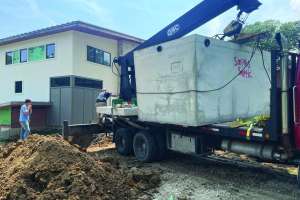
Most of their work is residential and the systems they install are pretty basic, Angie says — gravity fall, pump systems, using concrete tanks from Pile’s Concrete Septic Tank, Zoeller Pump Company pumps and Polylok risers. “What changes most is the trench media, and that ranges from pipe and gravel to Infiltrator chambers, EZflow,” she says. “And when we can’t get a boom truck in, we use Infiltrator poly tanks and their associated risers.”
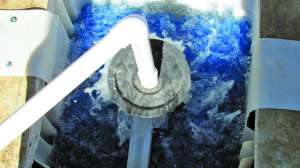
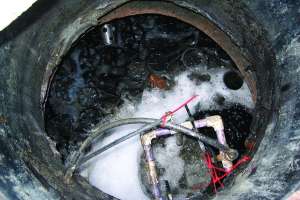
But recently during the construction of a brewery, she had the opportunity to put in something completely different — an aerobic bacterial generator system. “We used that because of the type of waste involved,” she says. “It’s the first aerated system I’ve done. It’s an Aquaworx Remediator system made by Infiltrator. It’s basically a bubbler.”
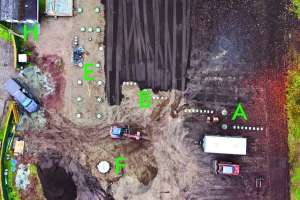
The brewery project involved pumping 200 or 300 feet up a hill. “My lateral field is on the top of a bluff — which is a little intimidating but I’m a bit of an adrenaline junkie,” she says. “There are two remediators on each end of a 2,000-gallon tank, and then it flows down to a 1,000-gallon tank, and then to a separate 500-gallon pump chamber, and then pumps up the bluff line, four 100-foot lateral lines, with gravity-fall down from there to a D-box.”
Angie’s daughter Cyndel works in the office with Lisa. Lisa takes care of financial tasks including invoicing, insurance and accounting. Cyndel (also a licensed installer) handles estimating, payroll, scheduling and works with the Arkansas Department of Health.
Scheduling is done using a dry-erase board and sticky notes showing the work for the day. The notes are color-coded — orange for septic, yellow for dirt, green for dump truck. “And then we have blue for something we call squeezes, which is people who don’t want an estimate, but just want us to come out for a day,” Lisa says.
When crew members come in in the morning they check the board. When they’re done with a job they give the sticky note to Cyndel who pulls all the paperwork for the job. “Then she hands it off to me so I can do the billing,” Lisa says. “It’s old-school, but it works for us.”
The company doesn’t do a lot of marketing, Lisa says. “It’s mostly word of mouth. And Jack is like a good old boy. He knows a lot of the builders around here. And a lot of our work comes from people who see us working on the road. Our logo and phone number are on the trucks, so people call. And Angie drives 45 minutes to get home, so she’s like a rolling billboard.”
Like most companies, finding good workers that stick around has been hard. But the current team is working out well for them, Lisa says. And hiring Angie proved to be fruitful, as she eventually brought in her daughter, son and future son-in-law. And Jody brought in his brother and a friend at one time. They’re even getting a little help now from their two sons — Jet (15) who is on the payroll doing mowing, shredding and filing, and Liam (8) who helps with office tasks such as stamping envelopes.
The team meets up every morning at six. “They have a meeting out in the parking lot and talk about who needs to go where and how they can support each other,” Lisa says.
The company is also dedicated to serving their community. “We’re here to help in any way,” Lisa says. In one instance they donated time and materials to install a septic system for an elderly woman taking care of a disabled son.
And in the aftermath of a tornado in 2024, Angie, Traven and Logan traveled to a nearby town to check on Logan’s mom. They noticed her neighbor was in distress because the electricity was down and her oxygen was not working. “There was a massive tree in her driveway, so no one could get in and she couldn’t get out,” Lisa says. “Angie and the guys came to our house and picked up the excavator and some chain saws and went back and cut up the tree — then ended up helping other people in the neighborhood, as well.”
Lisa says their motto is ‘We dig Arkansas.’ “We tell people we’ll pretty much do anything that allows us to play in the dirt. And we have the best crew, I can’t even put into words. They go above and beyond for us and we try to do the same.”
Continue reading for free