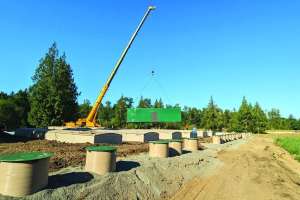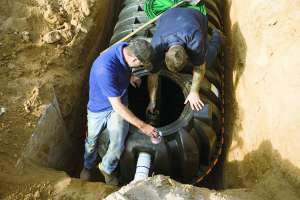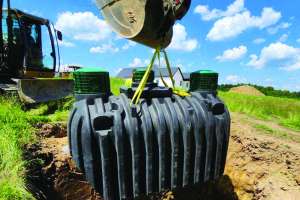

Jet Inc. rolled out a new polyethylene tank for its PLT Series residential wastewater treatment systems, which helps it do what it does best even better: transport and install without failure under difficult site conditions.
“We wanted a tank that would allow for greater burial depths and greater flexibility in installation,” says Ed Schloss, Jet Inc. sales manager.
Specifically, Schloss says the new tank, which hit the onsite market in November 2024, has a stronger design, allowing for an increased burial depth of four feet — double what the previous tank could do. It is also equipped with more inlets and outlets (three of each, this time), translating to greater flexibility for installers.
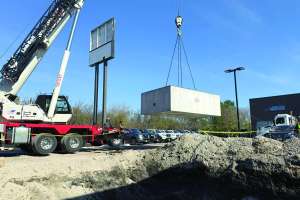
The PLT Series, available since 2015, is Jet’s counterpart to the standard precast concrete J-1500 series. PLT-500 and PLT-800 tanks are rotational-molded and designed for flows up to 800 gpd. While lightweight compared to concrete tanks, Schloss says it’s twice as heavy as the average polyethylene tank at 1,050 pounds, making it ideal for transportation and in soft, steep or wooded terrain, but without compromising on build quality.
“The Jet poly tank is engineered with a very robust design,” Schloss says. “PLT is best suited to difficult locations that make it easier for contractors to transport and install, or where there is no precaster available.”
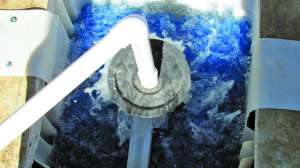
All residential Jet tanks have three compartments where wastewater is treated. In the first compartment, pretreatment, wastewater is held until solids settle to a bottom sludge layer, where organic solids are broken down physically and biologically. Grit stays in this compartment, while broken-down solids move to the bioreactor treatment compartment. Here, wastewater is fed to microorganisms in the Jet BAT Media, while the 700++ Aerator mixes oxygen and sustains the biomass during digestion. Treated wastewater moves to the third compartment, treatment: Fine particles that fall to the bottom return to the treatment compartment for further digestion, while effluent discharges through a baffled outlet.
The BAT Media process allows for denitrification, meeting NSF/ANSI 245 standards for nitrogen reduction. Jet also offers a UV lamp and a tablet feeder for disinfection, meeting NSF/ANSI 46 standards.
Schloss says that while the tank has been updated, maintenance processes for the PLT will remain the same.
“The PLT tank should last indefinitely as long as it is installed according to our instructions and it is not damaged by outside forces,” Schloss says.
The predecessor tank was phased out in December, shortly after its replacement launched, Schloss says, and he’s seen a strong early product launch.
“So far, the response has been very, very positive and they have been selling very well,” Schloss says.
800-321-6960; www.jetincorp.com
Continue reading for free