In 2009, when Tanya Wilson’s then-husband wanted her to help him start a septic business, she was less than enthusiastic. “I was like, ‘You want me to do what!?’”
But she went along with it. “And once I got into it, I just fell in love with the industry,” she says. “People don’t know anything about septic, so I was able to help them understand what they had and how to take care of it. I loved the customer aspect.”
After a few twists and turns over the years, Wilson now has a new husband, a new septic business and a plan to franchise her successful model.
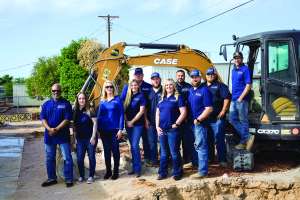
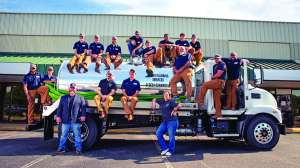
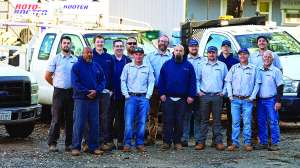
She originally called her company Priority Pumping, but in 2024 as part of a rebranding process, it is now called HomeField Onsite Environmental. They provide a full range of septic services, working in a 50-mile radius of their facility in Gilbert, Arizona, just outside Phoenix. The property includes a service yard and an office trailer where employees Lauren DiTusa, office manager; Heidi Hooker, marketing director; and Twyla Hawkins, customer service representative, work.
Wilson’s husband, Jake, oversees field operations. She manages internal operations, looks for growth opportunities and nurtures community relations.
“I also take care of the financials,” she says. “And I work hard on our reputation, making sure people know who we are and what the company stands for. And a big role is to take care of the people who work here, and then they take care of the customers and the company.”
Wilson is also a relentless promoter of the industry and a big supporter of the people in it.
GETTING STARTED
Wilson grew up in Wyoming into a family that worked in construction. Her degree in business administration turned out to be very helpful when she and her ex got their business going.
“It was a really fun business to market,” she says. “There were only a couple companies who had websites back then. I built an awesome site [for the time] and we killed it.”
She also enjoyed customer relations and team-building. She found the people in the industry to be good-hearted and hardworking, and that’s the type of environment she loves working in versus the rat race of corporate America.
The company was successful, growing to 12 people and a seven-figure revenue. But unfortunately in 2014, they got a divorce and lost the business.
STARTING OVER
With two young children to support, Wilson briefly picked up a job in the corporate world. Then she was approached by a couple of guys from her previous company who wanted her to help them get a septic business going. She agreed to work with them, but only for a year. What she really wanted to do was start her own company. She knew the industry well, knew there was great money in it and wanted to recreate that entrepreneurial experience of being able to have control over her time.
After the year was up, Wilson did start a business in partnership with two gentlemen. She handled internal operations, one partner worked in the field and the third provided financial backing. Two-and-a-half years later, she bought out her partners. By then she had several employees and was expanding into new markets.
“This time around I have 100% control over what it looks like,” she says. “This business runs with a high level of integrity and honesty. And it’s very people-centered versus just being driven on sales. I believe that if you take care of the people, the business just grows by default.”
NOT AFRAID OF A CHALLENGE
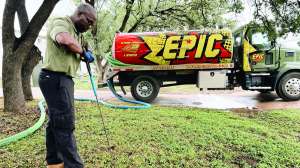
Pumping accounts for about half the company’s revenue. The service team includes service manager Tim Butler, tech lead Seth Coburn and Tim Butler, service manager; Seth Coburn, tech lead; and Issac Bencomo and Justin Carr, technicians. Their vacuum trucks are from Tank World — a 2021 Peterbilt with a 4,000-gallon steel tank and Fruitland pump; and a 2021 International and a 2022 Freightliner with 3,500-gallon steel tanks, custom 500-gallon freshwater tanks, Honda jetters and Masport pumps.
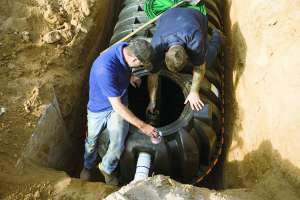
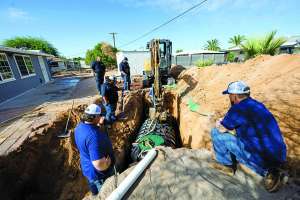
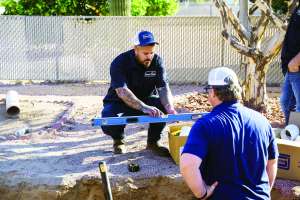
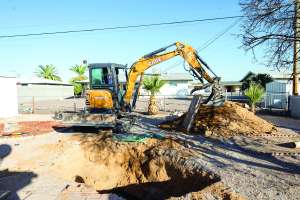
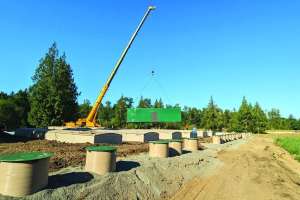
On the installation side, work is handled by project manager Dustin Nelson and Dusty Tuckfield. They work with a CASE CX30 excavator and a CASE skid loader. They partner with a local contractor to provide seepage pit drilling and rock and dirt hauling.
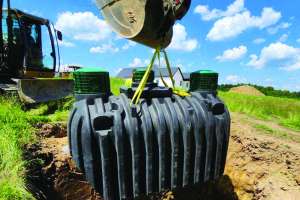
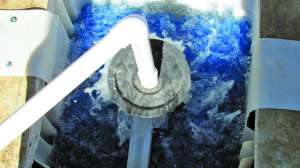
Most of their installations are conventional systems but as people are building closer to the mountains where advanced systems are required they are putting in more Advanced Enviro-Septic (Infiltrator Water Technologies) systems.
The company prides itself on being able to handle any project, including those for which they have no previous experience. An example is assisted living facilities.
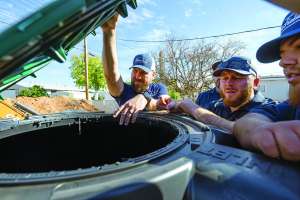
“The medications that go into those systems can cause a lot of issues, so the design engineers have to take that into account,” Wilson says. “Some meds can be corrosive to concrete. In one case, we did a Norweco poly tank with aeration and UV filters to make sure the effluent going to seepage pits was at the right biochemical oxygen demand level so it’s not polluting the ground.”
A bus depot/wash station near the interstate required an Advanced Enviro-Septic system. “It’s an interceptor that flows into the system,” Wilson says. “That was an interesting engineering system to put together. We weren’t sure how the system would be sized since there really wasn’t an occupancy or fixture count to rely on. It’s a project we’d never done before but we figured, ‘Why not?’”
The company uses conventional systems for solar farm projects, but dealing with government contracts was unfamiliar territory. “It can be intimidating,” Wilson says. “But some of the best work we’ve had has come from taking a leap of faith on big contracts that sometimes you don’t really understand but you’ll figure it out. And we’ve gotten really good at asking questions.”
HIRING THE RIGHT PEOPLE
While it’s sometimes challenging to find good employees, Wilson believes if you create a great culture people will be attracted to your company and less likely to leave.
The company takes its time in hiring and is very selective. The interview process includes an unexpected question — “What are your personal goals right now?”
“Sometimes, people just give you that deer-in-the-headlights look,” Wilson explains. “But what we’re really looking for is whether this is someone we can help reach their growth potential. Do they have goals? Do they have the drive to show up and make a difference for their family? Do they want to be part of a team and contribute? I truly believe if a person has the right mindset and attitude I can train them to do anything.”
Candidates are interviewed in person, then do a ride-along for a day so they really get to know what the work entails. It’s hard work and not glamorous, but the reward is good pay and benefits, growth opportunities, and a supportive team environment and family atmosphere.
Candidates are reminded that an interview is a two-way street, and they’re asked what they look for in an employer. Some say, “Just please don’t yell at me,” which is an indication of the harsh atmosphere they’ve been working in.
The company takes a coaching approach when addressing challenges with employees rather than disciplinary measures, but they know when to cut their losses and make the hard decisions.
HELPING OTHERS
Having successfully run three septic businesses, Wilson has now expanded her focus to help others succeed. “I know how hard it is to bootstrap and start a company,” she says. “And I think it’s a crime not to share what we know with people who want to do it.”
Wilson sits on the Education Board of the National Association of Wastewater Technicians and is designing a digital course on the basics of getting started in the industry for people who may be good at the trade, but don’t know anything about the business side of things or how marketing works.
She is also on the board of the Arizona Onsite Water Reclamation Association. And she has been a presenter at WWETT and National Onsite Wastewater Recycling Association conferences, speaking about the importance of strategic planning, work-culture creation and branding a reputation.
Wilson is also working with three partners to franchise her business model. “That’s been my goal for many years — to get this to a point where we have systems and processes so dialed in that we can turn this business into a franchise,” she says. “We have taken everything and put it into a playbook to help other people build their businesses faster.”
Helping everyone in the industry is Wilson’s goal, even competitors. “If we would all just come together and elevate this industry, we’d all be doing better,” she says. “That’s what we talk about with our employees. I know my guys help competitors at the dumpsites who maybe don’t know how to offload trucks. They’re out to help others.”
PROMOTING THE INDUSTRY
Wilson has been named one of Phoenix’s Top 100 CEOs through the Titan 100 organization for three years in a row. “It’s been great exposure for this industry — and for women in this industry,” she says.
She loves being able to help set a standard for what the industry should look like, and to help people understand what the waste industry is — and talking about it in the light, not as a forgotten or shameful industry.
While she is proud of her accomplishments, Wilson wants success for everybody. She believes it’s a great industry to have a career in and her guys have done well. “That guy whose goal was not to be yelled at soon had a goal to pay off his debt, then to buy a house, and now he has a girlfriend and a baby on the way,” she says. “He never thought any of that was possible. It’s great watching people achieve their dreams.”