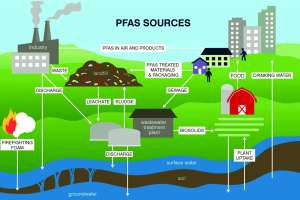

Per- and polyfluoroalkyl substances are a group of chemicals used in many consumer and industrial products, including cosmetics, food packaging and nonstick pans. Common residential sources are:
- Food – For example, in fish caught from water contaminated by PFAS and dairy products from livestock exposed to PFAS
- Food packaging – For example, in grease-resistant paper, fast food containers/wrappers, microwave popcorn bags, pizza boxes and candy wrappers
- Household products – For example, in stain and water-repellent used on carpets, upholstery, clothing and other fabrics; cleaning products; nonstick cookware; paints, varnishes and sealants
- Personal care products – For example, in certain shampoo, dental floss and cosmetics
Origin Story
They are sometimes called “forever chemicals” because some do not break down in the environment. PFAS are not new chemicals, but have been used since the 1930s because of their useful properties. More recently, we have been sampling them and developed the ability to test them in ppt, whereas in the past it was in ppm. One common characteristic of concern of PFAS is that many break down very slowly and can build up in people, animals and the environment over time.
A significant portion of PFAS environmental contamination comes from industrial sources like manufacturing facilities, particularly those involved in chrome plating, electronics production and textile manufacturing. Additionally, firefighting foams used at airports and military bases are considered a key source of PFAS contamination in soil and water, contributing a substantial percentage to overall PFAS pollution. Wastewater is also a source of PFAS to the environment. When consumers utilize products in their home that contain these substances they are delivered to a septic system or wastewater treatment system.
Where in Water
Recently a few studies have looked at PFAS in relation to septic systems:
Wisconsin: Samples from 450 homes with shallow private wells throughout the state of Wisconsin were collected and analyzed for 44 individual PFAS and indicators of human waste as well as agricultural influence. At least one PFAS was detected in 71% of the study samples, and 22 of the 44 PFAS analytes were detected in one or more samples. Levels of PFOS exceeded the Maximum Contaminant Levels of 4 ng/L in 17 of the 450 samples. Those samples above 4 ng/L level tended to be associated with developed land and human waste indicators (artificial sweeteners and pharmaceuticals), which can be released to groundwater via septic systems.
North Carolina: A recent small study of 18 sites in three counties in North Carolina collected samples from septic tank effluent and private wells. These tested numerous for various contaminants including PFAS. They found 61% of drinking water wells contained detectable levels of PFAS with 50% of them exceeding the EPA’s recently established national primary drinking water regulation maximum contaminant level of 4 ppt.
Massachusetts: A small study tested 20 domestic drinking water wells for PFAS in a sand and gravel aquifer in an area served by septic systems. The study found five distinct types of PFAS with maximum concentrations for three of the five relatively high compared to public drinking water supplies in the U.S. It was identified that septic systems were the likely source, although landfill leachate may also be a source. They did find a positive correlation between nitrate levels which could serve as a helpful screening tool to determine if groundwater could contain PFAS as well.
Safe Drinking
If ground water sources contain PFAS there are many water filters on the market which remove and are certified to remove PFAS. There are currently five American National Standards Institute accredited third-party certification bodies that evaluate drinking water filters for PFAS reduction capabilities. Each has a registered trademark that is used on certified products.
The most common filters that are currently available and can be effective at reducing PFAS:
- Charcoal (Granular Activated Carbon or GAC): These filters use carbon to trap chemicals as water passes through them
- Reverse Osmosis Systems: Reverse osmosis is a process that forces water through an extremely thin barrier that separates chemicals from the water
- Ion Exchange Resins: Resins are tiny beads that act like powerful magnets that attract and hold the contaminated materials from passing through the water system
Wastewater treatment systems at any scale contribute PFAS to the environment because many PFAS do not fully break down during treatment. The simplest way to reduce PFAS from wastewater entering our ground or surface water is to eliminate their usage whenever possible. Research is being done about enhancements to septic systems to treat PFAS and other emerging contaminants.
A study in Sweden evaluated the use of a tertiary filter containing biochar as a replacement or complement to sand for the removal of PFAS and found promising results, although more testing is needed.
Continue reading for free