The Boucher Nissan car dealership that opened in Oconomowoc, Wisconsin, in 2023 decided to open another Hyundai dealership on the same lot in 2024. Unfortunately, the site was not equipped to handle the waste stream from another dealership.
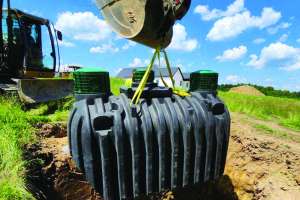
Four 7,000-gallon holding tanks had to be installed over a two-year period. This translated into two tanks for each dealership. One 7,000-gallon tank was needed to hold sanitary waste, the other to contain the contents of the dealerships’ floor drains. As well, a 10,000-gallon holding tank had to be installed at the Nissan dealership’s car wash in 2023, plus a 2,500-gallon three-compartment tank for its water recirculation system for removing oil and sediments.
“The reason the client needed to install multiple tanks is because Wisconsin’s Department of Safety and Professional Services regulates sanitary systems, and the Department of Natural Resources regulates nondomestic wastewater,” replies Todd Stair, vice president of Herr Construction in Oconomowoc, the company contracted to do the work. “So we needed separate tanks to satisfy both departments.”
Size specifications for the tanks was determined by the projected wastewater needs of each dealership, as tied to a weekly schedule for having these tanks pumped and their contents tucked offsite. “7,000-gallon tanks are designed for a five-day flow,” Stair says. “It was designed for 1,400 per day which equates to requiring 7,000-gallon tanks based on a projected five-day pumping cycle.”
Site Challenges
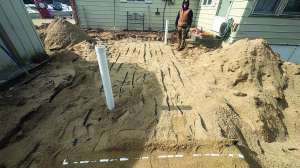
Soil conditions on the site were far from ideal. “The soil testing showed that the soil was all disturbed fill — including some of it coming from a previous dealership that had been demolished on the site — and was not suitable for an onsite system,” says Stair. “So we had to dig it all out, line the bottom with gravel and go from there.”
Then there was the fun associated with getting construction permits processed through two state departments and the local county. “The county is the final permit issuer for projects in Wisconsin,” Stair says. “Fortunately, it was easier to get permission from them to build in these disturbed soil conditions because it was a commercial site, than it would have been if it had been residential.”
System Components
Stair designed the system to handle up to 1,400 gpd. Major components include:
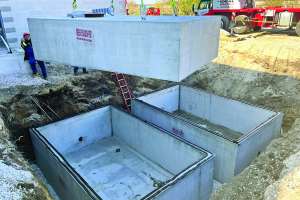
- Four Wieser 7,000-gallon concrete traffic rated holding tank
- One Wieser 10,000-gallon holding tank
- One Wieser 2,500-gallon three-compartment recirculation tank
- 360 feet total of 4-inch Schedule 40 PVC pipe for the drainage system
- 70 feet of 4-inch Schedule 40 PVC pipe for venting
- 1.5-inch Schedule 80 PVC conduit for holding tank alarm wiring, running from tanks to buildings
- Four vents installed from the tanks back to the main buildings
System Operation
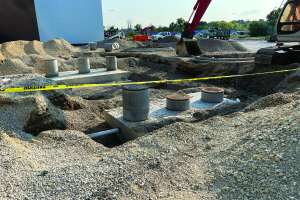
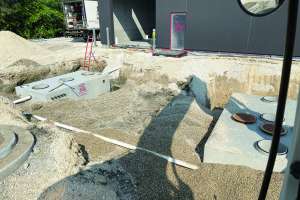
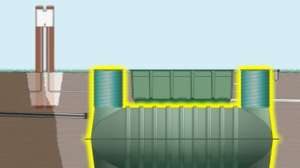
Drain pipes run from the two dealerships’ sanitary systems, shop floor drains and the car wash into their respective holding tanks. Water from the service department floor drains and catch basins goes to a DNR regulated 7,000-gallon tank. Water from the bathrooms and nonservice department floor drains flows to the other 7,000-gallon tank in each building. Wastewater from the car wash goes to the 10,000-gallon sedimentation tank and three-compartment recirculation tank for treatment and reuse of the car wash water.
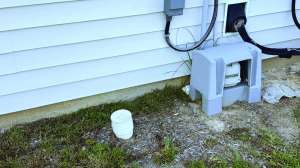
Traffic-rated Wieser tanks were needed to withstand the weight of cars and trucks passing overhead on a regular basis. The vents from the tanks have been situated by the dealership buildings, due to a lack of sewage systems and underground infrastructure to vent them into.
Actual pumping frequency is approximately every three weeks. Pumping occurs at the 7,000-gallon tanks.
Installation
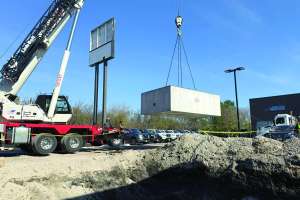
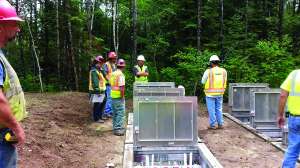
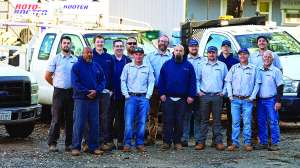
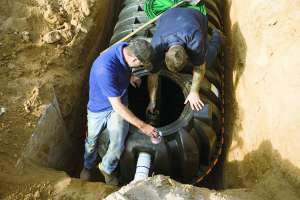
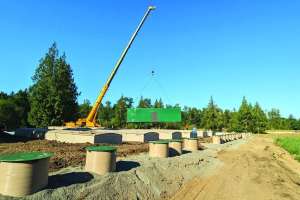
The installation of the Boucher Nissan dealership tanks and vents were done in 2023 by a Herr Construction crew consisting of Jeff Reese, Jeff Christensen and Jeremy Wagie. Reese operated the Link-Belt 330 excavator that dug up the parking lot area to install the Wieser tanks. The spoils were loaded into Mack quad-axle dump trucks and hauled offsite.
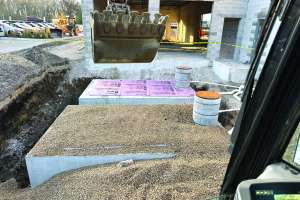
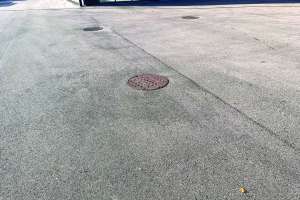
“Those trucks then returned with #1 washed stone for bedding beneath the tanks,” says Stair. “After the tanks were installed and insulation put on top, #1 washed stone was used to completely backfill then within a foot of the surface, we used a foot of compacted 1 1/4-inch traffic bond to make sure that the asphalt had sufficient and proper bedding to allow it to be placed on top, to prevent any settling at all in the future. And then they would’ve cut the risers to the perfect grade so that the cast iron manhole covers would be at the perfect elevation for the asphalt.”
For the car wash tanks, Herr Construction owner Michael Herr used the Link-Belt 330 to excavate the site, with the spoils being hauled offsite by the Mack trucks driven by Christensen. The site preparation was handled “the exact same way” as was done for the 7,000-gallon tanks, Stair says.
The Boucher Hyundai tanks were installed the same way in 2024, except that this time Michael Herr operated the Link-Belt 330 while Christensen and Mike Eguerra drove the Mack trucks. Eguerra provided his muscle to the ground work as well.
Since then the tank systems at both dealerships have performed as expected, without issues. The wastewater is being safely drained, stored and removed, while the parking lots above are staying level and strong.