
Onsite sewage treatment systems commonly disinfect harmful viruses and bacteria using unsaturated soil conditions.
It’s not uncommon to come across sites with insufficient soil and applications where treated effluent is applied to the surface, reused on site or directly discharged into a water body.
In these instances, other disinfection techniques are needed to protect public health. Historically, the most common approaches in these instances for decentralized systems have been chlorine and UV disinfection.
New options
Ozone (O3) disinfection is an up-and-coming technology in decentralized projects particularly in California. Ozone is a powerful oxidant that can effectively disinfect wastewater by destroying bacteria, viruses and other microorganisms.
It works similarly to chlorine destroying harmful microorganisms through oxidation. It disinfects by direct destruction of the cell walls. Ozone is more effective than chlorine at inactivating a wide range of pathogens, including viruses, bacteria and protozoa which have been found to be resistant to conventional chlorination. The extra oxygen atom binds in a split second to all the organic matter it contacts including various organic pollutants, such as pharmaceuticals and personal care products. After this oxidation process, all that remains is the pure and stable oxygen (O2) molecules.
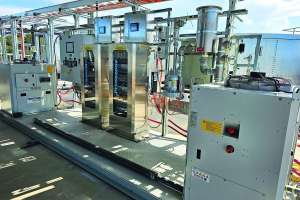
Ozone must be generated on site because it is unstable and breaks down to oxygen in a short amount of time. An ozonation system consists of the ozone generator, an air dryer or oxygen source, a means of adding the ozone into the wastewater, a mixing/contact chamber and a ventilation device.
How it’s made
Ozone is generated on-site by passing oxygen through an electrical field. Oxygen molecules are broken apart with an energy source into oxygen atoms and then collide with an oxygen molecule to form an unstable gas O3. The most common way that ozone is produced is by discharging electricity in very dry air. A high voltage (6 to 20 kV) is applied to two electrodes, and the high voltage converts oxygen to ozone.
The feed gas for the ozone generator may be air or purified oxygen via an oxygen concentrator. Air feed systems must remove dust and moisture from the incoming air for effective generation. The process works best in a sealed, controlled temperature environment, such as a small shed or large cupboard that is controlled via air conditioning. Ozone production works better in cooler temperatures (lower than 90 degrees F).

System input
Ozone is then introduced at an appropriate concentration into the wastewater effluent, where it reacts with pollutants and microorganisms, breaking them down or inactivating them. Ozone is added to the effluent and dispersed as finely as possible by using a fine bubble diffuser or a Venturi configuration. The mixing/contact chamber or tank must be sized so that there is adequate contact time, typically 10-30 minutes for disinfection. For the disinfection to effectively work, the contact time and the concentration of the ozone are critical.
Wastewater applications must follow advanced treatment so the ozone will be used for disinfection versus reducing the amount of solids. Organic compounds measured as TSS, BOD5 or COD will exert ozone demand and therefore must be low.
One additional benefit of ozone is that it will also lower the levels of organics in the final polish step after treatment. Ozone will also oxidize iron, manganese and hydrogen sulfide, resulting in precipitates downstream of the ozone process. If ozone is being used in a reuse system, these precipitates will need to be settled and filtered out.
Cons with the pros
Treating water with ozone is energy intensive. It requires high-tech equipment and a service provider that knows how to work the system. Quarterly maintenance visits are preferred to keep the system operational in the long term. These all add costs, making ozone wastewater treatments more costly than alternative purification methods.
Due to ozone’s high reactivity it has some disadvantages. Problems can arise with metals pipes and containers in wastewater treatment therefore corrosion-resistant materials such as stainless steel must be used, which adds to construction costs.
Additionally, because ozone is so reactive, wastewater service providers must take extra care and design the system to ensure that they do not come into contact with any ozone gas escaping from the water. Again, this adds to the cost of the ozone water treatment system. The ozone levels need to be constantly monitored with an ozone analyzer which is fairly expensive to buy and replace.

Where it makes sense
Due to the cost and complexity of ozone it is more likely to be used on larger commercial projects, cluster systems and systems with direct reuse. It is more common outside of the U.S., but we may see that shift in the coming years.
The cost of ozone systems has been decreasing, and they have become more robust and reliable. Unlike many other forms of disinfection they have additional treatment benefits, such as BOD5 and COD reduction. In systems with membrane filtration, ozonation can help reduce membrane fouling and improve filtration efficiency. The benefits of ozone include lack of harmful residuals, including disinfection byproducts which can adversely impact public and aquatic life. With ozone, there will not be a regrowth of microorganisms and there is no transportation of chemicals. Another large benefit is the effluent will have increased levels of dissolved oxygen in solution.
Woodfordia case study
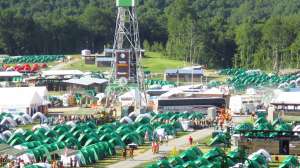
In 2023, I visited an interesting treatment site while touring a small part of eastern Australia. The Woodford Folk festival generates 2.1 million gallons of wastewater in one week where 130,000 people come to enjoy the festivities and camp on site.
During the rest of the year flows are extremely low in comparison. This makes it impossible to rely upon natural processes to treat the wastewater. At the treatment site an ozone system is used to oxidize the water. Ozone disinfects (bacteria, viruses and some protozoa), decreases BOD and COD, breaks down pharmaceuticals and personal care products and reduces odor and colors. The ozone also acts as a microflocculant. The ozone is generated on-site from concentrated atmospheric oxygen. The amount of ozone dosed is adjusted by the operator and varies depending on the volume of wastewater being treated.
Ozone is another tool in the toolkit for decentralized designers. For larger projects needing disinfection it is worth evaluating.
Continue reading for free