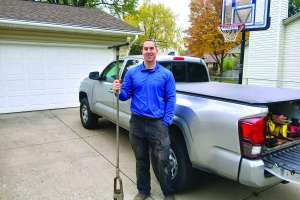
Many installers treat time-of-sale septic system inspections as simply a sideline. For Todd Willis and family, they have been part of the foundation of a thriving and diversified business.
When Willis launched New London County Septic & Excavation a dozen years ago, inquiries from real estate agents, combined with connections in the construction market, helped the company get off the ground quickly.
Operating from Ledyard, Connecticut, the business serves the southeast part of that state along with southwest Rhode Island, offering system installation, septic tank cleaning, general excavation and site work, drain cleaning and, yes, inspections.
Another key to growth is a passion for excellence, notes Willis: “We’re very focused on doing the right thing. We don’t cut corners. With all of our crews, if there’s a right way, that’s how we want to do it.”
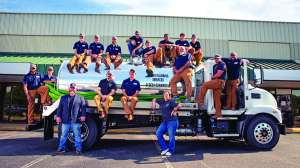
Willis doesn’t shy away from big or difficult jobs. “I like to be challenged,” he says. “I’ve been doing this for a long time, so I tend to be attracted to jobs that maybe other people don’t want to do.” He’s joined in the business by his wife, Melanie (bookkeeper); sons Jacob (foreman and equipment operator), Carl (vacuum truck operator) and Zachary (crew leader and operator); and Carl’s wife Kayla (receptionist and executive assistant).
Time to move on
Willis grew up in the business: his uncle Robert Maguire owned a septic pumping and excavation company. “I remember going out with him on the pump truck when I was 11 or 12 years old,” says Willis. “That piqued my interest. He was one of those people who got along with everybody.”
While learning carpentry at a technical high school Willis worked nights and weekends for his uncle. After earning a Class A CDL at 17, he began driving dump trucks and running a low-bed trailer to move heavy equipment.
He worked full time for his uncle for a couple of years after high school in 1986 and then spent a decade and one-half with construction firms, including 21 years with P&H Construction, where for several years he and two owners had a septic pumping business.
“By 2013 it was time for me to move on,” Willis recalls. “They were great people, there were no hard feelings. By that time I had three sons, and they were getting ready to graduate high school. It was time to do something for myself. At first it was just Carl and me. We had a pump truck and started doing installations.”
The installations — 60-75 per year — consist mostly of replacements at homes built in the 1950s and 1960s. The nearby Naval Submarine Base New London has a transient population, which leads to high turnover of area housing.
“We started getting asked to do septic inspections for real estate sales,” says Willis. “We would do an inspection and maybe find out the tank was bad or needed repairs, or the full system needed replacing. More Realtors started using us, and that market really drove our growth.”
Tight squeezes
New London County Septic installs only three to five systems per year on new lots. The majority are replacements on properties with older homes, generally no more than half an acre. Rocky soil is a common obstacle. “We’re in an area where there are pockets of sandy soil, but being on the coastline, we have a lot of rocky terrain,” says Willis.
“We don’t really have clay soils here. We have some poor-draining soil, but people who come here are surprised at the amount of rocks. There are ledge outcroppings and high groundwater tables. We sometimes find boulders three or four yards in size. We have to hammer them, split them, move them out of the way or sometimes move the septic system.”
Other challenges include well and property line setback issues and trees or other landscape features in the way: “So we’re always looking for systems that are compact with a high yield.”
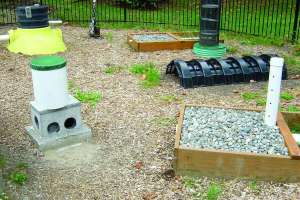
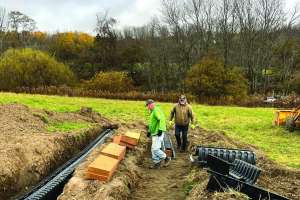
That makes GST Leaching Systems from Geomatrix the go-to option. “There’s a form with columns that you put in the ground,” Willis says. “You put washed stone and sand in alternating columns. Then you pull the form out, and it leaves columns of sand and stone.” The finished system is covered with filter fabric and topsoil seeded with grass.
Few projects lend themselves to conventional drainfields: “We do maybe one or two rock and pipe systems a year, and a couple with plastic chambers (Infiltrator Water Technologies). In recent years we’ve done a few drip dispersal systems. That’s about as advanced as Connecticut gets. The state is a bit behind the times when it comes to ATUs.”
Willis and his team use precast septic tanks from Jolley Concrete and Polylok risers, covers and filters. Liberty is the preferred pump supplier, although pumps come into play only on sites where tank effluent has to be delivered uphill to a drainfield (eight to 10 systems per year).
Up for the challenge
Willis always looks for bigger and more complex jobs, although projects like apartment buildings and commercial establishments tend to concentrate in sewered areas. “We’ve done some installs for lakeside homes with very steep terrain,” he says. “The house is in the middle of a hill that continues 30 to 40 feet down to the water, and we have to fit a system in there.”
One especially challenging job was for a Catholic retreat center on the coastline with five buildings. “The site had a ledge and big rocks,” says Willis. “It was at a campus setting where people were walking around.” The installation had a septic tank for each of five buildings, all feeding into a settling chamber. Effluent (1,250 gpd) was then pumped to a drip dispersal field with 900 feet of drip tubing (Perc-Rite supplied by Oakson).
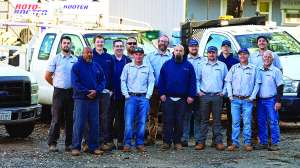
The team that makes it all happen, besides those already mentioned, includes Christy Maguire, foreman and /equipment operator; Tristan Stammell, vacuum truck and equipment operator and mechanic; Aiden Greely, truck driver and laborer; Jeff Smith, truck driver; and Burnette Connell, laborer. The equipment fleet includes:
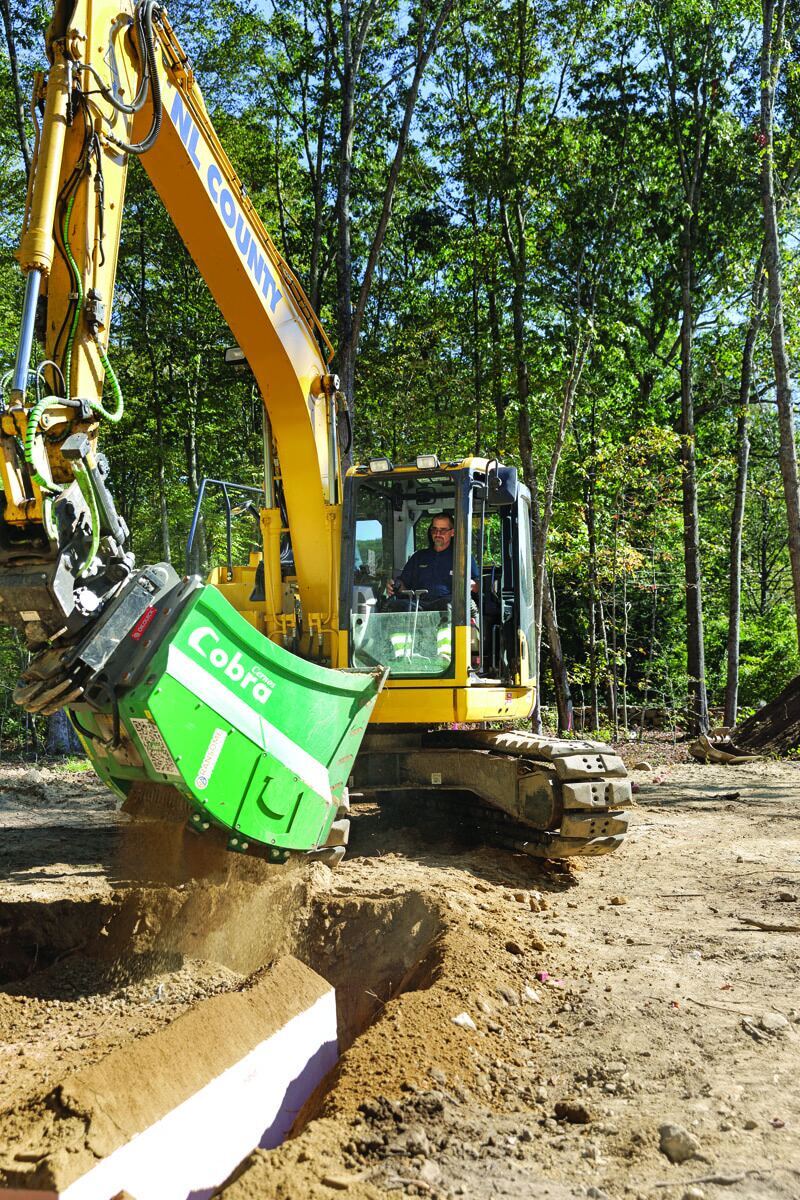
- 2023 Komatsu PC138-11 excavator with Steelwrist X18 tiltrotator
- 2025 PC88-11 and 2020 PC88-10 Komatsu excavators, both with Rototilt R3 tiltrotator
- 2016 Kubota 040 excavator with Geith hydraulic coupler
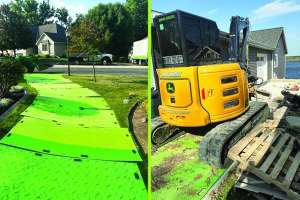
- 2020 Yanmar Vio17 mini-excavator
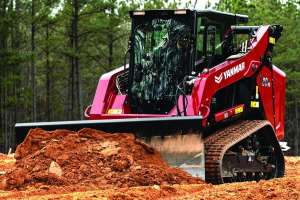
- 2015 Kubota SVL75 tracked skid-steer
- 2003 International six-wheel and 2007 Peterbilt 10-wheel dump trucks
On the septic tank pumping side, the workhorse is a 2016 Peterbilt 348 with 3,400-gallon waste/200-gallon freshwater steel tanks by Pik Rite, a 4,000 psi/10 gpm PTO jetter. The backup unit is a 2007 Peterbilt 340 with 3,400-gallon steel tank by Andert. Both carry Masport 400 cfm water-cooled vacuum pumps.
Staying busy
Willis keeps the business running through the winter. Septic pumping continues at a slower pace; the trucks have heated valves and are stored indoors. “We try to work on installations through the winter, but if there is too much frost or snow, we stay busy with the snow plowing and fixing emergency water and sewer line breaks.
“Drain cleaning is mostly a winter activity; there’s limited time for it in the peak season. “It might account for 5% of sales in a given year,” says Willis. “It’s not something we seek out; it kind of finds us. If people call, we take care of it.” Equipment includes a sectional rodding machine and a portable jetter, both RIDGID.
Marketing today is mostly word of mouth: “We have a website, an Instagram page and a Facebook page. Most leads still come from real estate agents. We’re members of the Better Business Bureau, and we advertise on Google. I wouldn’t say we’re aggressively advertising.”
Keeping it together
Family ties help keep the business strong: “We have family eyes and ears on job sites every day. We buy late-model equipment and keep it taken care of. We provide health insurance and paid time off. We try to be flexible with people. I was an employee for a long time. I remember what it was like; I keep that in mind and try to treat people fairly.”
Willis stays current on industry trends through membership in the Connecticut Onsite Wastewater Recycling Association. “They help keep us abreast of changes in our health code,” Willis says. “They also provide training. I’ve sent team members to classes they hold to help them get installer and pumper licenses. That is really helpful.”
For the future, Willis would like to take on more commercial work, including complete site preparation. For now, he’s content with how the business has prospered. “It’s about hard work,” he says. “We stay pretty busy. I often wonder what got us to where we are today. In the end, it was a lot of weekends and long days over the years.”