Groundwater plagued the dedicated onsite systems serving the five buildings comprising Dartmouth Village, a senior housing complex in Columbia, Connecticut.
Each system had a septic tank and a gravity-fed drainfield of 4-by-4-foot concrete galley leaching chambers installed perpendicular to site contours and in silty clay soil. (Based on older maps, the property should not have been developed, since the area was historically wetlands.)
“High groundwater kept this area wet even during the dry season,” says John Holden. His company, Holden Construction in Broad Brook, Connecticut, won the bid to replace the systems. Mark Green of Green Construction Management in Waterbury, Connecticut, acted as overseer.
Delays hounded the project from the onset. Bradley Korth, P.E., of Korth Engineering in Marlborough, Connecticut, designed the replacement systems in 2018. He chose the pressure-fed GeoMat 7800 Leaching System (Geomatrix Systems) based upon equalization of effluent distribution and height restrictions.
Holden bid the job in 2020, then personnel changes in various agencies postponed it until 2023, the year of perpetual rain. “We never worked a full week because we always had 2 to 4 inches of rain, then the soil took two days to dry out,” he says.
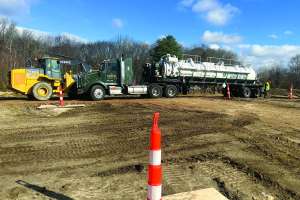
July was the wettest on record with 14 inches of rain. To combat the flooded systems, Holden hired pump trucks that hauled 20,000 to 30,000 gallons per month. The install lasted four months in conditions that tested workers and machinery almost daily. Rainfall for the area totaled 62.59 inches in 2023.
Site conditions
The downgradient ran from System 5 to System 1. Investigations suggest that the galleys were set at grade, then backfilled with 6 feet of miscellaneous fill.
System components
Korth’s design for the complex treats a combined 4,200 gpd.
Buildings 1 and 3 each have:
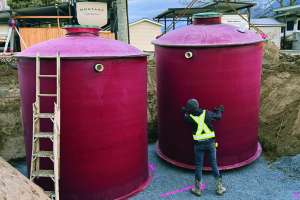
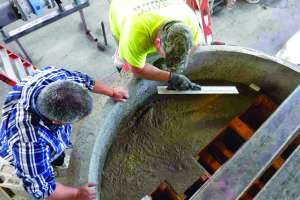
- 1,500-gallon dual-compartment concrete septic tank. Precast tanks from United Concrete Products, Yalesville, Connecticut, with Polylok risers and covers.
- 1,500-gallon concrete pump tank
- 1/2 hp ME50 Simplex pump (Myers) with STF100A2 effluent pressure filter (Sim/Tech Filter)
- 684 square feet of GeoMat 7800 Leaching System (Geomatrix Systems)
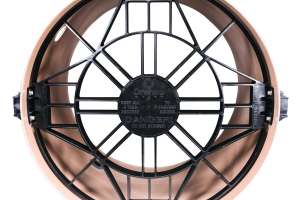
- All systems have SoilAir air diffuser piping and a TDP-S control panel (Geomatrix Systems)
Buildings 2 and 5 each have:
- 2,000-gallon dual-compartment concrete septic tank
- 2,000-gallon concrete pump tank
- 1/2 hp ME50 Simplex pump with STF100A2 effluent pressure filter
- 1,027 square feet of GeoMat 7800
Building 4
- 2,500-gallon dual-compartment concrete septic tank
- 2,500-gallon concrete pump tank
- 3/4 hp ME75 Simplex pump with pressure filter
- 1,369 square feet of GeoMat 7800
System operation
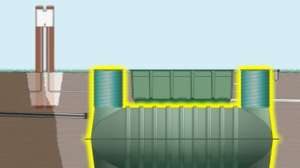
Wastewater from the buildings flows through 4-inch PVC Schedule 40 pipe to the septic tanks. Piping between the tanks and pump tanks is 4-inch SDR 35, as are the 1.50-inch force mains.
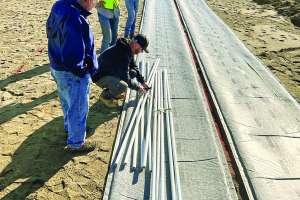
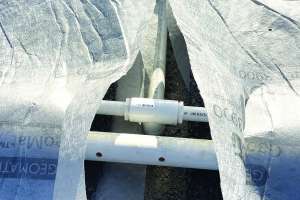
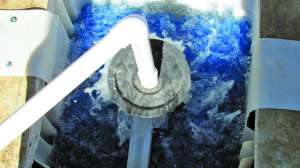
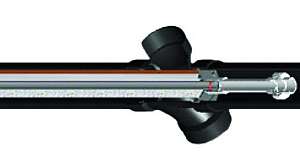
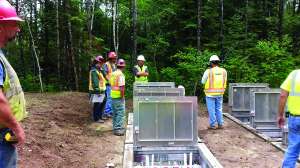
All five drainfields have two parallel trenches, each containing two 39-inch-wide rolls of GeoMat. System 4 has 1.25-inch distribution lines; the remainder have 1-inch lines. Piping is 3 feet on center. The low-profile drainfield has a 1-inch-thick transmissive polymer core surrounded by a hygroscopic membrane bonded to one side of it. On top of the core are the GeoGuard pressure distribution system and SoilAir piping. The membrane’s charge pulls water evenly across the surface to prevent hydraulic overload.
The pumps cycle three to five times per day and run for two minutes. They dose the 58-foot trenches in systems 1 and 3 with 47 gallons, the 87-foot trenches in systems 2 and 5 with 70 gallons, and the 116-foot trenches in System 4 with 94 gallons.
Installation
After Labor Day 2023, Holden hired an underground utility location service to mark the site. They discovered coaxial cables running the length of the work area, but the cable company didn’t reroute them until October.
It was mid-month before Holden’s crew built the temporary gravel access road to behind the buildings. As they stripped and stockpiled the topsoil, effluent bubbled from the galleys and mixed with groundwater. Parker Septic in Somers and Environmental Services in South Windsor pumped the tanks and galleys daily.
“We initially had two 5,000-gallon tankers, but it was difficult for them to enter the job site and they were too heavy to leave the access road,” says Holden. “We switched to 3,000-gallon tankers, but even their versatility was limited because the galleys were in the way and still operational.”
Water, water everywhere
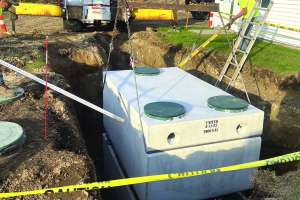
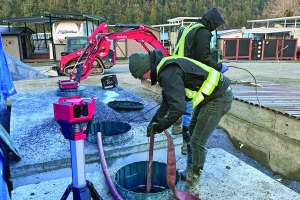
Downpours turned the stockpiled topsoil to mud as the crew excavated for the tanks, working from the deepest (No. 5) to the shallowest system. Water tainted with effluent was bypassed to a live galley, while a 2-inch or a 3-inch electric Wacker pump or both discharged groundwater downstream.
“It wasn’t unusual to bed a hole, leave for the day, dewater it the next morning, and find a deep pile of soil on top of the stone,” says Holden. “The volume of water at 3, 2 and 1 caused the unstable banks to collapse. We kept digging the holes wider and wider and longer and longer and adding more stone until we had beds 12 to 18 inches deep.” Sometimes the pumps ran overnight, powered by a quiet generator. From October through January, they dewatered or pumped 100,000 gallons.
Despite the pumping, the John Deere equipment made holes and dozers extracting stuck tractors left ruts. Holden covered them with plywood sheets. “The rain and groundwater were killing us,” he says.
Sandman cometh
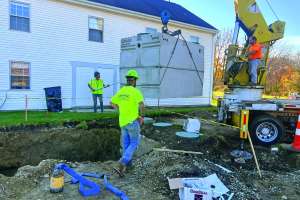
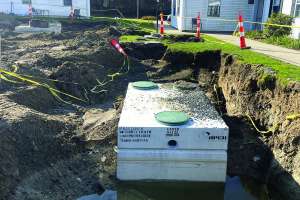
After setting the tanks, the crew tied in the building sewers. Because groundwater seeped into the septic tanks until backfilled, they were pumped weekly or more often when it rained.
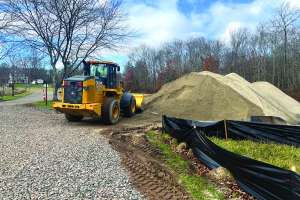
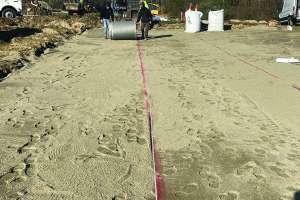
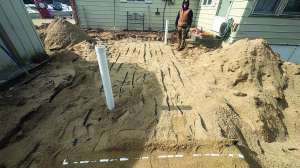
While some workers installed a 6-inch PVC underdrain 5 feet above the head of the new drainfields to control groundwater, others began installing Drainfield 5 in the only expanse without galleys. Holden’s dump trucks hauled sand daily from Windham Materials’ wash plant and stockpiled it on an area off the traffic pad. Two John Deere 624K wheel loaders transported a total 2,000 cubic yards of sand to the prepared leachfields and a John Deere 333 track loader spread it.
“We built the beds in two 11-inch lifts and verified grades with a Topcon rotary laser,” says Holden. “The select fill extended five feet laterally on both sides, 10 feet upgradient, and 25 feet downgradient.”
Meanwhile other workers decommissioned the existing septic tanks, but the galleys remained active. Once they were pumped and removed, the new septic tanks became holding tanks until the replacement of the associated drainfield.
Because this was Holden and Green’s first experience with the leaching system, two company representatives arrived to help train and install Drainfield 5. “The installation went smoothly,” says Holden. “Like everything in excavation, the success of the project depended on diligent prep work.”
The control panels also run the SoilAir systems. “We hooked up the piping and set the parameters so they’re ready to activate if needed,” says Green. Work concluded at the end of January 2024.