Loading rates aren’t determined at the drop of a hat, well at least they shouldn’t be. They should be based on the soil characteristics, wastewater strength and the design configuration.
With single-family home design and septic tank effluent, we focus on the hydraulic loading rate. For any given soil treatment area (STA), the hydraulic loading rate is the quantity of effluent applied to the soil expressed as volume per area per unit time (e.g., gallons per day per square foot). A site with finer texture, poor structure, poor consistency or horizons that restrict water movement should be assigned a lower loading rate. These characteristics will limit the amount of water that can be accepted into the soil, and thus a larger soil treatment area will be needed to accept the wastewater generated at the site.
Wrong approach
One would think there would be a standard way that a loading rate is chosen, but it varies across the country. First, let’s get into how it should not be done, which would be to only look at the soil survey information. The soil survey is an extremely useful tool providing general information about the likely soil you may experience once you get on site, but does not provide the detailed information needed to design an STA.
Many regulatory bodies, including the United States EPA since 2002, use the texture and structure of subsurface soil to determine the loading rate rather than the percolation test or saturated hydraulic conductivity. Accurately determining soil characteristics requires considerable training and experience, and the classifier needs access to the undisturbed soil column that exists under the proposed onsite wastewater treatment system. This often requires excavation of a test pit several feet deep. Many regulatory programs allow infield measurement of infiltrative properties to infer how a soil will hydraulically respond to a soil treatment area.
Perc tests
A percolation test and hydraulic conductivity are both methods used to measure how water moves through soil, but they have different procedures.
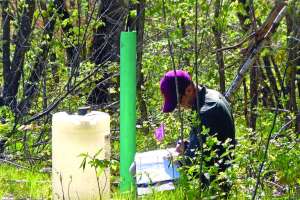
Percolation refers to the downward movement of water in saturated or nearly saturated soil and historically, percolation rate was used to size STA. It is a measure of the rate of movement of wastewater from the dispersal area into the soil. The percolation test, or perc test, was developed in the U.S. in the 1920s as a tool used to help determine the appropriate loading rate for STAs. A perc test observes how quickly a known volume of water dissipates into the soil of a drilled hole of a known size that has been soaked.
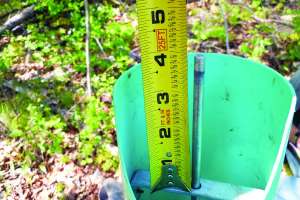
No national standard method for a perc test method exists, so a number of different testing protocols are in use and referenced in different regulations. Even when they were first popularized, perc tests were represented as one small part of the information needed to design an STA. In particular, the perc test does not indicate where the limiting condition is. One of the most important and sometimes overlooked requirements of a representative perc test is to allow the soil to swell. Swelling is when water gets into individual soil particles. This takes time, as soaking occurs for at least 4 or more hours. Perc tests are most commonly performed with a hole 6-8 inches in diameter, although there are some vertical pits done that are 3-4 feet wide. Checking your local regulations is essential to verify the method you are using will conform to the requirements and allow for reproducible results.
Other methods
Some professionals and specific regulations have moved toward utilizing saturated hydraulic conductivity, or Ksat, to assist in sizing STA. Ksat values can be found in the soil survey or other reference documents. The reference values have very wide ranges due to the high variability in soil structure. Therefore, if Ksat is going to be used in the design of an STA the data should be gathered in the field.
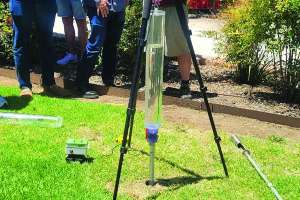
For field tests, there are two common devices commercially available to measure Ksat — the Guelph permeameter or the Amoozemeter. These devices allow a constant head test without the need for a technician to be in constant attendance adding water to maintain the starting elevation. Generally, a 2–4-inch diameter hole is utilized where a set height of water is maintained. Once the infiltration rate reaches a constant, measurements are made. This data is then fed into a model which estimates the Ksat. The big benefits are less water to haul around, a smaller hole and you do not have to soak holes the day before. It does however take experience to set it up correctly and the equipment is more expensive than a percometer which is often built by hand.
Design purposes
For design, if you will be doing percolation or Ksat testing, some considerations apply. If the soil is similar over the property, several (2-3) tests should be run. If the soil changes within the potential area you want to do a few in each of the areas. The goal with these tests is to get reproducible results.
If another professional performs the test, they should be able to get comparable results if they use the same procedure. Even if not required, perc or Ksat tests are useful in providing a better understanding of site impacts such as compaction or fill. The downside with all of these methods is they rely on eye measurements and written notes.
It is important to note that the perc test or Ksat are really just indicators or indexes of how the soil will perform under an operating system with intermittent flows and varying application amounts. If the soil actually accepted sewage at the Ksat or perc rate, the STA would be exceedingly small.
Organic loading is an important aspect ,which is why the biomat formation is crucial to consider when sizing systems as well. The flow from an STA will usually be unsaturated and, depending on the biomat or physical crust development, it will be much slower than our measurements with clean water under saturated conditions. The results from a perc or Ksat test are most helpful in identifying challenging soil conditions. They should be viewed to be verification of the texture, structure, and consistency of the soil versus results used solely to size an STA.