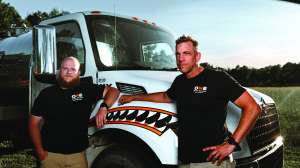
Nick Dykes has gone far in the onsite profession at the tender age of 34. For that he credits his grandfather, his father, and a few key players in the Missouri onsite community.
Already other installers can justly call him a mentor: He’s one of his state’s leading advocates for and instructors to people learning the trade. He teaches training and accreditation courses for the Missouri Smallflows Organization, of which he is president, and speaks at industry conferences in his own and other states.
“I’m really passionate about the industry,” says Dykes, of Dykes Construction based in Lawson, 30 minutes northeast of Kansas City. “I really enjoy helping grow our state organization. Installers everywhere are only as strong as the weakest one in their area. If you have one person out there doing horrible work and taking advantage of people, what does that do to the onsite wastewater profession? It tarnishes everyone.
“I enjoy speaking to people. I always get a good response. I feel like if more installers would find the courage to speak in front of groups and share their day to day life and their knowledge, it would be a great asset to our industry.”
Three going on four
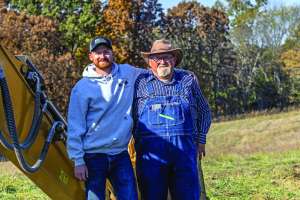
Dykes represents a third-generation business, and already his 9-year-old son Riley lends a hand on jobs. The late James Dykes founded the company in 1966 doing general excavation. “It was a lot different back then,” Nick Dykes says. “I was born on the outskirts of Kansas City where everything was large farm fields. Mostly it was earth work involving ponds and terraces.”
Nick’s father Scott Dykes, now the owner, joined the business in the early 1990s. Around that time, Missouri began developing onsite treatment codes, creating a need for qualified installers: “That was when they made the switch and started doing onsite.”
James Dykes died suddenly four years ago. “At that point he was in his 70s, and he was still active,” says Nick Dykes. “He wasn’t on job sites pushing dirt or laying pipe, but he did lots of book work, or if we had a ditch to be backfilled he would be there. It was a neat experience for me to work with all three generations.”
As for his father, “They don’t make many men like him,” Dykes says. “He is just a go-getting son of a gun. He’s incredibly witty and smart. I can’t say enough good words about him. My granddad was the same way. I’ve been blessed with the people who brought me up and the work ethic, values and virtues they gave me.”
Dykes joined the company in 2011 after previous jobs helping to start up and manage a rock quarry, and working briefly at Ford Motor Company. “My dad and granddad didn’t want me to get involved in the business right out of the gate,” he says. “They wanted me to have some kind of other experience.”
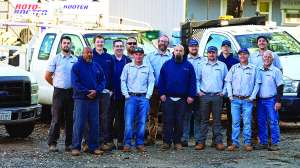
These days Nick Dykes functions as an operations manager and does the company’s bookkeeping. His father spends most of his time bidding jobs, applying for permits and meeting with customers. The rest of the Dykes Construction team consists of Cameron Huett, lead onsite wastewater field specialist, Kyle Arnold, equipment operator and driver, Nathan Mullins and Isaiah Mullins, trench and field professionals, Marilyn Dykes, secretary, and rounding out the residential sewage treatment system team are his two nephews, Kessler and Kooper Willimetz and his son Reiley.
Challenging soils
The company installs alternative systems almost exclusively because site conditions are challenging. “We are in the last quadrant of around Kansas City that is not suburban and super developed,” Dykes says.
“In the last 10 years the urban sprawl in our area, and our growth rate, have dramatically taken off. The soil is so bad that it’s not economically possible to run sewer to most of these places. The lots being developed are just big enough to not justify clusters, so almost everything is on individual onsite systems.”
Heavy 4B clay is common, sometimes as shallow as 10 inches. Dense frangipan subsurface soils are widespread, as are shallow bedrock and high water tables. “Our primary county is Clay County – that’s how much clay is in the soil,” Dykes says. “If you drive one hour south below the Missouri River, the soil is completely different.”
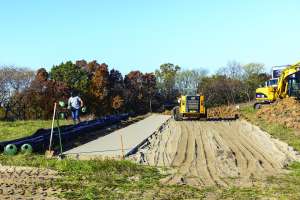
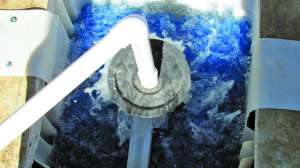
The company installs mainly drip distribution systems, sand mounds and evaporation ponds. These make it possible to develop land once considered unbuildable. The drip systems include pretreatment with Jet or Norweco aerobic units, Geoflow drip tubing and Sta-Rite high-head pumps (Pentair).
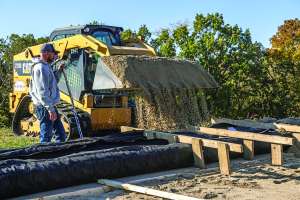
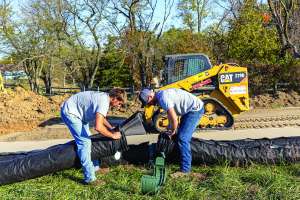
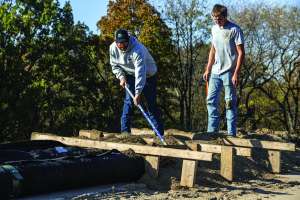
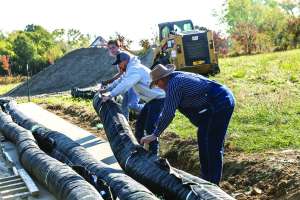
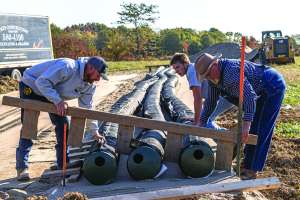
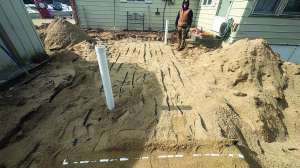
Sand mounds use the Advanced Enviro-Septic system (Infiltrator Water Technologies). The media consists of pipe sections 12 inches in diameter and 10 feet long, wrapped in a fabric that promotes development of a treatment biomat.
Building ponds
Evaporation ponds are essentially a solution of last resort. They are built mostly for single-family homes. The state code requires 400 square feet of water surface area per bedroom. “We’ve done ponds for up to 2,000-square-foot, five-bedroom homes,” Dykes says. “Those things from the edge of the toe on the slopes are 100 by 100 feet.”
Septic tank effluent sent to the ponds is pretreated with an ATU. Typical water depth is three to five feet. “It’s wild to watch them work,” Dykes says. “You can see the sun and wind hit them in summer, and if we don’t get rain for a long time they will draw down a whole bunch. Then if we have a wet spring, they’ll only have a foot of freeboard on top.”
Disinfection for the water is not required, but the ponds must be surrounded by child- and animalproof fencing, and the minimum setback from property lines is 100 feet, 10 times greater than for conventional or other alternative systems.
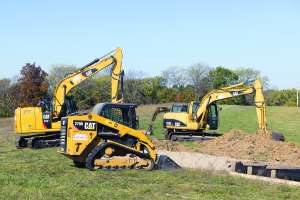
To dig the ponds and for other earth work the company’s workhorse machines include:
- 2023 Cat 313F L excavator
- 2017 Cat 316E L excavator
- 2008 Cat 312C with Kent hydraulic breaker
- 2022 Cat 304 E2CR mini-excavator
- 2017 Cat 304E mini-excavator
- Cat 279D, 277D and 299D3 skid-steers
- Vermeer RT45 vibratory plow
Dykes Construction also owns a vacuum truck, a Mack Granite truck with 3,200-gallon tank and Masport pump used mainly for the company’s own purposes, such as pumping for septic tank replacements or time-of-sale system inspections.
Getting it done
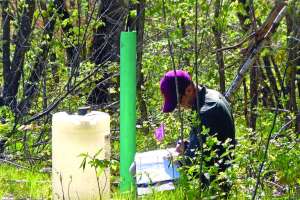
Most of the company’s leads come by word of mouth and referrals. Work on any given site begins with a soil morphology sample analyzed by Chris Nothstine from Tall Guy Soils. The results dictate the type of system to be installed. Then the customer receives an estimate and gives the go-ahead for the project.
Some 75-80% of systems require design by a professional engineer; for that, Dykes relies on Nothstine as well. The plans and soil test results are then submitted to the county health department for permitting; turnaround takes about six weeks. The entire process from the first contact with the customer to permit approval is typically about 90 days.
Along the way, Dykes and his father take pains to inform customers about the system they will live with. Nick Dykes observes, “You can talk to homeowners before you put in a system, while you put in a system, after you put in a system. You can talk until you’re blue in the face and five out of 10 times they won’t listen to you. But for the ones who hear you out and take time to learn about the system and the importance of maintenance, it makes all the difference in the world.
“The big thing is just to let them know what they’ve got. There are so many options out there. We make sure they understand what maintenance has to be done and why that service contract is important. I tell homeowners: This is an investment just like a vehicle. If you don’t do the maintenance and change the oil in your car, what’s going to happen? Bad things. It’s the same with your onsite system. You put a lot of money into it. You need to take care of it.”
On the circuit
The workload slows down between Christmas and the beginning of March, which is when Dykes does most of his training and speaking. Dykes is dedicated to the Missouri Smallflows Organization and how it promotes professionalism. He credits Tammy Tranthan, executive director, for her inspiration and leadership.
“The industry we work in is so important,” he says. “Even some people in the field don’t realize how vital it is to our future. There was a time when I was a kid when people could run a pipeline to daylight and get away with it. The idea of sewage hitting the ditches on our county roads, and then our streams, kind of makes me sick.
“I grew up in this industry. I watched it grow and change dramatically, from when it was one good-old boy and a backhoe and his best buddy, to what we have today, where we have codes and we have good systems. I think of myself and my family as trusted servants to our communities. We help them with their problems.
“We want people to know that onsite works. It successfully removes pathogens before they get back to our drinking water. It can be a long-term solution. We can protect the water by providing systems that last the lifetime of a home.”
Among his MSO mentors, he counts Tom Fritts, owner of Residential Sewage Treatment Company, which handles maintenance on most of the systems Dykes Construction installs: “He is one of my father’s really good friends and has always been a second mentor to me. He always kind of pushed me. He encouraged me to start speaking to people about onsite and sharing the things I’ve learned.”
That sharing includes teaching a wide array of basic and advanced onsite courses. It also includes keynote addresses for industry conferences. “Probably the favorite keynote topic I’ve given was in North Dakota, in Minnesota, and at NOWRA in 2023. It’s called ‘Onsite Wastewater Treatment Systems: Looking Back and Moving Forward.’
“I do a lot of one-hour general courses, like let’s talk about drips for an hour, or replacement systems for an hour, or let’s talk about where our code is right now. When I get up there and share, I’ve been right where the folks in the audience have been the whole year, with my hands dirty and boots on the ground. They respect that.”
Success secret
Dykes is grateful to Sara Heger of the University of Minnesota onsite program: “I met Sara three years ago. She has helped me grow with my educating and speaking. She calls herself my agent because she will message me late at night and say, ‘Would you like to speak at whatever show?’”
As for keys to prosperity in the business: “If you want to stay busy and have tons of work, all you have to do is be good people, do what you say you’re going to do, do it right the first time, and be honest and fair. If you can do those things, you’re going to have way more work than you ever dreamed of.”