It takes dedication and foresight to build a business that spans four generations and continues to reach for the future. For owner John Hack II, continuing to grow the business requires a steady hand and respect for the hardworking tradition set by his grandfather and father before him.
Hack’s grandfather, Joe, established the company in 1969, the year he was born. “My grandfather bought one of the first Bobcats in the area,” he says. “Nobody really knew what they could do. He bought one that had a backhoe attachment so he could dig with it, then take it off and move soil and gravel around.”
Following college, John’s father, the first John Hack, was drafted into the Army. After completing his military service he joined the business in 1974, bringing along his own Bobcat. While the business provided general excavation services, septic system installation was offered from the start. Hack’s father was known to install an entire septic system by himself and at the time, septic tanks could be bought for $90.
“My grandpa retired in the early ’80s and then Dad took over, supported by part-time help,” Hack says.
He recalls getting on a Bobcat at a young age working for his father through school. While earning his degree in civil engineering from Purdue University, he told his father that he wanted to start his career at Hack Excavating. He joined the company full time in 1991.
At that time the company specialized in residential and farm construction, primarily foundations, driveways, farm drainage and septic systems. Father and son worked mostly on their own, supported by Hack’s mother, Jennie, who ran the office. He installed his first septic system at age 22.
“Once I got out of college, my dad asked me to take over the design of the septic systems,” he recalls. “Prior to that it was just a simple sketch that was required, but it got more detailed, so it required more of an engineering eye.”
Taking the reins
Hack gradually became part owner of the business in the mid-1990s. He and his wife, Stacey, who also holds a civil engineering degree from Purdue, became full owners of the business in 2023.
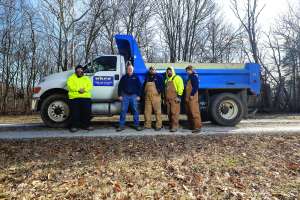
Today, the company employs five people full time and three to five part time. Hack’s father, now 77, continues to operate equipment and provide helpful advice. Hack’s mother Jennie has gradually stepped back and retired as Stacey takes a more active role.
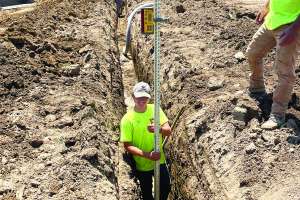
The scope of the work has broadened to include site development work, utility work, drainage work, erosion control and demolition. Septic installs can be seasonal because the soil is too wet for part of the year, so the full range of services keeps the contractor busy.
What’s going in
The service area, about a 30-mile radius from home base, already contains more than 20,000 septic systems, with more required to support new construction.
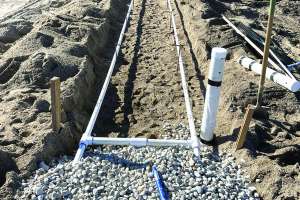
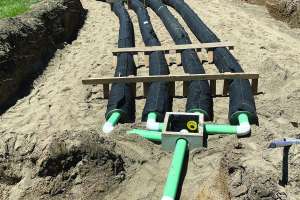
“When we started off, we just had stone and pipe systems,” Hack says. “Then we got into septic chambers, sand mounds, drip irrigation and sand-lined systems. I figure I have personally worked on over 1,000 septic systems.”
Lot sizes for new construction outside of metropolitan areas must be no smaller than 1 acre, in part to accommodate room for appropriately sized septic systems. However, homes are getting bigger both in urban and rural areas, leading to greater use of systems provided by Infiltrator Water Technologies.
“Some of the older subdivisions have lots of one-third of an acre, so it can be pretty challenging to design a replacement septic system,” Hack says. “We have to get very creative sometimes and it’s helpful to have lots of options with different types of systems.”
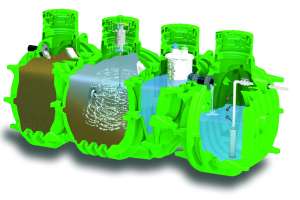
Hack Excavation prefers to use concrete tanks. “They’re quick and easy to install,” Hack says. “If the tank needs to be uncovered down the road, you can scratch the top of a concrete tank a little bit with a backhoe, but if you scratch the top of a plastic tank, you got a big problem.”
The company installs both residential and commercial systems, but tends to leave the design of commercial systems to specialists who can provide the detailed drawings required by state regulators.
Past commercial onsite wastewater projects include hog facilities, a popcorn plant, an amusement center, a dog kennel and even septic systems used by students at Purdue University farm research facilities.
The company sources tanks from Carter Septic Tank Inc. of Monticello and Rensselaer Septic Tank of Rensselaer. Leachfield chambers are by Infiltrator Water Technologies. Risers and lids are from TUF-TITE and outlet filters are by Polylok. Pumps are Little Giant from Franklin Electric. Lift Stations are built on site using various components or ordered complete from Rensselaer.
Equipment round-up
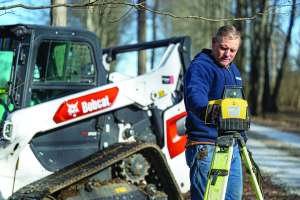
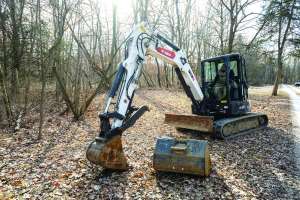
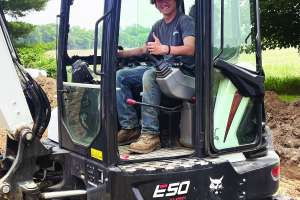
Hack Excavating still loves Bobcats and operates three of their track loaders, a 2019 T650, a 2021 S76 and a 2022 T76. Excavators include a 2013 Caterpillar 316E and a 2022 Bobcat E50, backed up by a 2004 Caterpillar D5 dozer and a 2013 John Deere 310SK backhoe. Dump trucks include a 2012 Ford F750, a 2015 Ford F550, a 2007 Sterling LT9 and a 2021 Kenworth T880. A 2019 Ford F550 service truck rounds out the fleet.
Lasting relationships
Surprisingly, many of the business relationships supporting the company have lasted as long as Hack Excavation has been operating. The company still does business with the third generation at Bobcat of Lafayette, which sold them their first Bobcat. Carter Septic Tank has been in business since 1953.
Even the septic system inspector for Tippecanoe County has worked with every generation of Hack’s family, including his sons.
“Ron Noles retired last year,” Hack says. “For 50 years he inspected septic systems in our county. He was a good inspector and he was tough, but easy to work with.”
Finding and keeping good employees remains a big challenge for the business. Hack follows a modified version of the advice offered by Warren Buffet when looking for new employees: “You’re looking for three things, generally, in a person — intelligence, energy and integrity. And if they don’t have the last one, don’t even bother with the first two.”
“Once hired, we try to take care of them as best we can,” Hack says. “Pay them well, give them the benefits they need and if they need time off for family or personal reasons, they get it. We still have a good amount of turnover, but one of our guys has been here for more than 20 years and another for almost 10.”
With the Water & Wastewater Equipment, Treatment & Transport (WWETT) Show held in nearby Indianapolis, Hack attends most years, taking new employees along for the experience.
“To have this available for us locally is something we definitely take advantage of,” he says.
Not done yet
Hack is now 55 and works a busy week, arriving at the shop at 7 a.m., assessing plans, loading equipment and materials and often accompanying crews on various projects.
“If the weather’s good, we’ll work a 10-hour day on the job site,” he says. “We try to finish the job, or get to a good safe stopping point. I then head back to the shop to close up or I meet with clients about potential projects on the way. I then go home, talk to my wife about paperwork and plan out the jobs for the next day.”
However, he still finds time to volunteer with associations including the Indiana Onsite Wastewater Professionals Association.
Plans for the next 10 years include conservative growth — more people, more equipment and more services, while maintaining quality, safety and profitability.
“I would rather stay small and check all of those boxes than to get too big,” Hack says.
While he has no official succession plan, there are plenty of potential candidates who may become part of the next generation of the business.
He has seven children aged 15 to 28 and all of them have worked with the business in some capacity. From oldest to youngest, they’re Logan, Conner, Julia, Lauren, Olivia, Jacob and Owen. Both Olivia and Jacob are following in their parents’ footsteps, working toward degrees in construction management at Purdue.
Hack sees himself continuing to work for the business past typical retirement age.
“I think I’ll be like my father,” he says. “I enjoy operating the equipment and I won’t be out there because I have to, but because I love what I do.”