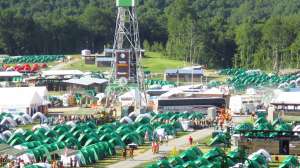
Aerial view of Kowaliga Marina looking north. Kowaliga Restaurant is located on the northern tip of the facility. (Photos provided by Dale’s Septic Service)

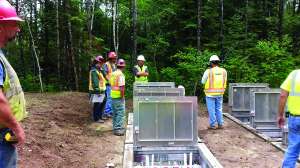
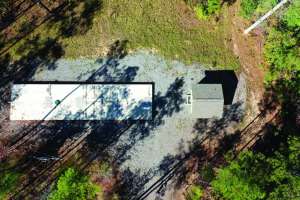
Aerial view of the treatment system installation and control room.

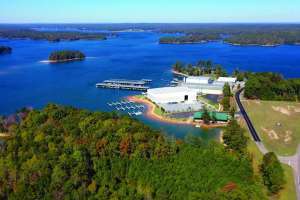
Aerial view of Kowaliga Marina looking north. Kowaliga Restaurant is located on the northern tip of the facility. (Photos provided by Dale’s Septic Service)
Aerial view of the treatment system installation and control room.
At almost 100 years old, Lake Martin is an engineered lake offering 750 miles of shoreline, punctuated by campgrounds, marinas, golf courses, waterfront neighborhoods and luxury homes.
One of the largest landowners in the area is Russell Lands, which operates four marinas on the lake, in addition to developing luxury homes and neighborhoods along the shoreline.
In 2021, Russell Lands sought a contractor to replace and expand its traditional septic system, serving its Kowaliga Marina, the largest marina on the lake. The marina, located in Alexander City, includes six boat storage warehouse, 700 dry stack spaces, more than 100 covered wet slips, boat sales and service and gas docks. In addition, the facility includes the busy waterfront Kowaliga Restaurant, an area landmark and a dozen luxury homes.
Dale’s Septic Service of Eclectic, Alabama, is owned by Dale Mask. The business was established in 1990 when Mask sought a change of pace after working 18 years as a drill superintendent in the state’s oil and gas industry, often spending weeks away from home.
“I tell folks I went from pumping water out of the ground to pumping water back in the ground,” he says.
The business employs 15 people, including Mask’s wife Sharon, his son Tony, his grandson Michael Walls, and his daughter-in-law Kayla Mask. The company offers septic system service, installation and repair for commercial and residential applications.
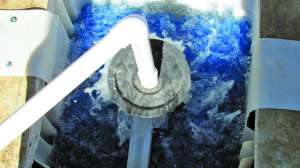
Dale Mask works primarily on projects around Lake Martin, often installing advanced treatment units to meet local environmental requirements. His company tends to use products from Infiltrator Water Technologies, often Infiltrator’s ECOPOD units, which pump additional oxygen into the wastewater and leverage a fixed-film wastewater treatment system.
In 2008, Mask installed Alabama’s first ECOPOD, an 8,000 gpd system, at Children’s Harbor, a support facility for seriously ill children and their families. The facility is located just across the road from Kowaliga Marina.
“Children’s Harbor was a bit of a learning experience for us and it has served the facility well,” Mask says. “Since the original installation, we’ve added a 15,000-gallon dosing tank for huge events. After 17 years, we’ve made a few adjustments, and had to change out only one dosing pump. The original blowers are still here and it’s done an excellent job as far as treatment goes.”
Mask has worked with Russell Lands on several occasions, always installing ECOPODs, according to client requests.
“They know they work and they’re easy to operate and to maintain over time,” Mask says.
The client required Mask to decommission the traditional septic system already installed on the property and replace it with a new system which would serve the restaurant, the new boat showroom and the dozen new luxury homes on the property.
A flowmeter study of the restaurant alone recorded production of 3,500 to 4,000 gpd of wastewater.
“Restaurants are probably the hardest things to incorporate into a septic system,” Mask says. “In our experience, ECOPODs do an excellent job with processing grease.”
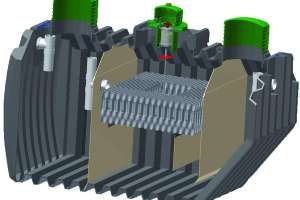
The new system, designed by Larry E. Speaks & Associates of Montgomery, Alabama, specified two model E600 ECOPODs, each offering treatment volumes of 6,000 gpd, for a total capacity of 12,000 gpd. The system also incorporates a pair of Gardner Denver duplex blowers.
“One tip for installing these systems is that we always place a window air conditioner in the duplex blower rooms,” Mask says. “Blowers produce heat, and if you keep the temperature down, we find it doubles the life of the blowers.”
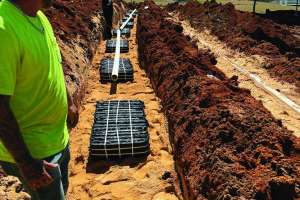
Wastewater from the facility is conveyed to the treatment system through 4,800 feet of 6-inch schedule 40 PVC pipe.
The pipe trench was approximately 36 inches deep and 2 feet wide and followed the shoulder of Kowaliga Road, which provides access to the marina. Dale’s Septic Service owns a fleet of excavation equipment, but contracted Ballard Construction of of Alexander City, Alabama to excavate the trench.
“The land is relatively flat, so we don’t have a whole lot of gravity here,” Mask says. “We installed a set of Myers (Pentair) duplex 3 hp effluent pumps to get the wastewater to the treatment area.”
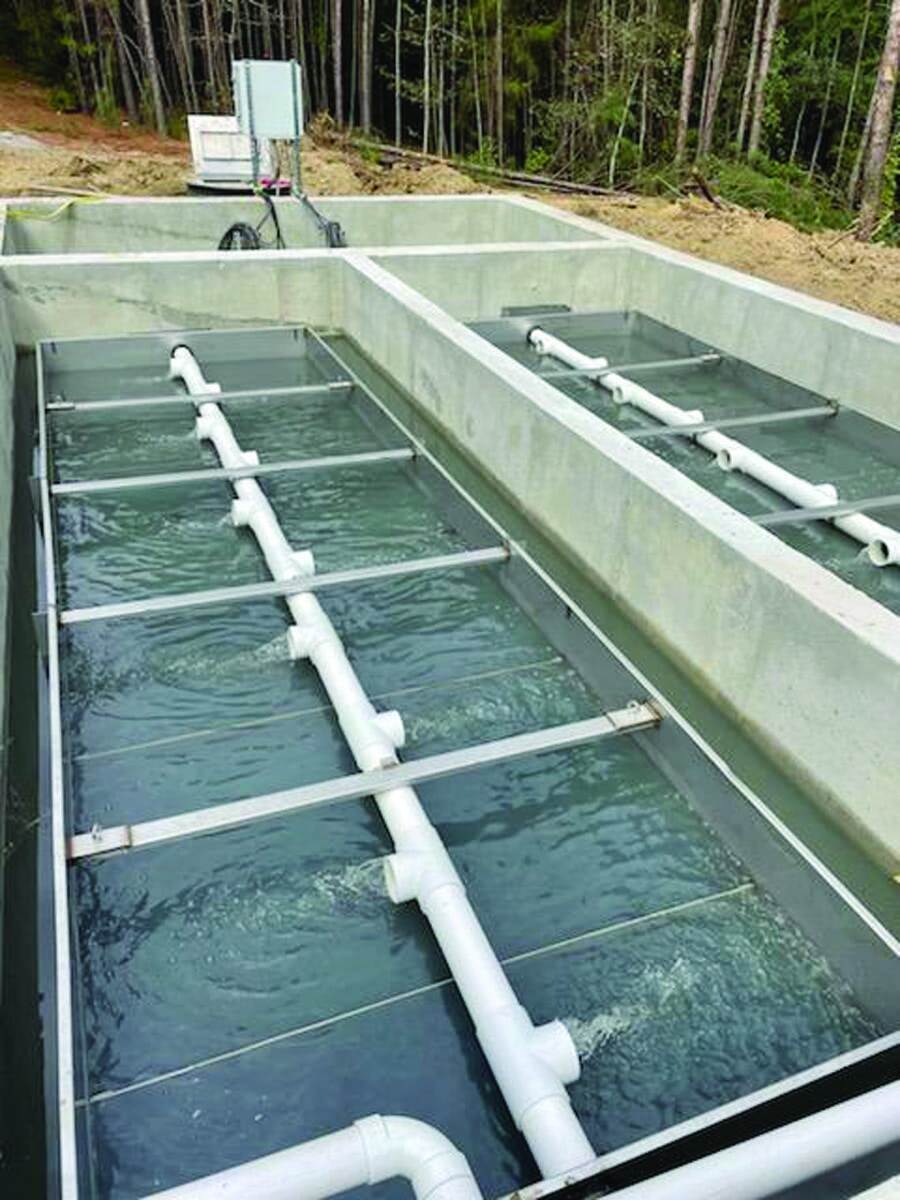
Ballard also constructed a poured-in-place concrete holding and treatment tank totaling 35,316 gallons. The tank is built with 8-inch walls and measures 8 feet deep with 2 feet above ground.
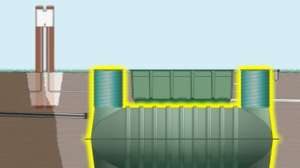
“The tank is divided into four sections,” Mask says. “The first section is the surge tank that we pump wastewater into — about 8,000 gpd.”
From the surge tank, wastewater is time-dosed and conveyed via a duplex 1/2 hp EQ Liberty pump into the second and third sections, which are parallel. The ECOPODs are suspended in the wastewater of each tank in a stainless steel rack. The treated wastewater is then conveyed into the final chamber, where it is pumped into the disposal field using a duplex 1/2 hp Liberty discharge pump.
The disposal bed is composed of five zones, each 6 feet wide and totaling 2,500 linear feet. The beds consist of 26 inches of gravel on top of 12 inches of rock.
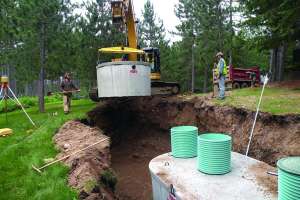
Dale’s Septic required as many as four crew members to install the treatment facility equipment and six people to install the disposal bed. The crew worked on the disposal field at the same time as the tanks were being poured, allowing the entire installation to be completed on a one-month schedule.
After four years, the septic system is still going strong with no major repairs required.
“All our operators love the system because it’s so simple to operate,” Mask says. “Everything is accessible from the deck and there are no moving parts. You might have to skim off the tanks once in a while, but you only have to pump out the sludge every six to eight years. So far, we’re seeing five to 10 BOD and TSS sampled monthly, which is outstanding, considering our regulatory limits are 30/30.”
At age 73, Mask is still in the business, though he’s considering stepping back a little from day-to-day operations following two large Infiltrator projects in northeast Alabama. The contractor will be installing a 60,000 gpd ECOPOD system in the town of Geraldine and a 45,000 gpd ECOPOD system in the town of Section.
However, Mask has taught sessions of the basic installer class at the University of West Alabama for students intending to be licensed by the Alabama Onsite Wastewater Board for the past 24 years.
“I don’t intend to give that up any time soon,” he says. “My job is to teach these guys how to put conventional residential septic systems in the ground and I love to do it.”
Continue reading for free