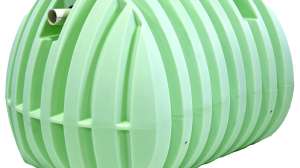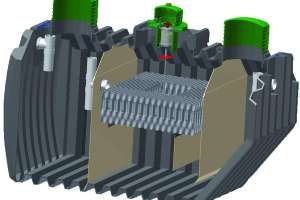

The septic tank is probably the single most important treatment unit in residential septic systems as it accomplishes approximately 50% of the ultimate treatment and up to 80% removal of solids.
Without this treatment, the discharge of residential wastewater to downstream components can overload and cause premature failure. The septic tank treats wastewater through physical, chemical and biological processes and this article will focus on the physical treatment.
Physical treatment
Flow attenuation occurs when higher velocities come into a tank that are then somewhat dampened by the septic tank. Even with that, there is still the risk that high velocities can disrupt settling. To truly spread-out peaks flow, equalization is needed but does not commonly occur before the septic tank.
Septic tanks allow for temperature cooling. This is a positive for grease traps designed to accommodate the fat, oil and grease that would be solid at room temperature to solidify in the scum layer, but a negative as soil temperatures (particularly in cold climates) are below optimum for bacteria.
Septic tanks also allow for solids waste which should not be introduced to be retained. Obviously, waste suited for the garbage should not enter our systems, but it still must be accounted for in design and management.
As wastewater enters the septic tank, the velocity of flow is reduced providing relatively quiescent conditions. This allows portions of the suspended solids to settle to the bottom, provides storage space and permits grease and other floatables to rise to the surface and be retained.
The septic tank is a gravitational settling device that provides a space for sedimentation and flotation to take place. Thus, the primary purpose of the septic tank is to provide relatively idle conditions to allow settleable solids to sink to the bottom and accumulate and floatable solids to rise to the top and accumulate.
The settling is described by Stokes Law where the velocity of settling of grease globules or other solids in the wastewater will rise, fall or remain suspended in the tank depending on their size, density and density of the surrounding wastewater. In general, the larger the solids, the faster the rate of separation.
Wastewater that has been physically or chemically emulsified will not behave in a similar manner. An example of this would be to compare an oil-and-vinegar dressing that you have to shake before using versus a ranch dressing that does not separate because it has been chemically emulsified. Emulsified solids tend to stay in suspension and not settle or float.
Capacity requirements
Effective treatment is dependent upon the amount of time effluent remains in the septic tank. Detention time is a measure of the time it takes for the wastewater to get from the inlet to the outlet of the tank. It is calculated by dividing the tank volume by the daily flow. This is not completely accurate though as the actual retention time is impacted by the flow rate, size of the tank, design of the tank and sludge/scum storage.
The required size for the septic tank is commonly based on the number of bedrooms in the residence which predicts maximum occupancy. Generally, the regulations specify the minimum size of a tank based on 48-hour retention time before any sludge or scum accumulation. The sizing of septic tanks should always be based on peak versus average flows. There are thoughts with decreasing water usage that septic tank capacities should decrease as well. The challenge with decreasing water usage is that the concentration of solids and other contaminants is rising, therefore the septic tank capacity is not recommended to be reduced.
Common minimum septic tank volumes
- One or two bedrooms, 1,000 gallons
- Three bedrooms, 1,500 gallons
- Four bedrooms, 2,000 gallons
Keep in mind that state codes are minimums and do not always consider habits in the home which impact the amount and size of particles. When homes have garbage disposals, they are introducing food waste, which is much smaller in size and therefore more difficult to settle. Grinder or ejector pumps moving the waste into the septic tank also tend to reduce the particle size and may introduce the waste at a higher velocity. These are examples of times a designer should consider increasing the septic tank size even if the regulations do not require it.
Clear water additions via a sump pump, downspout, foundation drain, condensate line or infiltration of surface water through a leaking pipe, pipe penetration or access riser/tank seam increases flow beyond design capacity and reduces detention time and should not enter the septic tank or system. When retention times are maximized, you should have a slow velocity and limit turbulence and therefore use as much of the tank as possible for settling.
For nonresidential and commercial applications, the wastewater flow is subject to wide fluctuations with time. For existing facilities, it is best to obtain flow data over a time period of peak usage to size the septic tanks and downstream components. In the absence of actual flow data, most regulations have tables to estimate peak flows. Commonly, two to four times the estimated peak design flow is required or recommended.
If wastewater is recirculated from an advanced treatment device back to a treatment tank, the increased hydraulic load and reduced hydraulic detention time must be addressed in tank sizing. An additional 50% can help in these conditions.
Maintenance
To sustain retention times it is critical that maintenance occurs before the sludge and scum levels impact the settling. As sludge and scum increase, the zone for settling decreases. The exact depth will vary based on the design of the tank but typically pumping is needed when the tank is 25-33% full. This is best determined by using a sludge/scum measuring device.
Continue reading for free