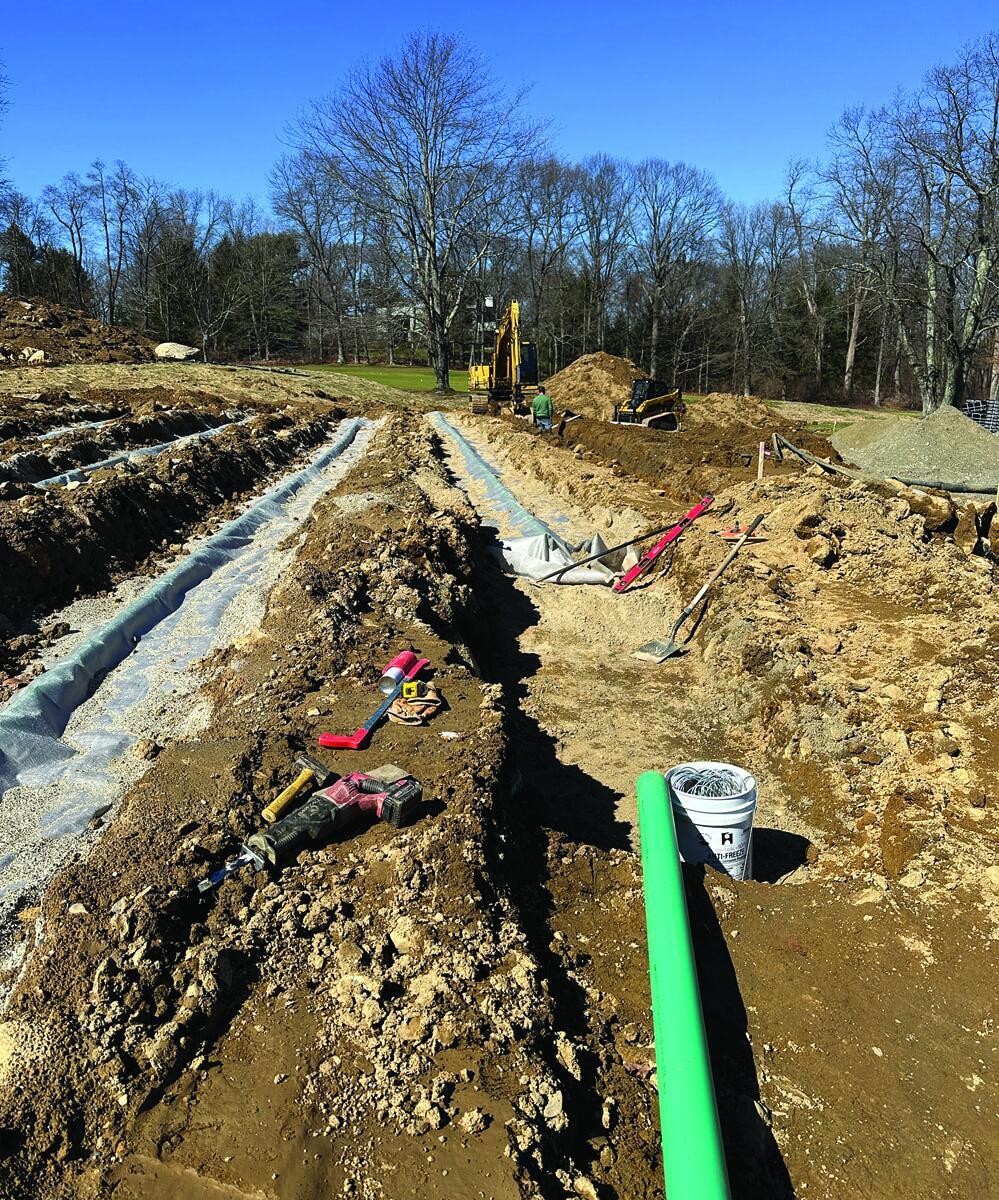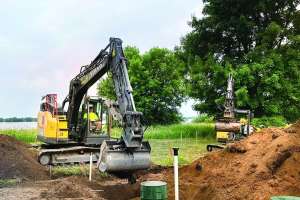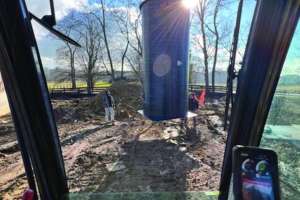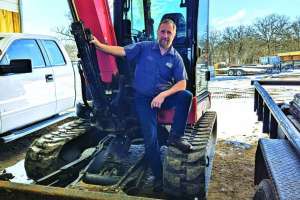
Rich Cordone digs a gravity sewer trench using the Caterpillar 312B excavator. (Photos provided by Pecord Excavating)


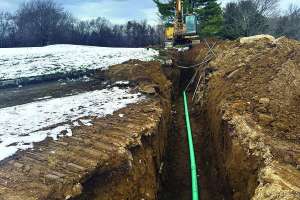
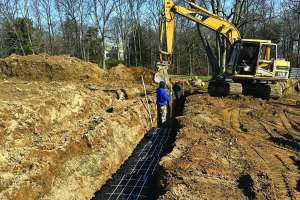
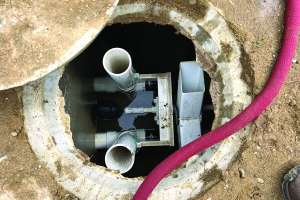
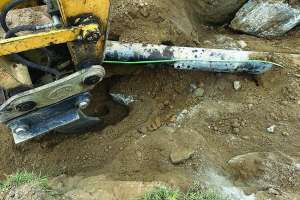
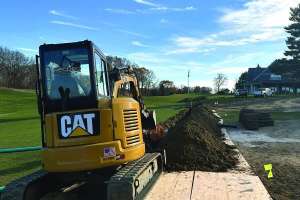
Rich Cordone digs a gravity sewer trench using the Caterpillar 312B excavator. (Photos provided by Pecord Excavating)
The two-zone drainfield at a private country club in Armonk, New York, was raising eyebrows. Instead of the maintenance staff switching the active zone every six months, the rotation was down to every other month due to the biomat level in the galleys. In December 2023, management approached JMC Planning and Engineering in Armonk and Pecord Excavating in Yorktown Heights to design a solution before members had sewage water all over their golf cleats.
“This was our third project with the club and it’s the largest septic system we’ve installed to date,” says Rich Cordone, P.E., and Pecord’s project manager. “The client wanted minimal disruption to the fairways and an environmentally friendly system.”
Designing the system presented multiple challenges. For example, the area is in the New York City Watershed east of the Hudson River and code specified only conventional stone-and-pipe systems that, in this case, would total almost 5,000 square feet. The code also mandated a second identical field.
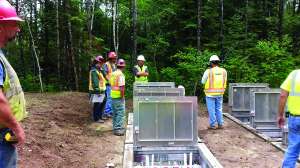
After a surveyor mapped the watershed’s exact boundaries, Cordone found a site 50 to 60 feet from it in the rough for a 1,656-square-foot field of Eljen Corporation modules. “It was a tight fit even with the reduced footprint,” he says.
The site’s 10% slope enabled Cordone to design a gravity system, which brought the next challenge. Because of the system’s size, the county health department wanted effluent pumped to three zones. Cordone negotiated with officials to flood two zones using a dual alternating flout.
“The mechanical flout operates without electricity, makes dosing simpler and is one less moving part to fail,” he says. Officials approved the design 10 months later. Despite more obstacles, the install finished ahead of the April 16, 2025, deadline.
Soils are light brown sandy silt with cobbles and a loading rate of 0.6 gpd per square foot. The club occupies one of the highest points in the area.
Cordone designed the system to handle 5,961 gpd. Major components are:
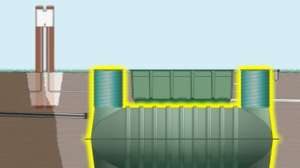
Kitchen waste flows to a 2,500-gallon precast grease trap, then combines with wastewater in two 3,000-gallon dual-compartment septic tanks set in series.
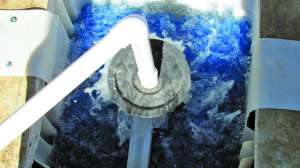
A 4-inch SDR-35 PVC pipe from the Bull Run valve carries effluent 1,200 feet via gravity to a dual alternating flout. The flout sends 355-gallon doses via a 4-inch pipe to two dedicated distribution boxes, each feeding a zone with nine 92-foot-long rows and 23 modules per trench.
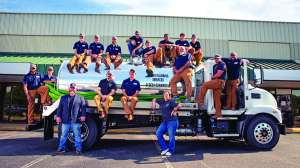
The company’s Caterpillar equipment — a 312B excavator, 304E2 mini-excavator and a 259D compact track loader — rolled on site on Nov. 18, 2024. Peter Cordone, Rich’s father and Pecord’s president, supervised laborers Jon Koller and Chuck Lowden.
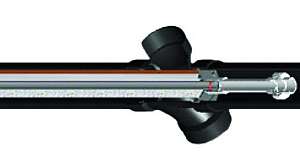
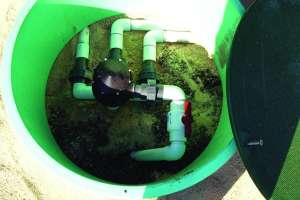
Since the clubhouse remained open all year, Peter Cordone had the septic tanks pumped, then installed a three-way Bull Run valve in the sewer pipe with the riser tube at grade. Turning a standard water key alternates the flow between drainfields.
“The valve had been sitting on a shelf since we bought it at a trade show years ago,” he says. “Suddenly here was the perfect application, so we didn’t have to rip up the area in front of the clubhouse in spring.” With the valve components and piping assembled previously, the installation took only 20 minutes.
Meanwhile, the team laid plywood and matts to protect fairways as they trenched across them with 1,200 feet of 4-inch pipe. To achieve gravity flow at this distance, Cordone used a Topcon Positioning Systems RL-H5A rotating laser to maintain a minimum 1% slope, but the fates weren’t cooperating.
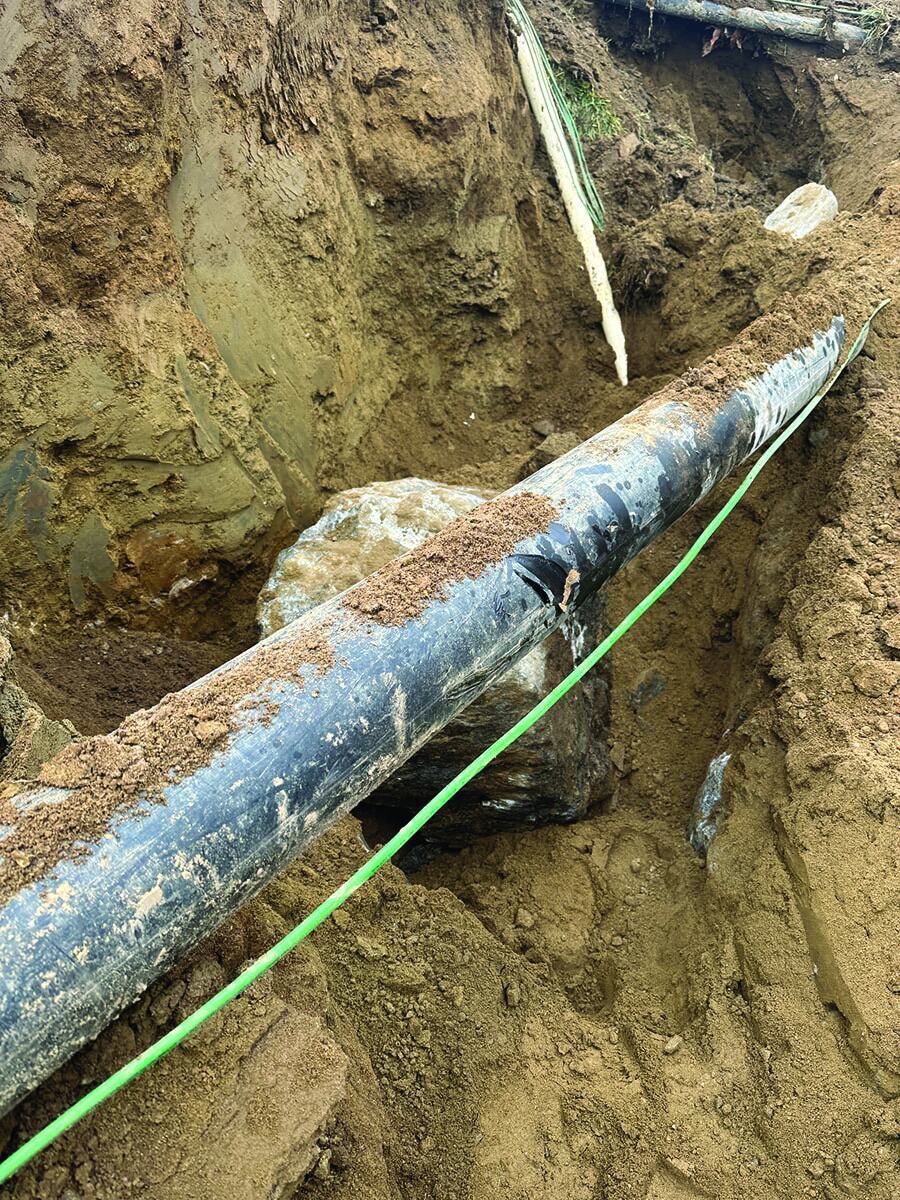
“The area has a lot of ledge rock and every time we hit it, it was directly beneath an 8-inch irrigation main,” says Cordone. “We also killed our old rock hammer.” He replaced it with a 1,000-pound Rockblaster hammer (Heatherdell RB Hammers).
The temperature dropped below freezing and light snow fell. Trenching continued until the team could no longer backfill because the soil came out in frozen chunks. Work ceased in mid-December. “We had a long, cold winter with little snow and a late spring thaw,” says Cordone. “It was mid-March before we returned and hit it hard.
The road to the field came down a hill with the staging area at the bottom. “We worked closely with Carmel Winwater, our supplier, so deliveries of sand, pipes and modules arrived as needed and didn’t encroach on the fairway, which was 6 to 8 inches away,” says Cordone.
State code specified 5 feet of usable soil from the bottom of the system to the impervious area, and the system’s base conditions required a 7-foot-deep hole. “We fell just short of the required separation, so we covered the plateau with 6 inches of bank run sand and gravel,” says Cordone. “That was more than adequate.”
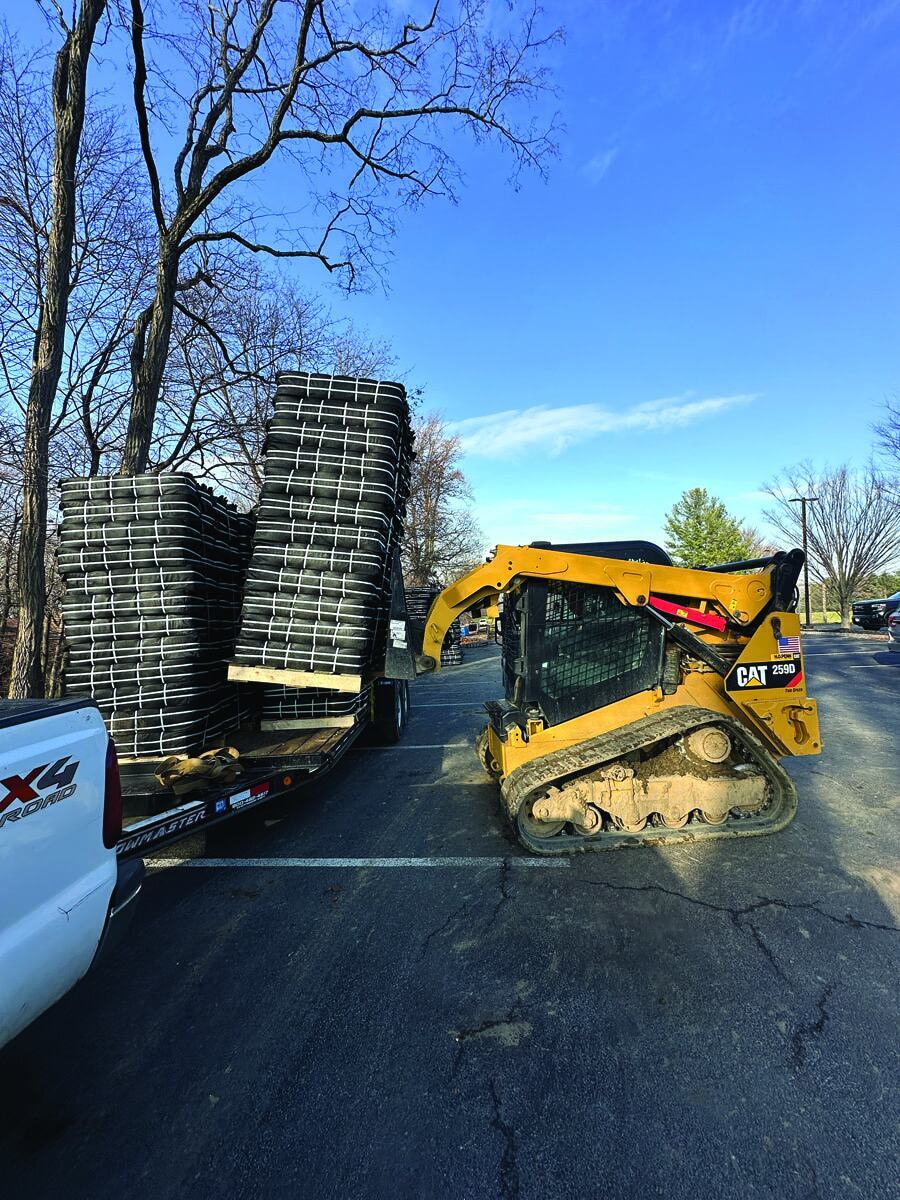
LJM Trucking hauled in the backfill, then 250 cubic yards of septic sand in 16 loads. The modules arrived in tractor-trailer box vans. “That was a surprise because we had assumed they would be open trailers,” says Cordone. “It was a scramble to find a pallet jack to offload them.” From then on, the installation was straightforward.
The system is rated to handle golf carts and light maintenance vehicles. With time, the galley system will rejuvenate and serve as another backup for emergencies or future expansion. The club has a pumping schedule for the grease trap and septic tanks.
Continue reading for free