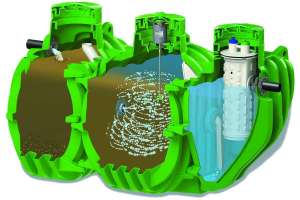
As an industry, there is a general consensus that having two compartments in a septic tank is better than one with the same volume.
For example, it is thought that a 1,500-gallon tank is better if split into one compartment with 1,000 gallons and another with 500 gallons because baffles and compartment walls result in a less direct flow path for the effluent, allowing for separation in the tank. Stokes’ law, which explains the settling that occurs in a septic tank, shows that slow velocities through long tanks yield the highest effluent quality.
The ins and outs
At the inlet and outlet of septic tanks there is a loss of effective settling area due to entrance and exit turbulence. The flow comes to the tank in a pipe with a much smaller cross section than that of the tank. This means as the inflow enters the larger cross section in the septic tank it can form eddy currents and turbulence. The same issue occurs at the outlet as the effluent has to travel out via a pipe with smaller diameter. Inlet and outlet devices, as well as compartmental walls, can cause excessive flow velocities if they are not properly designed, sized and placed causing turbulence, short-circuiting and channeling and reducing settling efficiency.
Multipurpose
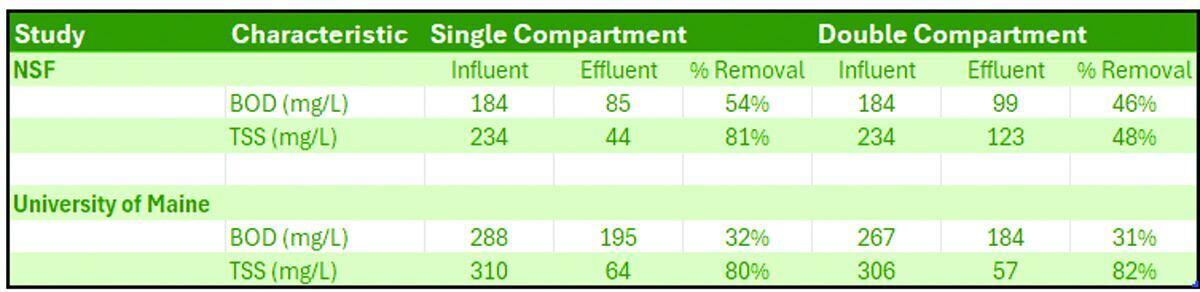
Septic tanks are a primary settling device, but they are also anaerobic digestors. If we were concerned only about settling, a one compartment tank is likely better. When we put a wall in the middle of the tank with a transfer hole, the wastewater will experience a Venturi effect when it travels into the second compartment.
The Venturi effect is a phenomenon in fluid dynamics where a fluid flowing through a constricted area experiences an increase in velocity. This effect is not exactly helpful for settling. The two images show modeling of a grease interceptor from a 2008 Water Research Foundation report illustrating how tanks of the same size have quite different velocities when a wall with a baffle is added. Although the design is different with grease interceptors, the images are helpful in understanding how compartments can impact velocities.
More to learn
When we look at the septic tank as a digester producing gas bubbles that interfere with the settling of particles, the first compartment may concentrate the digestion, and the second compartment may assist in providing another area for suspended solids to settle. This could increase service time on an effluent filter.
There is little research on this topic and conflicting findings about whether compartmentation of septic tanks is beneficial or not. Some investigators have stated the benefit of dividing a septic tank into compartments is insignificant, while others report that a two-compartmented tank is better than a single-compartment tank of equal capacity.
Past studies
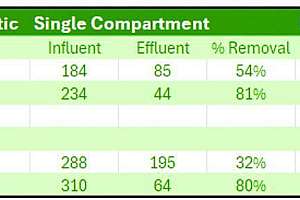
The NSF conducted a study for the University of Washington in 1982. The purpose of the study was to determine the treatment efficiency of a single-chamber 1,000-gallon septic tank and a double-chambered 1,000-gallon septic tank (2/3-1/3 split) when operated under parallel conditions. The specific type of baffle was not identified.
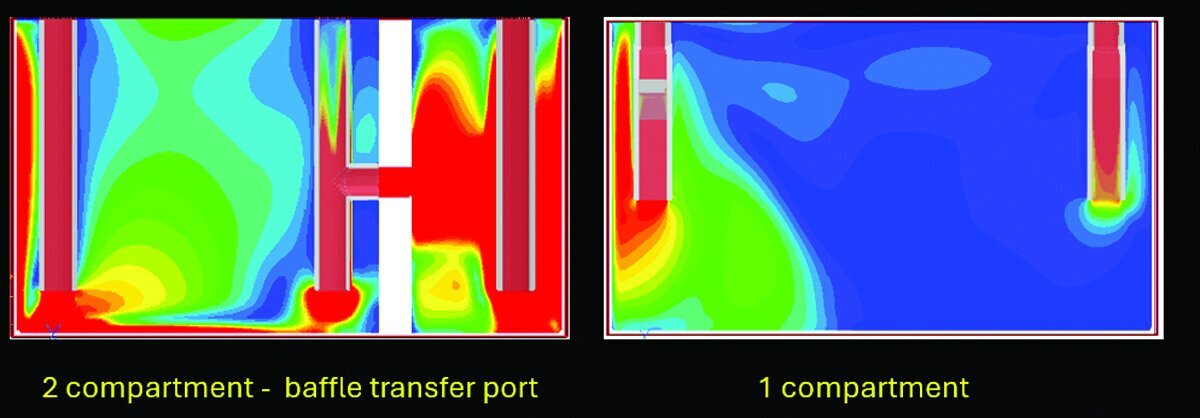
The septic tanks were dosed 600 gpd for six months using ground-up raw sewage from the city of Ann Arbor, Michigan. Wastewater from a wastewater treatment plant is different from wastewater from a home as it is influenced by infiltration and is a mix of domestic, commercial and industrial sources. It also travels long distances, spending time in the collection systems. The influent in this study was lower than expected for BOD and suspended solids, but the flows were high. Reviewing the NSF data the single compartment tank performed better in this short-term study with high flows.
Table image from NSF study for the University of Washington.
Another full-scale testing program was conducted at the University of Maine by Boyer in 1992. Over 15 months, wastewater from college dormitories was pumped to the septic tanks. The wastewater was all domestic in nature, but was still conveyed to the tanks with a pump that ground up the waste. They used the same septic tank capacity of 1,000 gallons with the same 2/3-1/3 split as the previous study, but dosed the system at 200 gpd. A horizontal, rectangular opening was in the compartmental wall. For TSS the compartmented tank performed statistically better. These tanks were loaded at a more typical rate as you would likely see with a single-family home.
In both studies, the effluent values are from septic tanks without effluent screens. Since pumps were used to deliver the waste to the tanks the velocities may have been higher than typical rates produced in homes. These studies are 30-40 years old and wastewater concentrations and water usage per home have changed during this time. As concentrations have increased, flows have decreased and therefore hydraulic retention times have gone up.
Getting it done
It is important to note that there are two common ways to compartmentalize a septic tank, and they impact the tank performance differently.
A baffled compartment wall in the middle will cause an increase in velocity and turbulence as the diameter reduces significantly to pass to the second compartment. This results in two smaller tanks connected in series when an overflow tee is installed in the baffle wall.
Compartmentation may also be accomplished by placing a larger flow-through port in the baffle between the expected sludge and scum layers. This hydraulically links the liquid surface of both compartments, and thus the liquid-level rise and flow-through rates would be equivalent and dependent on the outlet configuration. The flow to the outlet of the first compartment will still increase in velocity, but not as significantly as with a baffled pipe. Both ASTM C1227-50 and IAPMO Z1000-19 indicate that the minimum size should be 50 in2 (8-inch diameter). Therefore, a port may have double the area of a 4-inch pipe and therefore will have lower velocities and a reduced Venturi effect. Unfortunately, many septic tanks currently manufactured do not meet these standards — remember that larger transfer holes are preferred to minimize velocities.
Maintenance
It is important with dual compartment tanks that both sides are evaluated and cleaned as needed. When tank access lids are buried, this can create additional work to gain access. With regulations moving towards requiring access to grade this issue is not as significant, but there are a lot of buried lids that exist.
Although there is little significant or measurable difference currently available, many industry professionals do prefer two compartment tanks, and some regulations require them. What we do know is that both work and septic systems tend to be built with a factor of safety. More research on the topic with today’s more concentrated waste stream is needed to truly answer the question.
Continue reading for free