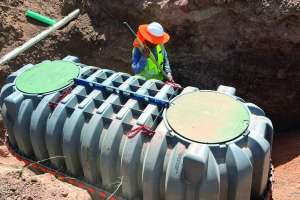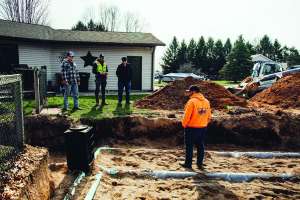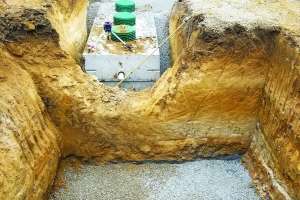
Operator Mike Chew running the company’s John Deere 160 P-Tier excavator to backfill some fresh set septic tanks on a residential installation. (Photos by Steve Hockstein)


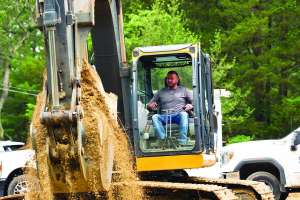
Operator Mike Chew running the company’s John Deere 160 P-Tier excavator to backfill some fresh set septic tanks on a residential installation. (Photos by Steve Hockstein)
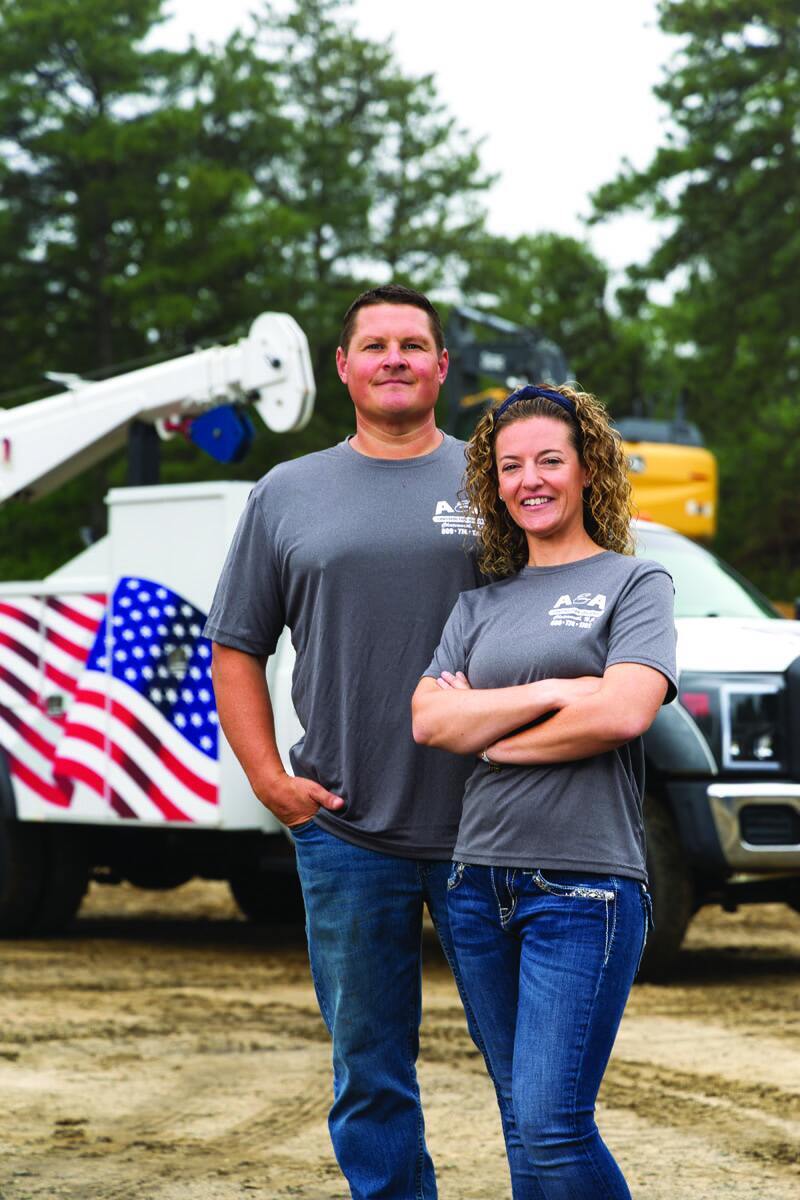
Digging dirt is intertwined with the Anderson family lore.
After working Monday through Friday as a grounds person for the state of New Jersey, Albert Anderson Jr. would borrow a backhoe and a dump truck from the cranberry farm that his father managed to help a neighboring town with their excavation projects on Saturday and Sunday. Albert eventually built a backlog of excavation work large enough for him to leave his state job in 1986, starting A&A Construction and settling in Chatsworth, New Jersey.
Despite his success, Albert advised his son, Jason Anderson, not to get into excavating, citing that dirt work in New Jersey had no future. So, Anderson set out on his own path after high school.
“I was mechanically inclined, so my best friend and I went to NASCAR school in Mooresville, North Carolina,” says Anderson, second-generation owner of A&A Construction and Septic. “After graduation, I got a full-time job at Mercedes-Benz as a mechanic.”
Even though he secured stable employment at a reputable car company, the repetitive work and being stuck inside on a beautiful day just didn’t satisfy Anderson. So, after a few years at Mercedes, he told his dad that he’d like to join him at A&A.
A&A had been operating for 20 years when he joined the company in 2006. At the time, the company primarily focused on its homebuilding and construction services, only installing about 12 septic systems per year. But Anderson saw potential in building up the company’s septic installation business.
Sewer connections are uncommon in the southern New Jersey communities where A&A operates, creating a large market for residential and commercial septic system installations, inspections and repairs. And don’t forget the competition.
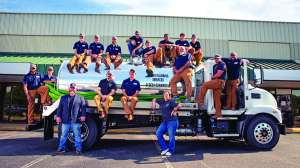
“It’s very competitive here, there are a lot of local people in the business,” says Anderson. “Our differentiator is that when you hire us, you get a full team. Not a person answering the phone while they’re on a job site digging a hole. We have office staff, managers, drivers, operators, laborers and mechanics.”
It’s no secret that running a septic installation business can be a juggling act.
“Nothing surprises me anymore,” chuckles Anderson. “Scheduling and organizing are our biggest operational challenges. I also feel COVID changed the customer interaction process. Before, you just needed to meet customers at their homes. Now, there are fewer in-person meetings, and more emails and contracts.”
New Jersey’s strict septic permitting and regulatory requirements also demand more administrative work than the average septic installer may encounter in other states and territories. Every county in New Jersey has a health department with different rules to follow.
“With every septic we do, we need a property survey. The permitting and approval process takes two to four weeks.”
In addition to rigorous permitting, New Jersey requires that septic systems are to be designed by professional engineers and approved by local administrative authority, adding another step to the installation process.
“We have a great working relationship with South Jersey Engineers in Voorhees Township. They specialize in septic system design and know the area well.”
A combination of COVID-driven demand and a large number of New Jersey septic systems reaching the end of their useful lives resulted in big sales for A&A in 2020.
“We were the busiest we had ever been during the pandemic. People were home instead of at their offices or schools and overusing their septic systems.”
COVID-19 also brought about logistical challenges for A&A, which changed the way the business operates today. “We had a twofold problem where we were busy, but we couldn’t get materials.”
To address the unpredictable sourcing landscape, A&A decided to change its business model. They began working with a larger vendor that could meet their needs and stockpiling septic supplies. “Now, we stock all our tanks, pipe, filter fabric and stone, load them and haul them ourselves,” says Anderson. “I never want to be in a position of having work and not being able to do it.”
A&A now has the space, materials and people to accomplish a month’s worth of septic installations without restocking.
“We buy Champion and Goulds pumps by the pallet and Infiltrator Water Technologies tanks by the truckload. We used to rent dump trucks, but now we own eight dump trucks, including four tri-axle Macks, a tandem-axle Mack, a tandem-axle Western Star, a Ford F800 and a Ford F550. When I need sand, stone or material moved on a job, we do it.”
The only part of the septic industry that A&A doesn’t tackle is pumping. The company relies on Denny’s Septic Service in Atco, New Jersey, to pump systems before their jobs.
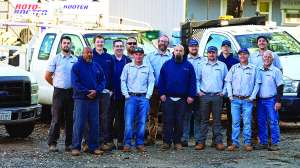
A&A has also been on a hiring spree ever since COVID-19 pandemic, starting with the hire of general manager, Michael Godfrey. Thanks to his leadership, A&A moved to a new location and now has a modern, well-equiped space to support it’s expanding team and continue building on its success for years to come.
During the expansion, A&A also brought on a construction manager, a shop manager/mechanic, an office manager and administrative assistant, five full-time truck drivers, five operators, additional laborers and a pump specialist.
A&A’s pump specialist, Kenny Hogue, has over 15 years’ experience doing wiring, pump replacements and treatment unit maintenance. He’s equipped with a completely stocked service truck, from hardware all the way to pumps and new floats, to respond to any emergency and perform pump repairs in a timely manner to better service their customers.
As mechanic shop bills piled up and the inconvenience of being down a truck slowed company operations, A&A decided to set up an in-house mechanic shop. The shop employs two full-time mechanics to repair and maintain A&A’s entire fleet of service vehicles and equipment.
“Heck, some of our office folks have Class A CDLs, and they jump in when we need every truck to go out.”
A&A serves a rural, heavily wooded part of New Jersey referred to as the Pine Barrens, meaning half of their septic system installations require tree clearing. So, the company assembled a tree crew to handle the task. “We used to sub out all our trees. Now we have a bucket truck, two chippers, a stump grinder, a mulcher and a chip truck. The whole nine yards,” says Anderson.
To top it off, A&A has six laborers, and Anderson’s younger brother, Jordan Torres, heads A&A’s septic inspection division.
Twenty years after Jason joined the family business, septic installations have become the largest part of A&A’s operations, installing around 200 septic systems annually. They primarily install 1,000-square-foot disposal bed systems, but every job calls for something different.
“We install conventional gravity systems, gravity systems with soil replacement, gravity dosing systems, pressure-dosing systems, and treatment systems, you name it.”
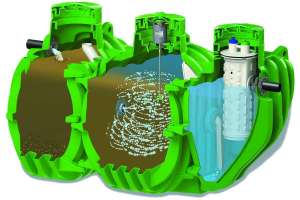
Because New Jersey is a coastal state with a high water table, roughly half of its installations are mounded, aboveground systems. More recently, the state of New Jersey has required new-build homes smaller than 3.2 acres to install treatment systems. This rule has spurred A&A to install more FujiClean and Infiltrator Enviro-Aire treatment units.
While septic installations make up most of its business, A&A Construction and Septic continues to operate it’s construction division headed by George Nieves. Nieves’s and his crew of two employees manage building new houses, overseeing site work, purchasing properties and handling permitting.
“We’ve been building new-construction homes since 1986,” says Anderson. “I think we’ve built around 80 houses in the last 40 years.”
A&A also rehabs old homes in the area and sells them. If that wasn’t enough, Anderson and his father own a rental home business with nearly 30 rental units in southern New Jersey.
Although A&A began with a borrowed backhoe and a dump truck, the business has since upgraded to the more modern tools that fellow septic installers use today.
“Excavators are a septic guy’s best friend. We have a Kubota KX080-4R3A and Hitachi ZX17U-2 all the way up to 160G and 160P John Deeres, and everything in between.”
In addition to these, A&A relies on Kubota KX057-4R3A, Kubota KX033-4R3A, Kubota U10-5, and Kobelco SK140SRLC-7 excavators for its work. Each of its excavators is equipped with thumbs to pick up the logs and stumps commonly found in the Pine Barrens.
“My John Deere salesman is one of my best friends. He was a best friend before he was a John Deere salesman, but now he’s both.”
After excavators, skid-steers are indispensable for A&A.
“We use low-ground-pressure track machines on top of the septics to avoid breaking pipes. All our skid-steers are John Deere and Kubota. We have smaller units, like the Kubota SVL75-3HWC and John Deere 325G, and we also have the biggest ones they make, like the Kubota SVL97-2HCC and John Deere 333G.”
In addition to excavators and skid-steers, A&A’s self-reliant approach has led to owning four John Deere loaders 744k 544h, 524k, 344k, two John Deere bulldozers 450J LGP, 650J LT, an L6060 Kubota tractor and a 25-ton equipment trailer. The team trusts Polylok for lids and effluent filters and TUF-TITE for effluent filters, D-Boxes and speed levelers. They even keep a 310SG John Deere backhoe just in case.
Reliable and trustworthy suppliers are just as important to A&A as the equipment they lean on to get the job done. The team credits much of their success to the relationship they’ve built and the support they’ve received from JESCO Equipment, Atlantic Plumbing Supply and Cherry Valley Tractor Sales.
In 2026, A&A will celebrate its 40-year anniversary. And Anderson intends to keep establishing roots in his southern New Jersey community. After working on a septic design project for a local bar, Mayo’s Halfway House, the opportunity arose to purchase the 100-year-old establishment. He couldn’t say no. He received the keys in April.
“My tagline is Make Mayo’s Great Again,” says Anderson. “It’s a local institution and I want to give it the attention it deserves.”
As for A&A, Anderson hopes to continue the family legacy with his son and daughter and keep the family business running for the foreseeable future. The company’s goal is to become as efficient as possible.
“I’ll admit, back when it was just me, my dad and a couple of helpers, I was a hire-and-fire guy. If you made me mad, you were fired. But I realized that’s not the way to grow your business. You need good people, and you need to take care of them to keep them.”
A&A offers its employees comprehensive benefits and a 401(k) plan as a commitment to their well-being.
“My son is 10, but he loves coming to work with me in the summer and doesn’t think twice about coming on Take Your Child to Work Day. He drives the machines around the yard, and he’ll ride in a dump truck with me. I’m hoping it nudges him to come work with me one day.”
Continue reading for free