
Recently I was at a continuing education seminar and one of the speakers was a tank manufacturer. His presentation was about how good his tanks work in wet conditions because of an additive they use in their concrete. I know the speaker, he is awesome and makes great tanks. But what struck me about his presentation was slide after slide of tanks going in very deep. We are talking about excavations of what looked approximately 19 feet deep. Add groundwater to those depths and yikes.
I remember being brought in to bid on the onsite system installation for a big box store. One look at the plans, and the tanks and other structures had depths of over 20 feet and some were 25 feet deep. There was no way that design made any sense, and I told them that. One year after the store opened, I was called out to assess why the parking lot was a giant ice skating rink in the winter because the system was already in failure mode. I did say I told you so. I can always tell when I look at a plan if the designer has ever actually installed a system or not. I knew this designer never had just by the depth of the tanks.
My company has a policy that every tank goes in as shallow as possible.
Our proposals/contracts say that they are based on the sewer exiting the building no deeper than 30 inches below finish grade. If a customer’s house has the sewer line exit below the basement floor, on a flat lot, we require they add a sanitary sump pump to change the sewer to exit the house no deeper than 30 inches before we install their system. Everything from the upper floors is still gravity; the only water being pumped up into the sewer is typically a basement floor drain and laundry tub. Obviously in finished basements, there could be more fixtures being pumped up through the sanitary crock. This allows shallow installation of the tanks.
Why is it important to install shallow tanks?
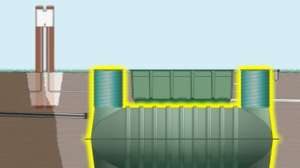
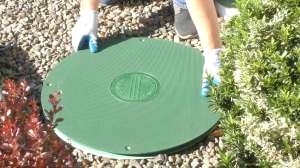
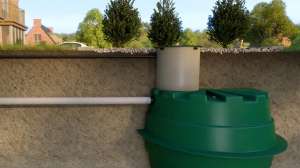
1. Maintenance: The less footage of access cover risers that are on the tank the better the maintenance will be — plain and simple. When a good septic pumper cleans a tank, in most cases they will use a type of flat "rake" to scrape solids toward their hose. The more risers you have on the tank, the smaller the "cone of access" the rake will reach. With only a few risers on a tank, that rake can reach far into the tank. If you have 8 feet of risers on the tank, the act of pumping will clean a very small portion of the tank just below the access cover only, allowing solids to build higher and higher. This is true even in a tank with an access cover on each end if there are too many risers on the tank.
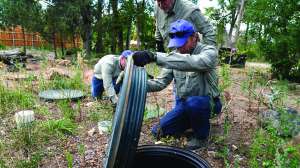
2. Tank entry: Obviously nobody should ever enter a septic tank for any reason unless you are certified for OSHA-compliant confined-space entry. Entering a tank is dangerous. However, being certified for confined-space entry, I sure would prefer to enter a tank with 2 feet of risers on it than 10 feet of risers on it, should tank entry be required.
3. Structural integrity: Make certain you are complying with the tank manufacturer’s depth of bury guidelines for your tanks. If a tank is manufactured for a 5-foot max bury depth, but you have 9 feet of cover over the top of the tank, the tank is not manufactured to withstand those pressures. The soil we are working in everyday averages 2,700 pounds per cubic yard. That’s almost a ton and a half per 3-foot cube. Do not install a tank below its bury depth.

4. Safety: If a sewer line exits below a basement floor, at let’s say 9 feet deep, that’s where the top of your tank is; the bottom of your tank will now be 15 to 18 feet deep in the ground. Depth kills, plain and simple. I don’t want to put my employees 15 feet in the ground because a customer didn’t want a sanitary sump pump.
- If you are installing a tank that deep, are the employees protected? Do you have room to properly slope or bench the sidewalls of the excavation in a safe and compliant manner?
- Are you using a tank box? Similar to a trench box but large enough to fit the tank in?
On tank boxes: My policy is no deep tanks but of course we do run into a situation now and then where the tanks end up being deep. I can think of two cases where my tanks ended up being really deep. In one instance we had the room to properly slope the excavation back. But in the other situation, I had a large 7,000-gallon tank that had to be set deep in a very tight spot between utilities and a curb and everything imaginable with of course water filling in the bottom of the excavation. We were using a Link-Belt 350 and called United Rentals and they had a tank box out to the job in no time. A tank box, like a trench box, is designed to install the tank in as safe of manner as possible. That job could not have been done without one. You don’t have to own a tank box, rent one from United Rentals or similar company. “Hey Todd, you sound like a commercial for United Rentals.” If it saves a life and gets your job done safely, I’m OK with that.

If installing tanks deep
- Make sure you are using the right size excavator; don’t be using your mini-excavator for this job, rent a bigger machine. In the case of renting a machine for a deep job I always recommend renting one size bigger than you think you’ll need. I guarantee you will thank me for that one.
- If you don’t have the room for opening up the Grand Canyon on your site, rent a tank box.
- Don’t forget in advance to special order pumps and floats with longer cords on them.
Please remember burying a tank deep should always be a last resort. Do not install tanks deep just because somebody wants gravity flow. Shallow tanks are best for you and your customer. Deep tanks are not a good idea. In most cases there are always ways to get tanks shallower even if it means using a pump to get you there. Keep the tanks shallow and your employees safe at the same time.
About the author
Todd Stair is vice president of Herr Construction, Inc., with 34 years’ experience designing, installing, repairing, replacing and evaluating septic and mound systems in southeast Wisconsin. He is the author of The Book on Septics and Mounds and a former president of the Wisconsin Onsite Water Recycling Association.
Continue reading for free