
One of the benefits of teaching a class on Evaluating Onsite Systems for Real Estate Transfers (through the Wisconsin Onsite Water Recycling Association) is that those who attend the class tend to reach out later with great questions. Not only do I learn from them, but they add to the list of examples I get to use at the next class.
So let’s learn together. A person who took the class, Jon Hempel of New Age Inspections LLC, reached out with a picture of what looked like a small crack in the top of a tank. This tank was not very old. One recurring question I receive is: Do I mention such a small crack?
Here are two important reasons to mention that small crack.
- If you don’t mention the small crack, the next time the tank gets maintained, pumped or inspected, you run the risk that the next person makes a big deal of it and now everyone is coming back to you asking why you didn’t see it and why you didn’t mention it. This might not sound like a big deal, but it is. Your report is what aids a person in deciding whether or not to purchase a house or building, or whether to ask for financial compensation in the deal from the sellers toward replacement of the system or that part of the system. They claim that because you did not tell them about the crack, they lost the ability to have the seller replace the tank, or reimburse them for replacing the tank, demanding to know why you didn't tell them.
- The crack could get larger. All the weight of the backfill on top of the tank (at an average 1.5 tons per cubic yard) is adding stress to the top of the tank that could increase the size of the crack, and very possibly adversely affect the structural integrity of the tank. Just because the crack is small does not mean it will remain that way.
My class teaches our state’s (Wisconsin) five statutory definitions of a failed system. Those five definitions of a failed system do not mention anything about cracks in a tank. Depending on the severity I will write an evaluation differently:
Tiny crack: Although the system passes and was not observed in a failed state, please note that a crack was observed in the septic tank. At this time it does not appear to be affecting structural integrity nor watertightness of the tank; however, it is imperative that the crack be monitored in case it gets worse, at which time it could cause the tank to lose structural integrity and would be dangerous to walk or mow on. Replacement of the tank would be recommended if the tank gets worse.
Large crack: This evaluation of the onsite system DOES NOT PASS due to a large crack observed in the septic tank. This crack appears to be causing the tank to lose both structural integrity and water tightness. This is a SAFETY issue and the tank should be replaced. Please do not allow anyone to walk, drive nor mow on or in the immediate vicinity of this tank.
Upon seeing a large crack, I would immediately verbally let the homeowner know of the safety implications and follow up with both the written report and a reminder in both an email and on the invoice so you have proof that you warned them of the situation.

It’s important to list everything you observe during a system evaluation — even things that may seem inconsequential at the time — in order to give a complete report, and recap at the end all the reasons that the system failed or not.
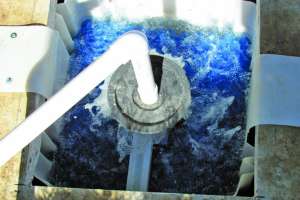
This also includes colors observed in a tank. I’ve looked in a tank and found white water with the color and consistency of Elmer's glue. I’ve had a person call and say at the time of an evaluation the water in the tank of a vacant house was as bright blue as the Caribbean Sea.
White can always mean that painters or drywallers washed their brushes and tools in sinks in the house or poured buckets of paint down the toilet, in which case it should be stressed to the homeowner to have these practices stop. In the Elmer’s glue incident, the home had several children on heavy medications. Heavy medication use seems to always take a toll on an onsite system, and it is best if the tank is used as a holding tank while the medications are being used. The blue system was caused by a leaking toilet that had a toilet bowl cleaner auto-feeding into it.
I’ve had several calls regarding mound systems that failed due to water being observed on or near the mound. I’ve found several that actually weren’t failing but had the following issues:
-A broken force main at the mound. I have found this several times and after an easy repair the mound functions normally.
-Someone’s mower broke a flushout valve so every time the mound dosed, the broken flushout valve leaked effluent. An easy repair fixes the issue.
-Probably the most surprising one I’ve been finding more often lately is just grading that could have been a little better. Stormwater unassociated with the mound or effluent may pond at the base of the mound due to the grading that left a low spot on the end or side of a mound. This is a reminder to us installers that grading around a mound has to allow stormwater to flow freely around the mound and to a lower point. Mound installations are supposed to prohibit ponding at the mound, but I am finding more and more mounds where the grading could have been performed better to prevent ponding at the mound.
Keep the questions coming regarding system evaluations. I enjoy helping out with wording or hearing about what you’re seeing during evaluations. It helps me learn and provides a lot more examples I can use during the class.
About the author
Todd Stair is vice president of Herr Construction, Inc., with 34 years’ experience designing, installing, repairing, replacing and evaluating septic and mound systems in southeast Wisconsin. He is the author of The Book on Septics and Mounds and a former president of the Wisconsin Onsite Water Recycling Association.
Continue reading for free