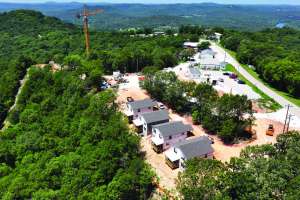
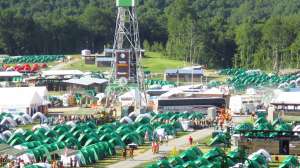
Opened in 1950, Opera in the Ozarks at Inspiration Point is one of the nation’s foremost training programs for aspiring singers and musicians, but the mountaintop facilities in Eureka, Arkansas, were rustic. A $34 million grant from the Walton Family Foundation enabled the music organization to expand the campus by building a 300-seat indoor theater and six two-bedroom cabins for faculty.
The problem was how to handle wastewater from these sources. “We were the third designer to review the job,” says David Meints, owner of Meinco Wastewater Services in Bryant, Arkansas. “Our company has a reputation for excelling at projects of this size and complexity.”
Meints’ design challenges included steep mountainous terrain, limiting soils, shock loads during the June through July opera season, environmental concerns and avoiding a NPDES permit. “We tested the soil in several downslope terraces behind the opera house and only one worked,” says Meints. “Thankfully, the facility’s original stone-and-pipe drainfield was functional and didn’t require upgrading.”
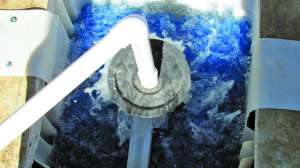
To stay within budget and limit operational expenses, Meints chose HighStrengthFAST 3.0 modules from BioMicrobics for their shock load capabilities, high-quality effluent and low maintenance. The only moving parts in the units are aboveground blowers. Drip irrigation (Geoflow) disperses the effluent.
Work totaling 50 days began in October 2023 and finished in March. The system went live for the cabins in May 2024, but the theater won’t open until the 2025 opera season.
Site conditions
Soils are gravelly silt loam with a loading rate of 0.226 gpd per square foot.
- System components
- Meints designed the system to handle 5,000 gpd. Major components are:
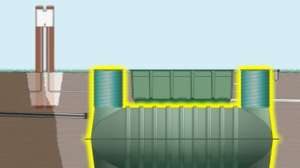
- Two 3,000-gallon concrete septic tanks with SaniTEE effluent filters (BioMicrobics). Tanks from SI Precast Concrete.
- 5,000-gallon equalization tank with FT0854-36 pump vault and duplex 0.5 hp effluent pumps (Orenco)
- Threeway Hydrosplitter (Orenco)
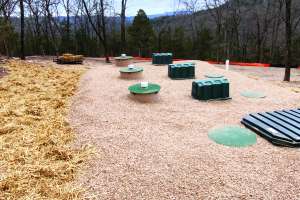
- Three HighStrengthFAST 3.0 modules (BioMicrobics) in 3,000-gallon tanks
- 5,000-gallon concrete dose tank with pump vault and duplex 1.5 hp effluent pumps (Orenco)
- DripFilterPRO headworks (Geoflow).
- 22,000 square feet of WASTEFLOW drip tubing (Geoflow)
- Custom TCOM control panel (Orenco)
System operation
Wastewater from the cabin’s gravity flows through the 4-inch sewer to the first septic tank 200 feet away. Wastewater from the theater flows 100 feet through a 4-inch line to the second septic tank. Effluent from the cabins’ septic tank gravity flows 500 feet and connects to the theater’s septic tank outfall. The combined flows travel 100 feet downslope to the equalization tank.
Alternating pumps in the equalization tank send 90 gallons per timed dose through the Hydrosplitter to a designated treatment module, then the effluent gravity flows to the dose tank. Dedicated alternating pumps in the dose tank run eight times per day, sending 313 gallons per dose through the headworks for distribution to zone 1 or 2.
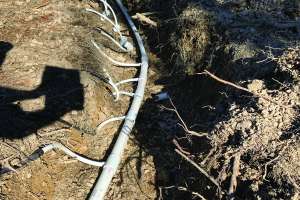
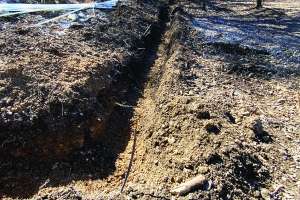
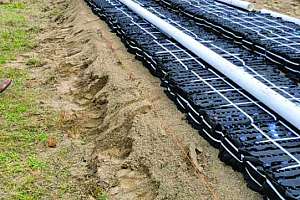
Each zone in the 36-foot-wide drainfield has 18 driplines 300-feet long on 2-foot centers buried 10 inches deep on a contour. The lines have pressure-compensating 0.5 gallon per hour emitters.
Installation
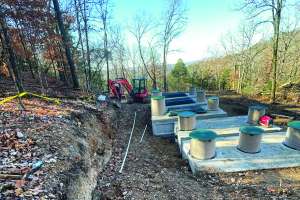
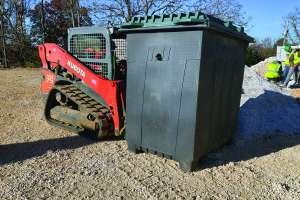
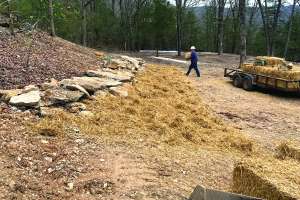
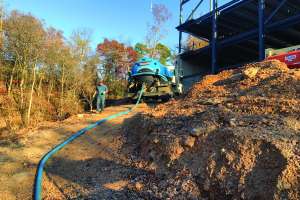
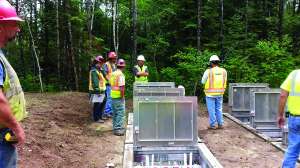
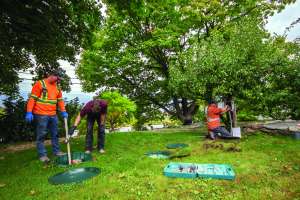
The SI Precast drivers staged the tanks at the top of the mountain as Crossland Construction built the cabins for early occupancy. Garrett Excavating cut a road behind the theater for utilities and septic, but Meints’ crew cut the trees in the drainfield area and spread the wood chips.
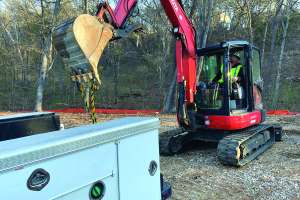
Walking 500 feet or more up and down the mountain was brutal, so Phillip Johnson, field operations manager, and installers Preston Johnson (no relation) and Tommy Douthit traveled in a Pioneer 1000 dual-purpose side-by-side utility vehicle (Honda). They used a Caterpillar 320 excavator to dig a hole per day, then a SI Precast driver brought down the tank in sections.
“The guys set the septic tank for the theater first, followed by the equalization and dose tanks and the three pretreatment tanks,” says Meints. “The fun began after we had clearance from the general contractor to install the cabins’ septic tank.”
The excavator struck weathered limestone, and it took two days with Garrett Excavating helping before they hammered out the 14-by-9-by-13-foot-deep hole. “We needed the depth because this tank has five feet of cover,” says Meints. It was made specifically to withstand the additional weight.
The crew plumbed 10 feet on either side of the tanks’ inlets and outlets, then the general contractor plumber brought the complex sewer lines down the mountain to them.
Away from home
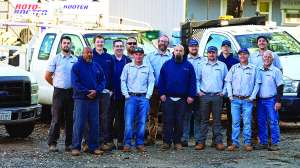
The project was three and a half hours from the shop, so the crew drove up Monday morning and came home Friday afternoon. “It was taxing for them to be away from their families for 10 weeks,” Meints says.
Over the next two weeks, Kyle Gaston and Tyler Anderson used a Ditch Witch 410 vibratory plow to install 11 rolls of drip tubing per zone, while Douthit spent two days gluing fittings. “The drainfield’s upper horizon was gravelly, so I was pleasantly surprised at how easily the tubing plowed in,” says Meints.
The only hiccup was toward the end of the project when the general contractor said they had installed the theater’s septic tank in a designated roadway. Even showing him the permitted design failed to change his position: The tank must withstand vehicular traffic or be relocated.
“So the guys replaced the fiberglass risers with precast risers, added manhole covers to the grade rings and poured a concrete slab over the tank,” says Meints. “The kicker is the road was cut specifically so we could maintain the tank.”
Maintenance
Meints holds the maintenance agreement and reports monthly to the local health department instead of quarterly. “I want to be positive that flows don’t exceed 5,000 gpd once the opera season begins this summer,” he says. Meints also monitors the old system serving the original campus, as students continue to use it.