Early on
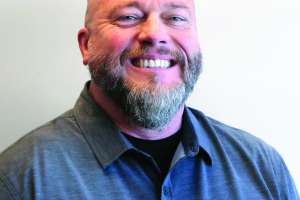
When he was a child, Bradley’s parents operated a logging outfit from an isolated area along the British Columbia coast. “I literally grew up in the forest in nowhere land, and you could always find me in the seat of a machine when I was a kid,” he recalls.
He and his mother eventually moved to Penticton, a city of about 40,000, located in British Columbia’s southern interior, where he attended high school. It’s a four-hour drive east of Vancouver and an hour north of the Washington border.
“I was going to go to college for engineering and realized that I like the outdoors way too much and I was going to lose my mind on a desk job, so I got into the trades,” he says.
All roads lead to septic
He found work with a landscape company, excavated peat bogs and also worked at road building and civil construction. But during that time, projects often involved the installation of septic systems. Eventually, he handled all of the septic system work for the homebuilding arm of a construction business. A friend who worked for a local engineering company suggested that Bradley become a certified installer. He never looked back.
Bradley launched his own business, SBC Excavation Ltd., in Penticton in 2018. He brought along Will Hardy, a co-worker at his previous employer.
“From the start, he’s been my right-hand man,” Bradley says. “We’d worked and trained alongside each other before and SBC would not have been as successful without his commitment to work and friendship.”
However, SBC Excavation’s work continued to veer toward septic system installation.
“I had an evaluation moment in 2020, and I spun off a new company SBC Septic Services,” Bradley says. “All of the work continued under that name and the old company became the parent company.”
Today, almost 90% of the company’s work involves septic systems.
“I don’t do random excavation jobs any longer,” Bradley says. “I still help out homebuilder-contractor friends digging out a foundation or excavating an electrical trench, but that usually rolls into doing the septic system as well.”
Septic systems have come a long way and the community is embracing the newer designs, although he still comes across some remnants of the past.
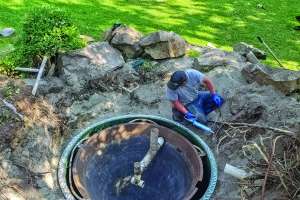
“I found one septic system that featured a 50-gallon steel drum with a single pipe coming out of it, and the pipe was completely engulfed by the roots of a weeping willow,” he recalls. “That one was pretty special.”
Service specifics
While Penticton is primarily served by a municipal sewer system, septic systems serve most of the region beginning at the city’s outskirts, offering plenty of work opportunities.
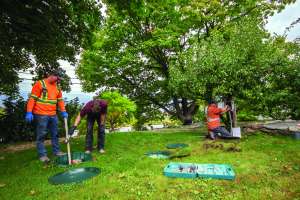
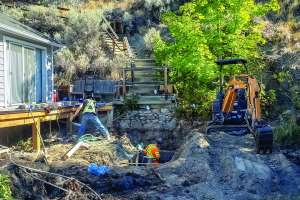
SBC provides installation of new systems as well as inspection and maintenance of existing systems for customers across a broad geographic area. Terrain is extremely variable as roads wind through mountainous regions and valleys wherever they can be built, so his service area is best defined in terms of driving time: Princeton, 90 minutes west; Osoyoos, an hour south: Rock Creek, 90 minutes east; and Vernon, two hours north.
In British Columbia, septic system designs fall into three categories:
- Type 1 is anaerobic treatment by septic tank to drainfield, either gravity-fed or pumped
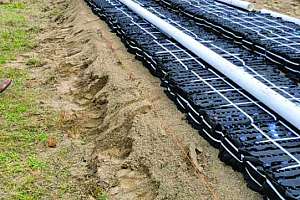
- Type 2 systems introduce further treatment, such as aerobic treatment, and can include trenches, seepage beds or sand mounds. These systems can be gravity-fed, but are most often pressurized.
- Type 3 systems produce a higher quality effluent than Type 2 systems and can include subsurface trenches, seepage beds or sand mounds. They employ aerobic treatment processes, but use additional treatment methods such as ultraviolet light, chlorination/dechlorination or ozone.
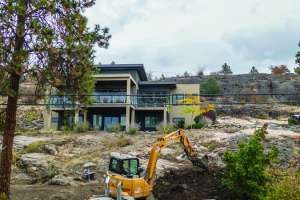
“We use a wide range of systems because of differing soils in our valleys and because of mountains, plentiful water bodies and exposed bedrock,” Bradley says. “In Penticton there are not a lot of large lots left for development and even in the mountainous areas you might have a decent-sized lot constrained by a well, water bodies or severe slopes. For that reason, we’re increasingly seeing demand for type 2 and 3 systems.”
The province licenses installers under four classifications of Registered Onsite Wastewater Practitioner — planner, installer, maintenance provider and private inspector. Bradley is currently certified as an installer and maintenance provider. As a maintenance provider, he’s also certified to perform septic system inspections for real estate transactions.
Equipment round-up
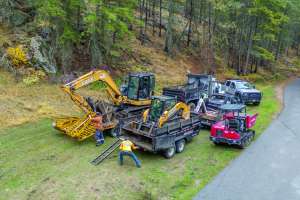
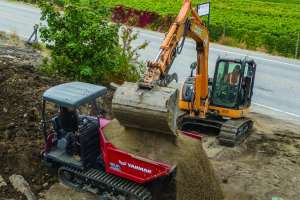
SBC operates a pair of CASE excavators, a 2017 CX37C Mini and a 2021 CX80C Midi, and a 2017 CASE SV250 skid-steer loader.
“I chose CASE because it has a reputation as a rock-solid brand,” Bradley says. “But also, I just like matching sets.”
The company owns a 1977 White-Freightliner WFC120 custom dump truck and Sure-Trac hydraulic dump trailer. It also owns a 2013 GMC Sierra 3500, a 2006 GMC 3500 flatdeck and CZ ENG 20K Flatdeck Tag Trailer.
“We like to own a standard set of equipment we use all the time,” Bradley says. “But we’re always renting equipment like different sized track dumpers and extra excavators, sometimes with hammer attachments, from our local equipment rental place, Pacific Rim Equipment.”
For inspections and line cleaning, Bradley owns several Hathorn Inspection Cameras, both large- and mini-reel with self-leveling camera and fully traceable reel, a Milwaukee Tool drain snake and auger, a self-built line jetter and a Sludge Judge sampler (Nasco Whirl-Pak).
The company’s toolbelt also includes a Husqvarna K760 Cut-n-Break concrete saw, a Husqvarna 365 Special chain saw and a range of Milwaukee SAWZALLs, grinders and impact and hammer drills.
A preference for concrete
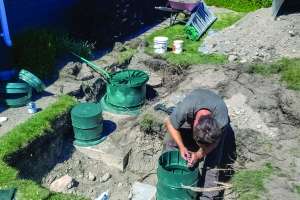
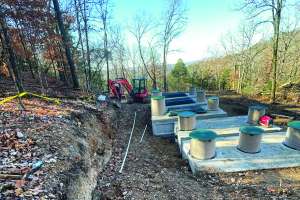
For septic system tanks, Bradley prefers concrete because of its strength and durability, although he uses poly when limited access to the site requires it. He relies on South Okanagan Concrete Products of Osoyoos to supply the concrete tanks.
“These guys are not just another concrete company,” he says. “The owners have been friends of mine for countless years and they’re one of the reasons our company is as successful as it is.”
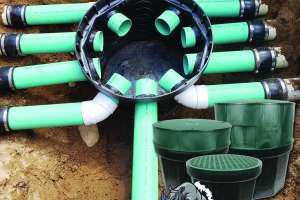
His preferred suppliers for septic systems include Liberty Pumps, SJE Rhombus control systems and Polylok.
Expanding to commercial
SBC is also taking on more commercial work, particularly for area wineries, which require systems for bathrooms, kitchens and the process systems for the wineries themselves.
“The process wastewater is created by washing and rinsing the grapes and it requires a completely separate system that can blow up greatly in size, depending on the size of the winery,” he says. “Filtering and retention time for the process wastewater is important because the particulates and skins can quickly clog up a dispersal area. It’s shocking how fast the skins can collect along the walls and pipes and bottom of the system.”
The work composition varies, but keeps the company busy. In 2023, SBC’s contracts were almost exclusively for new installs. In 2024, maintenance and inspections are taking more of their time.
A third employee, Dayton Christensen, joined the company last year.
“He’s proven to be a considerable asset and is training to be an equipment operator and truck driver as well as a wastewater technician,” Bradley says. “That will put more of us in the driver’s seat.”
A passion to learn
At age 38, Bradley is still eager to learn.
He’s earned certification through the province’s Environmental Operators Certification Program. That allows him to work on wastewater systems serving up to 500 people.
“Some of the small subdivisions around here own their own systems,” he says. “Each lot would have a septic tank to take care of solids and sludge and then the wastewater would flow or be pumped via force main to either a treatment tank or a treatment plant where they would treat it further to achieve effluent consistent with a Type 2 system.”
He’s working on earning his ROWP planner certification over the next year, and is currently apprenticing under several planners and engineers to build on his skills.
At the same time, Will Hardy is apprenticing as he pursues his ROWP installer certification.
“Once Will is certified as an installer, he can work on his maintenance provider certificate,” Bradley says. “When I’m fully certified as a planner, we’ll be a rolling wastewater package deal. Whatever issue, whatever is wrong, whatever you need, we can plan it, put it in the ground, fix it and keep you running.”